



Karna, steadfast in purpose and armed with a design of assured destruction, advanced against Arjuna and discharged the celestial Varunastra with commanding force. Arjuna, endowed with equal divine composure, met the weapon with the same sacred missile and rendered it powerless, dissolving the fury of Karna’s assault. Thereupon, Arjuna, accompanied by Satyaki, Dhrishtadyumna, and Bhima, poured forth a relentless shower of arrows. Yet Karna, admirable in skill and unwavering in focus, shattered each incoming shaft with astonishing ease, standing unshaken amid the storm. Even when Bhima and others hurled mighty Shakti weapons, he cleft them in mid-air, displaying a mastery that inspired both awe and dread.
Arjuna then intensified his assault; his arrows pierced Karna with painful precision, and in swift succession he severed the heads of Karna’s three valiant brothers, consigning them as a grim oblation to the Earth. Bhima, descending from his chariot in a surge of wrath, fell upon the kin and allied forces of Karna, crushing thousands with his mace before remounting and continuing his havoc with arrows that crippled the opposing ranks. Meanwhile, Dhrishtadyumna and Satyaki struck at Karna’s charioteer and tormented his steeds, impairing his mobility. The Pandava commander, with calculated aim, broke Karna’s bow, casting him into visible distress and weakening his position amidst the tide of battle.
Perceiving Karna’s peril, Duryodhana, along with Drona and Jayadratha, moved swiftly to rescue him from being overwhelmed by the encircling foes. Around them, the armies of both sides clashed in ferocious struggle; the fourfold divisions of war—infantry, cavalry, elephants, and chariots—were torn asunder. Horses lay fallen, elephants collapsed in heaps, and shattered vehicles littered the ground. The kings, observing from behind their forces, beheld a ghastly spectacle—streams of blood mingling with fragments of flesh and bone, forming a dreadful mire upon the battlefield.
Drona and Arjuna raged like two colliding mountains, cutting down warriors in vast numbers, leaving behind a void of devastation that defied measure. They seemed untouched by fatigue, their ferocity unrestrained, their destruction boundless. The field appeared transformed into the very stage of Death’s dance, where life and motion were consumed in a ceaseless rhythm of annihilation. As the sun descended in the western sky, it seemed as though it withdrew unwilling to witness the relentless slaughter of men, beasts, and engines of war alike.
Drona, surveying the rivers of blood, the mounds of flesh, and the hills of broken arms and chariots, found grim satisfaction in the ruin and commanded his forces to withdraw for the day. The opposing army followed suit. Though the carnage had been immeasurable, the Kaurava princes and their allies were not content, for their designs remained unfulfilled.
At dawn on the following day, Duryodhana approached Dronacharya in the presence of assembled warriors. With words edged in impatience, he reminded him of the vow to capture Dharmaraja alive, questioning why, when opportunity had arisen, the teacher had held back. He spoke harshly, accusing him of passivity and warning that such conduct would invite ridicule and diminish his honour. He pressed further, asking what gain could come from misleading an ally who had sought his protection.
Though wounded by these unseemly accusations, Drona responded with measured dignity. He reminded Duryodhana of Arjuna’s unparalleled prowess and the divine guidance that stood beside him, questioning how such realities could be disregarded. Yet he assured the king that his purpose would be fulfilled, if only Arjuna were drawn away from the field. He urged that a capable force be sent to detain him, and hinted that his words, though lightly spoken, bore the weight of truth.
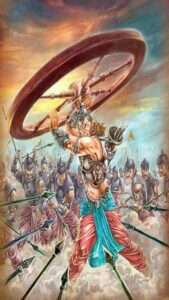
Hearing this, an elite band of warriors stepped forth with pride, declaring their ability to engage and restrain Arjuna. Confident in their strength, they advanced and challenged him, and a fierce encounter ensued. In the meantime, Dronacharya arranged his forces in the intricate Padma Vyuha. At Dharmaraja’s command, Abhimanyu, radiant with youthful valour, penetrated the formidable formation, scattering princes such as Brihadbala and Lakshmana Kumara in fierce combat.
Though the Kaurava forces resisted with determination, Abhimanyu shone like a brilliant star amid the darkness of war. Yet, surrounded and assailed unjustly by many at once, the young hero was slain upon the field. His fall cast a deep shadow over the Pandava ranks, plunging them into grief, while the Kauravas, exulting in cruel triumph, returned to their camp with pride born of a deed both fierce and ignoble.
Hearing of this, Dhritarashtra spoke to Sanjaya with a voice laden with sorrow. He lamented the fate of Abhimanyu, the noblest among his grandsons—courageous, virtuous, radiant, and tender in youth. He questioned how such a boy could have been subjected to such cruelty and confessed the heaviness of his heart at the grievous act committed by his own sons. He implored Sanjaya to recount every detail, unable to bear the weight of uncertainty.
Sanjaya, observing this unexpected depth of feeling in the blind king, was momentarily struck with wonder. He pondered the cause of such profound attachment, and paused in thoughtful silence, awaiting further words before beginning his narration of that tragic and fateful event.

