

There is an old English proverb that says, “An apple a day keeps the doctor away.” As a child, I often wondered what wisdom lay behind this simple statement. When I once asked my father, a physician, he smiled and replied, “Keep the gut healthy with good fibre and half the battle against disease is won.” The explanation was remarkably simple, yet it carried a timeless truth. Decades later, despite extraordinary advances in medicine and technology, that basic principle remains unchanged.
Life often teaches us profound lessons through ordinary experiences.
Our long-time housekeeper, who had worked with us for years, left after her son secured a permanent job. Financially secure at last, she returned to her village. Nearly two years later, she came back, looking healthier and more relaxed, requesting if I could employ her again, even if only for a few hours each day.
Curious, I asked why she wished to work when she no longer needed the income. Her answer was spontaneous and revealing. “Without work, I feel restless,” she said in her own colloquial way. “Bechain… bechain anipistadi.”
Her words instantly reminded me of another old saying: “An idle mind is the devil’s workshop.” For her, work was not merely a source of livelihood; it gave rhythm, dignity and purpose to life. Moderate, meaningful activity kept her physically active and mentally content.
Perhaps that is one of life’s enduring realities.
The British social thinkers Orange and Penty, while discussing the decline of the medieval guild system during the Industrial Revolution, lamented the gradual loss of individual craftsmanship, creativity and pride in one’s work. Machines undoubtedly increased productivity, but somewhere along the way, the intimate satisfaction of creating something with one’s own hands began to fade.
The same thought comes alive in everyday life. Vegetables grown in one’s own kitchen garden somehow seem more satisfying than those neatly packed on supermarket shelves. My mother often remarked that the fish curry prepared during vacations in our ancestral village tasted incomparable. The ingredients were almost identical, yet the flavour was different. Perhaps the fish had just been caught from the village pond, the spices freshly ground by hand, and the curry leaves and coriander plucked moments before cooking. More than ingredients, it was the personal involvement that enriched the experience.
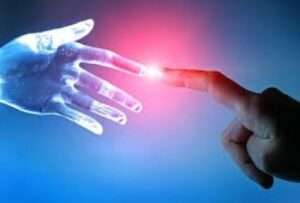
Human hands carry something that machines cannot replicate—care, emotion and ownership.
Technology, undoubtedly, has transformed our lives for the better. It has made teaching more interactive, healthcare more precise, communication instantaneous and scientific research remarkably efficient. Artificial Intelligence is now redefining professional boundaries in almost every field.
Yet a question quietly lingers.
Can technology replace human judgement, empathy and lived experience?
Many former students have shared a thought that continues to stay with me. “Information is available everywhere on the internet,” they say, “but one meaningful classroom lecture still provides clarity that hours of online searching cannot.” The old Telugu saying captures it beautifully: “Gangi govu paalu, garitadaina chalu”—even a spoonful of pure nourishment is enough.
Quality matters more than quantity.
If excessive mechanisation risks creating anxiety, alienation and emotional disconnect, should we abandon technological progress altogether?
Certainly not.
Human beings are naturally driven to innovate. Every generation strives to improve upon the previous one. A fisherman centuries ago may have predicted rough weather by observing fish behaviour. Today, sophisticated satellite systems warn entire nations of approaching cyclones with astonishing accuracy. Technology has connected continents, expanded knowledge and enabled humanity to explore even outer space.
Progress is neither accidental nor undesirable.
But every advancement also demands responsibility.
The French philosopher Jean-Jacques Rousseau warned that material progress often comes at the cost of moral and emotional balance. Whether or not one fully agrees with him, his caution deserves reflection. The Japanese offer another equally practical lesson: if you board the wrong train, get off at the very next station—the return journey will be far less expensive. It is a reminder that timely course correction is itself a mark of wisdom.
Perhaps that is where the real answer lies.
Neither blind rejection of technology nor unquestioning dependence on it serves humanity well. Machines can assist, accelerate and refine our work. They cannot replace human compassion, ethical judgement, creativity or the quiet satisfaction that comes from personal effort.
Reality, therefore, calls not for extremes but for balance.
Technology should remain our assistant, never our master. Human thought, human will and the human touch must continue to guide the direction of progress. Moderation, thoughtful blending and periodic reality checks are not signs of resisting change—they are the very virtues that ensure change remains meaningful.
After all, the future belongs not to machines alone, but to humanity’s wisdom in deciding how to use them.