



For decades after Independence, Bharat largely remained a continental power, obsessed with its land borders while paying insufficient attention to the vast oceans surrounding it. That strategic hesitation is now visibly changing. Under Prime Minister Narendra Modi, Bharat is steadily transforming itself into a formidable maritime force capable of safeguarding its interests far beyond its shores.
The commissioning of three indigenously built naval platforms—INS Dunagiri, INS Agray and INS Sanshodhak— on Sunday is not merely another defence event. It is a powerful statement of intent. Bharat is no longer content with being a passive observer in the Indian (Bharat) Ocean; it is preparing to emerge as a dominant security provider across one of the world’s most strategically contested regions.
This transformation did not happen overnight. Since 2014, the Modi government has consistently increased emphasis on defence preparedness, modernisation and indigenous manufacturing. Massive budgetary allocations, coupled with the Aatmanirbhar Bharat initiative, have fundamentally altered India’s defence ecosystem. For the first time in decades, the nation is investing not merely in buying weapons but in building them.
These three warships symbolise that change.
Their commissioning in the Bay of Bengal carries both strategic and political significance. It reflects a broader vision of integrating India’s eastern seaboard into its growth story while strengthening maritime capabilities in a region that is becoming increasingly important in global geopolitics. States that were once viewed through the prism of economic and political instability are now being integrated into Bharat’s larger developmental and strategic ambitions.
The message is unmistakable: economic growth and national security must advance together.
Each vessel fulfils a distinct operational requirement.
INS Dunagiri, an advanced stealth frigate equipped with BrahMos supersonic cruise missiles, significantly enhances India’s surface and sub-surface warfare capabilities. It is designed to project power, deter adversaries, and establish dominance across open waters.
INS Agray serves a different but equally critical purpose. As a shallow-water anti-submarine warfare craft, it is tailored to detect and neutralise hostile submarine activities in coastal and littoral regions. In an era where underwater threats are multiplying, such assets become indispensable.
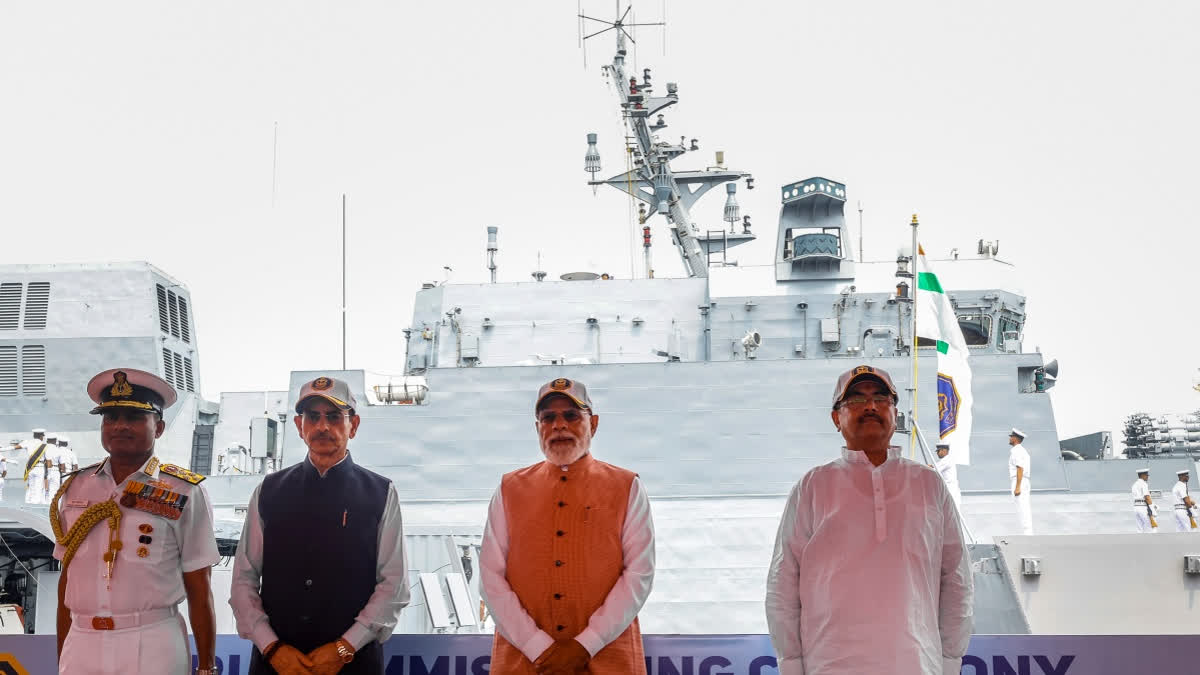
INS Sanshodhak, meanwhile, strengthens India’s maritime domain awareness. Survey vessels may not capture headlines like destroyers or aircraft carriers, but they provide the intelligence backbone necessary for modern naval operations. By mapping seabeds and critical sea lanes, the vessel equips the Navy with invaluable tactical information to operate effectively across the Indian Ocean Region.
These inductions also come at a time when geopolitical competition in the Indo-Pacific is intensifying. China’s expanding naval footprint, its growing presence around strategic chokepoints and increasing submarine deployments in the Indian Ocean cannot be ignored. Bharat can no longer afford a reactive approach to maritime security.
The Indian Ocean is not merely a body of water. It carries nearly 80 per cent of global seaborne oil trade and a substantial portion of international commerce. Any disruption in these waters directly impacts India’s economy and national security.
Therefore, strengthening naval capabilities is not an exercise in military symbolism; it is an economic necessity and a strategic imperative.
Critics often question rising defence expenditure. But history repeatedly demonstrates that economic prosperity cannot be sustained without security. Nations that neglect military preparedness eventually pay a far heavier price.
What distinguishes the present approach is the emphasis on self-reliance. Building these vessels at Garden Reach Shipbuilders and Engineers is evidence that Bharat is developing domestic technological competence instead of remaining perpetually dependent on foreign suppliers.
The larger ambition is clear: to build a 200-plus vessel navy by 2035 and establish Bharat as the primary net security provider in the Indian Ocean Region.
For far too long, India underplayed its maritime potential. That era appears to be ending.
The commissioning of INS Dunagiri, INS Agray and INS Sanshodhak is not simply about adding three ships to the fleet. It is about signalling a strategic shift in national thinking.
Bharat is no longer preparing merely to defend its coastline.
It is preparing to shape the future of the high seas.


