



The water demand is justified, but an officer should be judged by his actions, not his caste.
The ongoing protest over the water crisis in Chainat village, in the Hansi region of Haryana, raises an important social and administrative issue. In any civil society, the fact that people are forced to take to the streets for a basic necessity like drinking water is a matter of concern for the government. Water is not just a resource, but the very foundation of life. Therefore, the villagers of Chainat raising their voices about their problems is completely justified and in accordance with democratic rights. However, during this protest, some comments surfaced in which personal and caste-based derogatory terms were used against a senior administrative officer. This situation forces us to wonder whether the limits of social decorum and constitutional values can be crossed to secure a legitimate demand?
The Constitution of India guarantees every citizen the right to live a life with dignity. The Supreme Court has also clarified on numerous occasions that the right to life includes access to clean drinking water. If people in a village are deprived of adequate water, it is not merely a local problem but a matter of civil rights and administrative responsibility. The suffering of villagers is real, and addressing it is the primary responsibility of the government and administration. Water scarcity not only causes inconvenience but also adversely impacts health, education, employment, and social life. Women and children often have to work extra hard to secure water, disrupting their daily routine and opportunities.
The problem of water scarcity is not new in a country like India. Rising population, overexploitation of groundwater, uneven distribution of rainfall, lack of conservation of water sources, and unplanned urbanization have exacerbated the water crisis in many areas. In an agricultural state like Haryana, this challenge becomes even greater, as water resources are under increasing pressure due to agriculture, domestic use, and industrial needs. In such a situation, if the people of a village are protesting their problems, it is the responsibility of the administration to listen to them and find a solution.
In a democracy, protest and agitation are legitimate rights of citizens. When the public feels that their problems are not being addressed, they submit memorandums, hold demonstrations, and draw the attention of the administration. This is a healthy process in a democratic system. But democracy is not just about rights; it is also about responsibilities. The right to protest is as important as maintaining social decorum and mutual respect. If the dignity of language is lost during a protest and personal or caste-based comments are made, the moral basis of the movement is weakened.
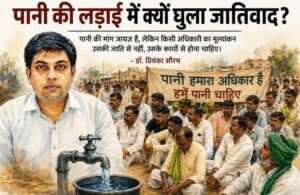
Criticizing an official, public representative, or public figure is part of democracy. However, criticism should be based on their decisions, actions, and policies. When criticism focuses on a person’s caste, clothing, language, or social background, it ceases to be a democratic debate but instead takes the form of prejudice and discrimination. This situation not only hurts the individual but also fosters division and distrust in society.
The fundamental spirit of the Indian Constitution is based on equality. The framers of the Constitution envisioned a society where a person would be judged not by their caste, religion, language, or birth, but by their abilities and actions. To this end, the Constitution guaranteed the right to equality and made special provisions to eliminate untouchability and caste discrimination. Despite this, caste-based thinking and prejudice still persist in many parts of society. When comments are made about an official or individual based on their caste, it not only insults the individual but also disrespects the fundamental spirit of the Constitution.
It is important to understand that reaching any administrative position involves years of hard work and struggle. Officers selected for the Indian Administrative Service, State Administrative Service, or other high-ranking positions undergo a lengthy competitive process. They pass rigorous examinations, undergo training, and prepare themselves for public service. Therefore, an officer should be evaluated not by their social or caste affiliation, but by their work and performance.
Dignity is of paramount importance in public life. If a tendency to criticize individuals based on their birth status grows in society, it impacts the quality of democratic discourse. In such a situation, even capable and talented individuals may hesitate to enter public life. This could also undermine public trust in the administrative system and democratic institutions.
It is equally true that the administration must be sensitive to the public’s feelings and concerns. Often, delays in resolving problems or a lack of communication contribute to public discontent. Therefore, the administration’s responsibility should not be limited to issuing orders. It must communicate with the public, listen to their complaints, and make transparent efforts toward resolution. If villagers feel heard and that sincere efforts are being made to find solutions, tensions and conflicts will be reduced.
In the case of Chainat, it’s essential that the administration and villagers strengthen their dialogue, rather than confronting each other. Solving a water crisis cannot be achieved through mere blame game. It requires administrative will, technical planning, and community participation. Immediate relief can include the provision of water tankers, additional water supplies, and temporary solutions. However, long-term solutions require measures such as water resource conservation, rainwater harvesting, pipeline network expansion, increased water storage capacity, and groundwater recharge.
The role of rural communities is also crucial. Water conservation is not solely the government’s responsibility. Society must also play an active role in judicious water use, rainwater harvesting, and the conservation of local water sources. If communities and the administration work together, permanent solutions to problems like water scarcity are possible.
Education and social awareness also play a crucial role in this regard. Schools, colleges, social organizations, and the media must foster a mindset that promotes equality, respect, and constitutional values. Laws alone are not enough to eliminate caste prejudices; the development of social consciousness is also essential. Unless there is a mental transformation within society, the constitutional ideals of equality will not be fully realized.
If casteist or derogatory remarks are made on a public platform, they must be addressed within constitutional and legal frameworks. In a democracy, the rule of law is paramount. Any discriminatory or derogatory behavior is unacceptable. It must also be ensured that such incidents are not used to divert attention from the underlying problem. The water crisis is real and must be addressed on a priority basis.
Today, the need is to reconnect the Chainat movement to its original purpose. The movement’s goal should be to ensure water availability, not to foster an atmosphere of hatred against any individual or community. The villagers’ demands are legitimate, and they deserve justice. At the same time, upholding social decorum and constitutional values is equally important.
Ultimately, the Chainat incident offers us an important message. In a democracy, the protection of rights and social respect go hand in hand. Citizens have every right to raise their voices to address their problems, but this voice should pave the way for dialogue and resolution, not division and hostility. Water is every citizen’s right, and respect is the foundation of every person’s dignity. Only if we can protect both these values will we be able to build a society that is just, sensitive, and truly democratic.
Solving the water problem is the responsibility of the administration, but addressing casteism is the responsibility of society as a whole. This is the biggest lesson from the Chainat incident.


