



In the breast of Karna, the indomitable warrior, there arose a rare humility, born not of weakness but of a singular resolve—to wage war against the Pandavas solely for the gratification of the imperious Duryodhana. Addressing the king with measured wisdom, Karna declared that every hero in the Kaurava host was endowed with sufficient prowess to command armies and subdue the foe; yet, since leadership must rest upon one, the choice ought to fall upon him who would neither kindle envy nor fracture the unity of the ranks. With thoughtful deliberation, he proclaimed that none would contest the supremacy of Dronacharya, the revered preceptor of princes, a Brahmin of austere virtue, unparalleled in archery and the science of arms, seasoned by age, steadfast in duty, and adorned with the dignity of royal conduct.
Heeding this counsel, Duryodhana, accompanied by illustrious kings, approached Dronacharya with folded hands and reverent speech. “O foremost among Brahmins,” he said, “in wisdom, experience, gentleness, courage, and mastery of celestial weapons, none equals you. Your strength and disciplined intellect stand without peer. Even the venerable Bhishma has extolled your greatness. As herds follow the mighty bull, so do we follow your guidance. You are to us as the divine Kumara who leads celestial hosts to victory over the demons.” Thus, with words steeped in devotion and urgency, he entreated the preceptor to assume command.
Sanjaya recounted that the appeal of Duryodhana soon became the united prayer of all assembled kings, filling the atmosphere with faith and solemn expectation. Thereupon, Dronacharya, casting his gaze upon the gathered warriors, spoke with restrained humility: “Though I have studied the four Vedas and the limbs of sacred knowledge, who can measure the bounds of courage and destiny? Yet, since you have placed your trust in me, I accept the charge. Install me as the commander of your vast fourfold army; I shall strengthen your ranks and confront the enemy with the might of divine weapons, dimming the radiance of the Pandavas.”
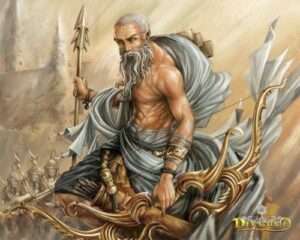
At these words, the spirits of the Kauravas surged like the rising ocean. With elaborate rites performed by learned priests, Duryodhana consecrated Dronacharya as the supreme commander. Cries of victory resounded; trumpets blared, conches roared, and drums thundered across the earth and sky, as if the very elements bore witness to the solemn investiture. Thus adorned, Dronacharya shone as a radiant ornament upon the face of the Kaurava army, standing amidst Karna and other mighty warriors, ready to confront the sons of Pandu.
When the battle commenced, Dronacharya blazed forth like a consuming fire. With unmatched vigor he shattered chariots, felled elephants, slew horses, and broke the standards and royal umbrellas that marked the pride of kings. The field was strewn with fragments of armor and weapons, while rivers of blood coursed through the carnage. Like Death incarnate, he mowed down vast multitudes, and the might of entire divisions seemed to dissolve before his relentless advance. The earth groaned beneath the weight of fallen warriors, and the sky itself appeared dimmed by the fury of his onslaught.
Yet destiny, inscrutable and inexorable, turned its wheel. Sanjaya, narrating these events to Dhritarashtra, tempered triumph with sorrow. In a turn most grievous and unforeseen, Dronacharya, the invincible commander, was struck down mercilessly by Dhrishtadyumna. At this tragic fall, a profound lament arose across the battlefield; for, save the slayer alone, warriors on both sides were united in grief at the passing of the great preceptor, whose life had been a beacon of discipline, valor, and sacred duty. Thus ended the glory of Dronacharya, leaving behind a silence heavier than the tumult of war, and a memory that would endure like an undying flame in the annals of dharma.

