



Why your risk appetite evolves as your wealth grows
By BG Srinivas
For decades, financial advisers have asked investors a seemingly straightforward question: How much loss can you tolerate?
Ten per cent? Twenty per cent? Thirty per cent?
The answer, however, may be fundamentally flawed.
A 30 per cent loss on a ₹5 lakh portfolio means losing ₹1.5 lakh. The same 30 per cent decline on a ₹5 crore corpus translates into ₹1.5 crore wiped out on paper.
The percentage remains identical. The emotional experience does not.
This is perhaps the biggest blind spot in conventional risk profiling. Most questionnaires assume risk tolerance is a permanent personality trait. Behavioural finance tells us otherwise. Risk appetite is dynamic. It changes as wealth accumulates and as the meaning attached to money evolves.
Simply put, investors do not react to percentages. They react to rupees.
Risk is emotional, not mathematical
Nearly five decades ago, Nobel Prize-winning psychologists Daniel Kahneman and Amos Tversky introduced the world to Prospect Theory, establishing that human beings experience the pain of losses much more intensely than the pleasure of equivalent gains.
But there is another important dimension often ignored: the absolute value of money.
At lower wealth levels, losses may be viewed as temporary setbacks. At higher levels, the same percentage decline can feel like years of disciplined savings disappearing overnight.
The question, therefore, is not: What percentage loss can you handle?
The real question is: What amount of money can you emotionally afford to lose?
Risk tolerance, in that sense, is not a fixed identity. It is a constantly evolving relationship with money.
The four wealth thresholds
Behavioural patterns suggest investors pass through four distinct stages as their corpus grows.
| Corpus Stage | Typical Drawdown Feel | Dominant Emotion | Behavioural Risk |
| Up to ₹10 lakh | Recoverable lesson | Optimism and experimentation | Overconfidence, speculative bets |
| ₹10 lakh to ₹50 lakh | Uncomfortable but survivable | Anxiety begins | Gap between stated and actual tolerance |
| ₹50 lakh to ₹2 crore | Deeply personal loss | Preservation instinct | Premature de-risking, panic selling |
| Above ₹2 crore | Sleep disruption territory | Fear of irreversible loss | Paralysis, poor rebalancing decisions |
Stage One: The experimental investor
At portfolios below ₹10 lakh, investing often feels theoretical.
The monthly salary remains the primary source of financial security, while the portfolio is viewed as an opportunity to experiment.
Losses, though painful, feel manageable.
This is also when investors tend to take the highest risks—not necessarily because they understand risk, but because they believe they can recover from mistakes.
The annual DALBAR Quantitative Analysis of Investor Behaviour consistently shows that retail investors chase high-performing themes such as small-cap stocks, IPOs, and sectoral trends, often entering at market peaks.
Bad investments are treated as learning experiences rather than existential threats.
Stage Two: Reality sets in
Between ₹10 lakh and ₹50 lakh, investing starts becoming personal.
A 30 per cent correction is no longer an abstract percentage; it could mean losing ₹15 lakh.
At this stage, the gap between theoretical risk appetite and actual emotional tolerance becomes evident.
A 2021 study by Vanguard’s Behavioural Finance team found that investors with portfolios between $100,000 and $500,000 were far more likely to alter their asset allocations during market downturns than smaller investors, despite claiming similar risk profiles.
The portfolio had become real, and reality evokes different reactions than theory.
Stage Three: The preservation mindset
Crossing ₹1 crore often marks a major psychological shift, particularly for Indian investors.
The corpus is no longer viewed merely as an investment account. It begins representing life goals.
Children’s education.
Retirement plans.
Housing aspirations.
Financial independence.
Losses stop being temporary setbacks and start feeling like threats to future security.
Many investors subconsciously begin reducing risk exposure, increasing allocations towards fixed deposits, gold and real estate.
Importantly, these decisions are often driven not by changing financial goals but by changing emotions.
Stage Four: When wealth disturbs sleep
Beyond ₹2 crore, behavioural changes become even more pronounced.
A 30 per cent correction can erase ₹60 lakh or more on paper. At ₹5 crore, the same decline translates into ₹1.5 crore.
Even seasoned investors struggle to remain emotionally detached.
Behavioural Portfolio Theory, developed by economists Meir Statman and Hersh Shefrin, found that high-net-worth investors naturally create multiple safety layers within their portfolios, irrespective of their stated risk profiles.
This is not irrational behaviour.
It is a predictable neurological response.
At higher wealth levels, protecting existing wealth often becomes more important than creating additional wealth.
A simple test may reveal one’s actual risk tolerance: How well do you sleep during a market correction?
Why behavioural biases intensify with wealth
Three behavioural biases become particularly powerful as wealth accumulates.
- Loss aversion amplifies
People experience losses roughly 2.25 times more intensely than equivalent gains.
The percentage remains unchanged, but the emotional impact grows exponentially with the size of the corpus.
- Mental accounting becomes rigid
Investors begin compartmentalising money into different buckets:
- Safe money
- Growth money
- Retirement money
- Legacy money
Any loss in a bucket mentally classified as “safe” creates disproportionate stress, even if the overall portfolio remains healthy.
- Recency bias strengthens
Painful experiences leave permanent emotional scars.
Investors who lived through the Covid-induced crash of March 2020 often recalibrated their tolerance levels permanently.
DALBAR estimates that emotional buying and selling decisions have caused equity investors to underperform benchmark indices by three to four percentage points annually over long periods.
The gap often widens as wealth grows because the stakes become much larger.
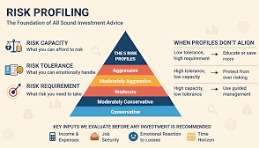
Risk profiling must become dynamic
The conventional approach of filling out a one-time risk questionnaire is increasingly outdated.
The investor with a ₹20 lakh portfolio is not the same person after accumulating ₹1 crore.
Financially, emotionally, and neurologically, they have changed.
Risk assessments should therefore evolve alongside wealth milestones.
| Corpus Level | Key Question | Recommended Action |
| ₹10 lakh | Am I taking risks I can truly absorb? | Stress-test against a 40% drawdown |
| ₹50 lakh | Has my comfort with losses changed? | Re-run risk profiling in rupee terms |
| ₹1 crore | What does this corpus represent to my family? | Introduce capital preservation strategies |
| ₹2 crore+ | What is my minimum wealth floor? | Separate safety assets from growth assets |
The objective is not to eliminate risk.
That itself can become a behavioural mistake.
The objective is to ensure that investment strategy aligns with actual emotional capacity rather than outdated assumptions.
The Hidden danger of frictionless investing
Technology has created another challenge.
Investing has become effortless.
Buying and selling take seconds.
There is no paperwork. No waiting period. No forced pause.
As a result, emotions become instantly actionable.
Investors who promised themselves never to chase speculative assets suddenly buy after a 15 per cent rally. Those who vowed to ignore market hype often succumb when idle cash is available.
Behavioural economists call this the “hot-cold empathy gap.”
Decisions made in calm conditions rarely predict behaviour during stressful moments.
Market crashes trigger emotional responses that no risk questionnaire can accurately capture.
Knowledge is no longer the biggest challenge.
Human behaviour is.
The bottom line
Investors often ask themselves the wrong question.
It should not be: How much percentage loss can I tolerate?
It should be: How much money can I emotionally afford to lose at this stage of my life?
The answer will change every time wealth grows and every time life circumstances evolve.
Risk profiling is not a one-time exercise.
It is an ongoing process of self-awareness.
Ultimately, successful investing is neither about taking the highest risk nor avoiding risk altogether.
It is about taking the right risk at the right stage of life.
And that requires something no app, algorithm or questionnaire can fully provide: the discipline to reassess one’s changing relationship with money honestly.
Because the biggest risk investors face is not the market itself, but failing to recognise that they have changed.



A fantastic analysis, higher the quantum lower is your tolerance, most get it wrong by treating the same as a percentage. well enumerated BG.
Very Good Article describes Investor behaviour on the basis of quantum of portfolio during market corrections and the importance of risk profiling, which is not a one time affair.