



The word “friendship” has perhaps never been used more loosely in international diplomacy than it has been by US President Donald Trump. If one were to judge by Trump’s public statements, almost every world leader is his “good friend,” “great friend,” or “true friend.” Yet when one examines his actions rather than his rhetoric, a very different picture emerges. India and Prime Minister Narendra Modi offer perhaps the best example of this contradiction. For years, Trump has publicly described Modi as a close friend. He has repeatedly praised the Indian Prime Minister’s leadership and popularity. Yet the same Trump administration has not hesitated to impose tariffs on Indian goods, threaten punitive trade measures, and publicly criticize India’s economic and foreign policy choices whenever they conflicted with Washington’s interests. The latest example is telling. Even while speaking positively about Modi and expressing optimism about a bilateral trade agreement, Trump has chosen to impose a 15 percent tariff on Indian exports. More significantly, he has openly clubbed India with countries such as China and Russia while criticizing New Delhi’s purchase of Russian oil. This raises an obvious question: Is this what friendship looks like? India’s decision to purchase Russian oil was never an act of defiance against the United States. It was a sovereign decision taken in India’s national interest. Every major nation prioritizes its energy security, and India is no exception. New Delhi has consistently maintained that its foreign policy will be guided by national interests, not external pressure. What makes Trump’s position even more perplexing is the inconsistency in his treatment of different countries. While India faces higher tariff barriers and repeated criticism, Pakistan has often received a comparatively softer economic treatment despite its long and well-documented history of harbouring terror networks that have destabilized South Asia for decades. Such inconsistencies reinforce what many global observers have long argued: Trump’s foreign policy is fundamentally transactional. Alliances, friendships, and partnerships often appear secondary to immediate political or economic calculations.
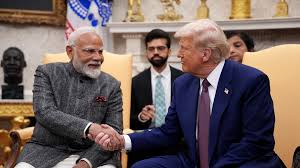
This is precisely why many nations today approach Trump’s statements with caution. The challenge is not merely what Trump says, but how frequently those positions change. A leader who praises a country one day and penalizes it the next inevitably creates uncertainty among allies and adversaries alike. The broader concern extends beyond trade disputes. Under Trump’s leadership, the United States has often sent mixed signals to both friends and rivals. Long-standing allies have occasionally found themselves publicly criticized, while strategic competitors have at times received unexpected overtures. Such unpredictability may generate headlines, but it rarely inspires confidence. India, however, must view these developments through a larger strategic lens. The India-US relationship today is far bigger than any individual president. It is driven by shared economic interests, defence cooperation, technology partnerships, educational exchanges and growing people-to-people ties. At the same time, New Delhi would be making a mistake if it viewed Washington as its only strategic option. India’s greatest strength has always been its strategic autonomy. Whether dealing with the United States, Russia, Europe, the Middle East or China, India’s foreign policy has been at its most successful when guided by national interests rather than bloc politics. The recent tariff actions are a reminder that even close partnerships have limits. Friendship in international relations is ultimately measured not by speeches or photo opportunities but by policy decisions. Another aspect increasingly discussed in strategic circles is the role played by diplomatic representatives. Critics have occasionally questioned whether certain American diplomats and officials have fully appreciated India’s sensitivities on issues relating to sovereignty, internal affairs, and strategic autonomy. Such perceptions, whether accurate or not, underline the importance of maintaining transparency and mutual respect in bilateral relations. Trump’s repeated references to Modi as a friend may make for good television soundbites. But friendship between nations cannot be built on compliments alone. It requires consistency, mutual respect, and recognition of each other’s sovereign interests. India has demonstrated those qualities. It has maintained independent positions on global conflicts, protected its economic interests, and engaged constructively with all major powers. The message for New Delhi is simple: welcome cooperation, pursue trade, strengthen partnerships, but judge every nation—including the United States—not by its words but by its actions. In diplomacy, as in life, actions speak louder than words.



good review