Upadhyayula Lakshman Rao
The sage Puruchhepa, steadfast in austerity and luminous in insight, raised his voice in sacred metres—Anuṣṭubh, Gāyatrī, Adhwathi, and Antyeṣṭi—addressing the mighty Indra amidst the solemn unfolding of the yajña. The sacrificial fire, kindled with precision and reverence, became not merely a ritual act but a cosmic operation, wherein the earthly and celestial realms were alike purified. The oblations, borne upward through Agni’s radiant tongue, symbolized a profound exchange between the visible and the unseen, harmonizing the energies that sustain existence.
In the vision of the sage, the yajña assumed a dual character—spiritual and elemental. It was both an invocation of divine grace and a disciplined engagement with the forces of nature. Those who turned away from this order, who neither sought refuge in Indra nor upheld the sanctity of sacred rites, were perceived as dissonant elements within the cosmic rhythm. Such forces, marked by disorder and hostility, were consigned to dissolution, their end likened to a return to the silence of the burial ground. Thus, the hymn reflects not mere destruction, but the restoration of equilibrium through the removal of imbalance.
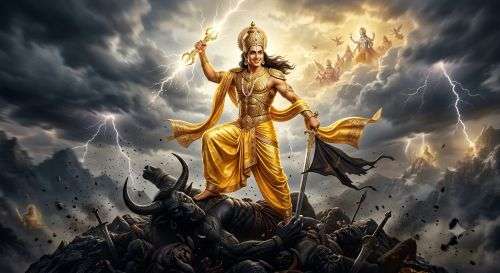
Indra, the wielder of the thunderbolt and sovereign of the firmament, is invoked as the relentless guardian of ṛta—the cosmic order. Mounted upon the celestial elephant Airavata, he advances with irresistible force, crushing the arrogance of adversaries and scattering hostile powers like dust before the wind. The imagery, though fierce, conveys the triumph of order over chaos, of clarity over obscuration. The enemies reduced to lifeless heaps symbolize the dissolution of ignorance and resistance that impede the flow of truth.
The sage recalls the immeasurable victories of Indra, who has time and again subdued forces far mightier than those presently encountered. Such remembrance is not merely praise but a reaffirmation of faith in the sustaining power of the divine. The red-hued spirits of destructive nature, embodiments of turbulence and imbalance, are shattered by Indra’s might, while the demonic tendencies that threaten the harmony of realms are driven away. In this, the hymn reflects an early scientific temperament—an understanding that disorder, if left unchecked, propagates decay, while disciplined intervention restores stability.
A profound ecological insight emerges as the hymn turns to the condition of the world. The earth, bereft of rain, laments in dryness; the celestial regions, deprived of oblations, grow barren and inert. The fire-form of Tvashta, once a source of creative potency, now evokes a sense of depletion, as the cycles of nourishment falter. Indra is thus invoked not only as a warrior but as the regulator of natural cycles, the one who releases the waters by cleaving the clouds and restores fertility to the parched earth. This reflects an intuitive grasp of atmospheric processes, where divine action symbolizes the release of rain-bearing forces essential for life.
Accompanied by twenty-one mighty warriors, Indra advances against the forces that obstruct both material prosperity and spiritual ascent. His weapons, described as relentless and unfailing, signify the disciplined application of energy required to overcome resistance. The yajamāna, the patron of the soma sacrifice, stands as a participant in this cosmic alignment. Through the ritual, he becomes a conduit of abundance, acquiring not only material wealth but also the vitality and nourishment that sustain life. His prosperity is not isolated; it radiates outward, strengthening the divine order and diminishing the influence of hostile forces.
Thus, the hymn of Puruchhepa unfolds as a layered expression of Vedic thought, where ritual, nature, and divine agency are woven into a unified vision. The destruction of enemies is not merely an act of violence but a metaphor for the removal of obstruction, allowing the currents of life to flow unhindered. Indra emerges as both protector and regulator, embodying the dynamic forces that sustain balance in the universe. Through this invocation, the sage reveals a worldview in which spiritual devotion and empirical observation converge, offering a timeless reflection on harmony, resilience, and the perpetual renewal of existence.