



During the scorching summer days, when the sun’s heat scorches the earth, a sip of cold water seems like one of life’s greatest pleasures. In modern life, refrigerators, air conditioners, and bottled water have found a permanent place in our homes, but the importance of the earthen pot remains undiminished. From village squares to city balconies, water from the earthen pot still holds a place in people’s hearts for its pleasant aroma and natural coolness. It’s not just a means of storing water, but a symbol of Indian culture, scientific understanding, and a lifestyle connected to nature.
The earthen pot has a very ancient history in Indian society. From the Indus Valley Civilization to the present day, the use of pottery has been a part of our lives. Our ancestors learned to live in harmony with nature. They knew that the solution to every problem lies within nature. Therefore, they began using earthen pots to find relief from the heat. At that time, there was no electricity, no refrigerators, or modern technology, yet people remained healthy because their lifestyle was natural.
Water from a clay pot is also considered extremely beneficial from a scientific perspective. Earthen pots have tiny pores that allow water to evaporate gradually. The evaporation process releases heat, and the water cools naturally. This cooling is not artificial, but rather beneficial to the body. Extremely cold water from the refrigerator suddenly affects body temperature, which can lead to sore throats, coughs, colds, and digestive problems. In contrast, water from a clay pot provides gradual cooling to the body.
Clay contains naturally occurring alkaline elements, which, when combined with water, help balance the body’s pH level. Nowadays, people’s diets have become increasingly acidic. Fast food, fried foods, cold drinks, and an irregular lifestyle have led to common problems like acidity, gas, and indigestion. Water from a clay pot helps alleviate these problems. It cools the stomach and strengthens the digestive system.
Doctors believe that during the summer season, the body loses large amounts of water and minerals through sweat. If these losses are not replenished in time, they can lead to problems like weakness, fatigue, and dizziness. Water from a clay pot naturally hydrates the body and helps replenish essential minerals. This is why farmers working in the fields in rural areas still prefer to drink water from a clay pot.
The most important characteristic of water from a clay pot is its natural purity. In modern times, the use of plastic bottles has increased rapidly. When these bottles are exposed to sunlight in the summer, harmful chemicals present in them can leach into the water. Scientific research has shown that elements like BPA present in plastic can have negative health effects. Furthermore, the quality of bottled water is not always reliable. On the other hand, a clay pot is completely natural and does not contain any chemical hazards.
Water from a clay pot is considered healthier than water from the refrigerator. Extremely cold water often affects the body’s digestive system. Drinking very cold water immediately after a meal slows digestion. On the other hand, water from a clay pot remains at a balanced temperature, causing no harm to the body. Ayurveda also considers extremely cold water harmful to health, while water from an earthen pot is considered beneficial.
Heatstroke is a serious problem in India. As temperatures rise, the body’s balance is disrupted, leading to fainting, vomiting, headaches, and weakness. Water from a clay pot cools the body internally and helps protect against heatstroke. It regulates body temperature and helps eliminate excess heat through sweating. This is why, in ancient times, water was kept in clay pots for travelers in homes, dharamshalas, and public places.
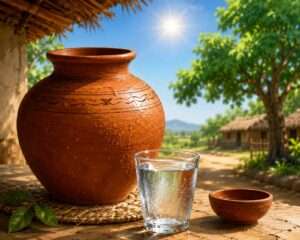
An important aspect of drinking water from a clay pot is its environmental protection. Today, the entire world is grappling with the problem of plastic pollution. Every year, millions of plastic bottles end up in rivers and oceans as waste, causing serious environmental damage. In contrast, a clay pot is completely organic and environmentally friendly. It requires no chemicals or machinery to manufacture. When the pot ages, it dissolves into the soil and becomes part of nature again.
The use of earthen pots is also linked to the livelihoods of rural artisans and potters. In the modern age, the increasing use of plastic and steel utensils has affected the traditional occupation of potters. If people increase the use of earthen pots again, it will also strengthen the rural economy. A simple earthen pot not only cools water but also fuels the stove in an artisan’s home.
Soil holds a special significance in Indian culture. Soil is considered akin to a mother, as it provides us with food and forms the basis of life. Drinking water from an earthen pot is not only a matter of health, but also a symbol of respect for nature. When a person drinks water from an earthen pot, they feel a unique sense of satisfaction and belonging. The earthen aroma soothes the mind and evokes childhood memories.
In today’s race for modernity, people are increasingly moving away from a natural lifestyle. Amidst mobile phones, the internet, and artificial conveniences, humans’ connection with nature is weakening. At such a time, water from a clay pot reminds us that happiness lies hidden in simplicity. Only by connecting with nature can humans live a healthy and balanced life.
However, some precautions are necessary when using a pot. The pot should be cleaned regularly to prevent dirt and bacteria from growing. Water should not be stored in the same pot for extended periods. If the pot becomes old or broken, it should be replaced. Maintaining cleanliness is the only way to ensure the water in the pot is fully beneficial.
Nowadays, the demand for clay pots is growing rapidly, even in cities. People have started keeping pots in their homes and offices. Many restaurants and hotels are also serving water from pots to customers. This change reflects a growing awareness of people’s health and the environment. Social media and health experts are also encouraging the adoption of a natural lifestyle.
Educational institutions and social organizations should also promote the importance of drinking water from earthen pots. Children in schools should be taught about its scientific and cultural benefits. Only if the new generation understands these simple remedies of nature will it be possible to build a healthy society. The government should also launch campaigns to reduce plastic use and promote traditional means.
The media can also play an important role in this direction. The benefits of drinking earthen pot water can be promoted through films, advertisements, and social campaigns. Today, the need is to strike a balance between modern technology and traditional knowledge. We must understand that not everything new is better, and not everything old is useless.
Water from a clay pot also teaches us self-reliance and simplicity. It tells us that nature has provided us with sufficient resources to meet our needs. All that is needed is to recognize and embrace them. Just as trees provide shade, rivers provide water, and soil provides food, a clay pot provides coolness and health.
Ultimately, drinking water from a pot in the summer isn’t just a tradition, but rather a science of healthy living. It cools the body, improves digestion, protects against heat stroke, and contributes to environmental conservation. Amidst the artificiality of the modern age, the pot teaches us to stay connected to nature. It is a heritage of Indian culture that we must preserve and pass on to future generations.
Whenever you’re thirsty in the summer heat, and you reach for cool water from a pot, it’s not just the taste of the water, but the earthy scent, the touch of nature, and the spirit of Indian tradition. This is why water from a pot is still considered nectar.


Use of earthen ware pottery for cooking, storing of food stuff and water and other liquids was in use in India since the evolution of Indus Valley civilization.
The use of earthen pots for storing water is in predominant use even today in most households.
The use of earthen pots for water is not only scientific but also very healthy with natural temperature control and aroma.