Shrikant Rao
Quarterly results usually make for predictable reading. Revenue goes up, margins improve, analysts smile, investors nod approvingly – and then everyone waits for the next quarter.
But the most recent news out of Irving, Texas – Caterpillar Inc’s latest performance numbers – refuses to fit that script.
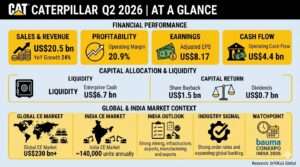
Crossing the $20 billion mark in quarterly sales for the first time in its century-long history is certainly remarkable. Revenue surged 24 percent to $20.5 billion. Operating margins climbed beyond 20 percent. Profit per share jumped dramatically. Orders strengthened. The backlog grew. Shareholders were rewarded. Every conventional financial yardstick pointed in one direction.
The temptation, very obviously, is to celebrate the numbers but the smarter question is why they exist in the first place.
Beyond Steel
For years the construction equipment industry has been described as cyclical. That description now feels increasingly incomplete.
Today’s excavator is no longer simply a hydraulic machine digging earth. It is becoming a connected asset generating data every minute it operates. Mining trucks are evolving into autonomous production platforms. Engines are becoming software-driven. Predictive maintenance is replacing reactive servicing. Fleet management increasingly resembles air traffic control.
Somewhere along the journey, the business quietly stopped selling only machines. It started selling productivity. It is that subtle transition which explains why Caterpillar’s latest performance deserves attention well beyond Wall Street.
Customers are not merely expanding fleets because business is good. They are investing because the nature of infrastructure itself is changing. Artificial intelligence demands data centres. Data centres demand electricity. Electricity demands mining. Mining demands equipment. Equipment increasingly demands intelligence.
The circle has become surprisingly complete.
Hidden Drivers
Look beneath Caterpillar’s earnings statement and another pattern begin to emerge. Governments are spending on infrastructure with unusual consistency. Critical minerals have become strategic assets. Copper, lithium and rare earths are attracting investments once reserved for oil. Energy security has become national security. Airports continue expanding. Ports are modernising. Rail freight corridors are multiplying. Renewable energy parks are spreading across continents.
Every one of those investments eventually arrives at the same place. The fact remains that someone has to move the earth.
That reality explains why order books remain healthy across much of the global equipment industry. It also explains why competitors including Komatsu, Volvo Construction Equipment, Liebherr, Hitachi Construction Machinery, Deere, SANY, XCMG and Hyundai Construction Equipment are pursuing remarkably similar strategies. Digital services, connected fleets, automation and lifecycle support are becoming just as important as horsepower and bucket capacity.
If the machines still matter, the ecosystem matters even more.
Growing Gravity
The one country on earth that perfectly illustrates this shift, it is India.
The Indian construction equipment industry has steadily moved beyond being a volume market into becoming a strategic market. Annual sales are hovering around the 1.4-lakh-unit mark despite global economic uncertainties. Exports continue to gather momentum. Mining equipment demand is strengthening. Road construction remains robust. Metro rail projects continue across multiple cities. Airport expansion is creating fresh opportunities. Data centres, industrial corridors, logistics parks and renewable energy projects are adding entirely new layers of equipment demand.
None of this happened overnight.
India’s infrastructure story has gradually stopped depending on one ministry or one flagship programme. Today it draws strength from multiple sectors moving simultaneously. Highways feed industrial corridors. Industrial corridors feed manufacturing. Manufacturing feeds logistics. Logistics feeds ports. Ports feed exports. The demand for construction equipment is no longer travelling on a single road. It is moving on several highways at the same time.
That has quietly changed the risk profile for equipment manufacturers. The Indian customer, meanwhile, has changed too.
There was a time when purchasing decisions revolved almost entirely around acquisition cost. That conversation is becoming far more sophisticated. Contractors now discuss matters such as uptime, fleet utilization, fuel efficiency, predictive maintenance, remote diagnostics, residual values, connected services, financing structures and productivity per litre of fuel. Veritably, the excavator has entered the boardroom. It was only a matter of time before manufacturers followed.
India Rising
For Caterpillar, India is no longer merely another market in Asia. The company’s manufacturing facilities at Tiruvallur and Hosur, together with component manufacturing, engineering capability and supplier ecosystem, have steadily evolved into an important part of Caterpillar’s global production and sourcing network. Machines, engines and components produced in India increasingly serve international markets alongside domestic demand.
The company’s engineering teams in India have also assumed a larger role in product development, software integration and digital technologies, reflecting a broader industry trend. India is contributing not only labour and manufacturing capacity but increasingly intellectual capital.
Very clearly that distinction matters.
The world’s largest equipment manufacturers are no longer asking whether India can manufacture competitively. They are asking how much more India can contribute.
Recent product introductions reflect this thinking. Next Generation excavators, connected fleet solutions, VisionLink digital services, autonomous mining technologies and advanced powertrain solutions all point towards a future where software accompanies steel from the factory gate. Dealers, too, are expanding beyond selling machines into offering lifecycle support, telematics, condition monitoring and productivity consulting.
An excavator, after all, does not generate revenue while standing still. Customers know that and manufacturers know it even better.
Competitive Heat
Success has another consequence – it attracts competition. Consider what is already happening. Komatsu continues strengthening its global mining position. Volvo Construction Equipment is accelerating its electrification strategy. Liebherr remains formidable in large mining and earthmoving equipment. Hitachi Construction Machinery is expanding its digital ecosystem. SANY and XCMG continue broadening their international footprint with increasingly sophisticated products. JCB dominates several compact equipment segments while Hyundai Construction Equipment and CASE Construction Equipment continue investing aggressively in India.
It is easy to therefore see that none of them can afford complacency. Ironically, Caterpillar’s record quarter raises expectations across the industry rather than lowering competitive pressure.
Success tends to have that unfortunate habit. Nobody allows the market leader to enjoy it for very long.
Confidence Test
This is precisely why Caterpillar’s latest results should be viewed as a leading indicator rather than a financial milestone.
Strong order books tell us that customers are committing capital months before machines are delivered. Growing backlogs suggest that contractors, miners and infrastructure developers are looking beyond immediate uncertainty. They are planning capacity. Betting on workloads. Preparing for projects that will stretch well into the future.
That makes the company’s record quarter less about the past than about expectations.
It also explains why bauma CONEXPO INDIA 2026 assumes greater significance than a conventional trade exhibition.
The exhibition will undoubtedly feature larger excavators, cleaner engines, smarter wheel loaders and increasingly connected equipment. Visitors will admire fresh paint, polished cabs and impressive specifications.
That is the easy part. The more revealing story will unfold in conversations away from the display stands.
Will contractors place larger fleet orders? Will quarry owners accelerate replacement cycles? Will mining companies invest in higher-capacity equipment? Will rental companies expand their fleets despite a changing interest-rate environment? Will customers spend more on digital fleet management than on additional steel?
Those decisions will reveal whether confidence has genuinely deepened. Exhibitions have always displayed machinery. Increasingly, they display sentiment which in the construction and mining equipment business is often worth more than horsepower.
Future Proof
If you look closely there is another lesson hiding inside Caterpillar’s record quarter. For decades, construction equipment companies competed by building stronger machines. Today they compete by building stronger relationships.
Aftermarket services have become strategic businesses. Software subscriptions are creating recurring revenues. Predictive maintenance reduces downtime before failures occur. Remote diagnostics enable dealers to identify problems before operators notice them. Artificial intelligence is beginning to influence maintenance schedules, fuel optimisation and fleet deployment.
The machine still earns the invoice but the ecosystem increasingly earns the margin.
India is exceptionally well placed to benefit from this transformation. Its contractors are becoming larger. Fleet owners are becoming more organised. Financing is becoming more sophisticated. Infrastructure projects are becoming longer, larger and technologically more demanding. Equipment utilisation is improving. The acceptance of telematics, machine health monitoring and productivity analytics is steadily moving from optional to expected.
That evolution suits manufacturers prepared to think beyond iron.
It also favours India.
Not because it is the cheapest manufacturing destination or it is the fastest-growing major economy, but simply because it is rapidly becoming one of the few markets where manufacturing capability, engineering talent, digital expertise and sustained infrastructure demand are all expanding together.
Indeed, that combination is unusually difficult to replicate.
Caterpillar’s record quarter, therefore, is not simply a celebration of one company’s financial performance. It is evidence that the global construction equipment industry has entered another phase of its evolution.
The next chapter will not be written solely in Texas, Tokyo, Gothenburg or Munich.
A meaningful part of it will be written in Hosur. In Tiruvallur. In mines across Odisha. Along expressways under construction. Inside expanding airports. Across renewable energy parks. Through industrial corridors. And, perhaps most visibly, across the exhibition halls of bauma CONEXPO INDIA 2026, where customer confidence will be measured not by applause during product launches but by signatures on purchase orders.
Twenty billion dollars made the headlines.
The far bigger story is that the world’s construction equipment industry is quietly repositioning itself around markets capable of sustaining the next twenty billion.
India is no longer waiting for an invitation to that conversation. It has already taken a seat at the table.