Vinay Rao
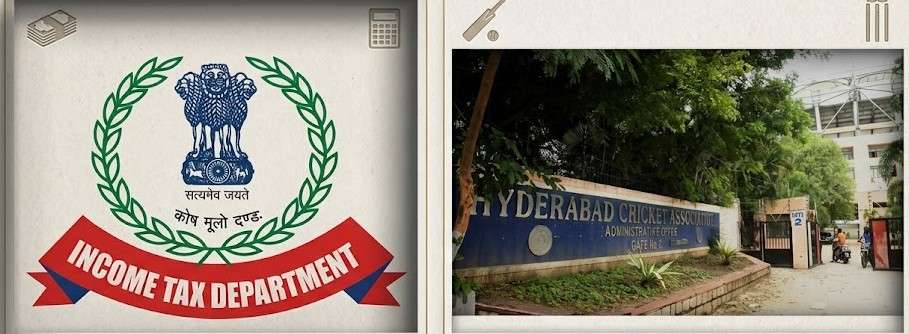
A letter lands like any other government notice—until you read the questions. A majority of the affiliated cricket clubs of the Hyderabad Cricket Association (HCA) have reportedly received notices from the Income Tax Department’s Investigation Wing. The notices seek bank statements, including those from previous years. More significantly, they ask club secretaries to furnish details of their personal relationship and financial transactions, if any, with former HCA president A. Jagan Mohan Rao, who is currently facing CID charges relating to alleged forgery and misappropriation of funds.
For a club secretary running a neighbourhood cricket club on a shoestring budget and coordinating activities largely through a WhatsApp group, this is anything but a routine compliance exercise. It marks the beginning of what could be a long and uncomfortable process with no clear end in sight.
Where did the money actually come from?
That is the fundamental question.
The money in question was not handed over privately or through unofficial channels. In June 2025, the HCA Apex Council, in an emergency meeting chaired by Jagan Mohan Rao and held in the absence of then Secretary Devraj, sanctioned development grants of up to Rs 5 lakh per affiliated club—Rs 3 lakh as an initial release and an additional Rs 2 lakh upon submission of utilisation certificates.
More than Rs 4 crore was reportedly disbursed to 136 affiliated clubs pursuant to an official Apex Council resolution. Nearly 60 other clubs, some of which were already facing conflict-of-interest proceedings or other issues, did not receive the grants—a separate controversy altogether.
By every institutional yardstick, the funds were sanctioned and released as official HCA development grants. They were not personal gifts, favours or private transactions.
A month after the disbursements, Jagan Mohan Rao was arrested by the CID in connection with allegations of forgery and misappropriation of funds. HCA’s bank account was subsequently frozen during the course of the investigation before being unfrozen later pursuant to orders of the High Court, enabling the association to resume its financial operations.
However, none of these subsequent developments alter the nature of the June 2025 disbursements. The funds were released through an official resolution of the Apex Council to affiliated clubs that were eligible to receive them.
The real question
The Income Tax notices raise an important question: Does receiving an officially sanctioned institutional grant from an office-bearer who later comes under investigation automatically obligate the recipient to explain his personal relationship with that individual?
Many club officials would argue that it does not.
For most of the 136 clubs, their only association with Jagan Mohan Rao was that he happened to be the elected president of the HCA when the development grant scheme was implemented. Club secretaries neither negotiated private deals nor received personal payments. They received funds transferred from the association’s bank account pursuant to a formal decision of its governing body.
If the grant itself was legitimate and sanctioned through institutional processes, it is difficult to presume that every recipient necessarily had a personal or financial relationship with the president who signed off on it.

Not every Club treated the money the same way
That said, the story does not end there.
“Everyone received the same grant” does not necessarily mean “everyone dealt with it in the same manner.”
Bank records from the relevant period reportedly reveal differing patterns of transactions. Some club accounts retained the grant money for months, either as a matter of caution or because the clubs had not yet decided how to utilise the funds. Others saw substantial withdrawals or transfers shortly after receiving the grants.
These variations, by themselves, do not establish wrongdoing. Different clubs may have had different financial requirements or legitimate reasons for utilising the funds promptly. Nevertheless, the transaction patterns may understandably invite scrutiny from investigating agencies.
At present, however, the Income Tax notices make little distinction between the club secretary who left the funds untouched and the one who utilised them immediately. Both are being asked to furnish explanations and documentary evidence.
The burden on small Clubs
This is perhaps the most overlooked aspect of the entire episode.
Many affiliated cricket clubs are not professionally managed institutions with dedicated accountants, compliance officers or sophisticated record-keeping systems. They are largely volunteer-driven organisations operating on limited resources. Financial records are often maintained informally, and office-bearers change over time.
Being asked, more than a year later, to reconstruct financial trails for grants that were officially sanctioned—while simultaneously explaining one’s personal relationship with a former HCA president now facing criminal charges—is no small burden.
Some clubs may be able to provide detailed documentation without difficulty. Many others may struggle—not because they have committed any impropriety, but because they never imagined that an institutional development grant would eventually require them to defend themselves before investigative authorities.
Institutional accountability matters
If there are genuine concerns about the manner in which the grants were sanctioned or utilised, those questions deserve to be investigated thoroughly and fairly. No one should be above scrutiny.
At the same time, there is an equally important principle that must not be overlooked: recipients of officially sanctioned institutional grants should not automatically be presumed to have personal complicity merely because an office-bearer subsequently became the subject of criminal proceedings.
An official grant cannot, by default, be treated as evidence of a personal relationship or criminal intent.
What began as a developmental initiative approved by an institutional body has now become a year-long compliance exercise for dozens of club officials who never anticipated having to justify receiving funds lawfully transferred by their parent association.
That, perhaps, is the real story here—not who is guilty, but why those who merely accepted an official grant are now being compelled to prove that they are not.
Disclaimer: This account draws upon reported facts contained in CID statements, court proceedings, public records and media reports, together with information regarding account transactions. Any observations relating to the timing or manner of utilisation of grant amounts are based on available information and do not constitute findings of wrongdoing. Nothing in this article should be construed as commenting upon the guilt or innocence of any individual named or referred to herein, all of whom are entitled to due process of law.