



Arjuna, blazing with terrible wrath, stood in the midst of the battlefield like a consuming fire. From his mighty bow he rained innumerable shafts upon the Kaurava army, and the fierce brilliance of his action revived the fading spirit of the Pandava forces. While the warriors trembled under his relentless assault, Bhimasena slowly approached that blazing centre of destruction where Arjuna stood like a living flame and conveyed to him the grievous news of the martyrdom of Iravantha.
For a brief moment, Arjuna stood startled, as though the earth beneath him had moved. He asked Bhima where the fallen hero lay, and Bhima silently pointed toward the distant field and followed him. Arjuna gazed upon the lifeless body of Iravantha, whose life had been cruelly taken by the demon warrior Alambusa. At that sight, tears gathered in Arjuna’s eyes, and his mind was carried back through the corridors of memory. He recalled the deceitful game of dice engineered by Duryodhana, the calm wisdom and unwavering righteousness of Dharmaraja, and the humble appeal made by the Pandavas for merely five towns in order to avert war. That noble request had been rejected with arrogance, and thus the cruel conflict had become inevitable. All these memories rose before him in vivid succession, and in anguish he cursed the destiny that had led to such devastation.
Yet within a moment he regained composure and praised the righteousness of Dharmaraja. Arjuna felt a deep sense of remorse within his heart, for countless warriors had already fallen beneath the fury of his own bow. The sorrow born from the death of his son burned fiercely in his mind, consuming his thoughts like an inward fire.
At that moment Srikrishna looked upon Arjuna and smiled gently at his sorrowful state. Arjuna immediately perceived the deeper meaning hidden in that smile. Addressing Krishna with renewed steadiness, he said that the divine charioteer had already enlightened him regarding the eternal philosophy of life and death. He had heard those teachings and understood the profound truth that life and death are but transient movements within the greater order of existence. Therefore, he resolved to cast aside grief over Iravantha’s martyrdom and urged Krishna to drive the chariot toward the Kaurava ranks so that he might shatter their pride through the force of his bow.
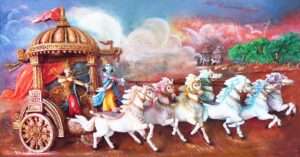
Obeying his command, Krishna drove the chariot swiftly toward the enemy lines. Arjuna immediately unleashed a storm of arrows upon the Kaurava warriors. Soon, the king of Trigartha, Bhagadatta, Kripa, and the mighty Bheeshma advanced together to confront him. Elsewhere Kruthavarma and Bahlika engaged Satyaki in fierce combat, while Bhima boldly challenged Dronacharya upon the field.
Sanjaya, narrating the events to King Drutharastra, declared that the sons of the king stood behind Dronacharya with large entourages and powerful weapons, attempting to overwhelm Bhima. Yet the trial before them was severe. Bhima, moving swiftly upon his chariot, checked the continuous flow of Drona’s arrows and responded with a relentless shower of shafts. His movement across the battlefield was fierce and unstoppable, like a blazing fire strengthened by the constant offering of clarified butter. Each arrow he released increased his resolve just as sacrificial fire grows brighter with every oblation of ghee. In his swift advance, he slew seven Kaurava warriors, and the others, terrified for their lives, began to flee in disorder. Bhima pursued them like a wolf chasing a frightened herd of goats, and the power of his sinews filled the Kaurava ranks with dread.
By that time, the sun had begun to descend toward the western horizon. Yet Duryodhana, filled with unending malice toward his opponents, continued to urge his warriors into battle. The Pandava forces, equally stirred with fierce enthusiasm, pressed forward with reckless determination, breaking the lines and ranks of their enemies. The battlefield became a dreadful sight. Blood flowed like streams, bones and torn flesh lay scattered across the ground, and the jewels and ornaments of fallen warriors glittered amidst the carnage. The earth itself appeared like a beautiful maiden adorned with crimson vermilion and decorated with golden ornaments, as the shining gems and armour reflected the fading light of the evening sun.
Gradually, darkness spread across the field as if fulfilling its inevitable duty. With nightfall both the Pandava and Kaurava armies ceased their combat and withdrew to their respective camps. On the eighth night, Duryodhana sat reviewing the heavy losses suffered by his army. His mind was greatly disturbed. Before entering his royal pavilion, he repeatedly instructed Dussasana to bring Sakuni and Karna to him without delay. Dussasana immediately carried out the command.
When they arrived, Duryodhana spoke to them in secrecy. He complained that Bheeshma, Drona, Kripa, and Aswaddhama were remaining neutral in spirit during the battle against the Pandavas. According to him, they were not fighting with full determination, and therefore the Kaurava army was steadily diminishing. He asked anxiously what should now be done. Karna, pleased by the accusations directed against those great warriors, responded with pride that Bheeshma should be withdrawn from the battlefield and retained in the camp. He declared that he himself would demonstrate the full strength of his arms and destroy the five Pandavas, thereby crushing the rising courage of their forces.
Duryodhana listened attentively to Karna and then ordered Dussasana that Bheeshma should be restrained from continuing the war. After dismissing the others, he bade farewell to Karna and Sakuni and sent them back to their quarters. Thereafter, he took a fragrant and refreshing bath. He anointed his body with cooling pastes of rare fragrance and dressed himself in the finest silken garments. Around his neck, he placed garlands of blooming flowers of many colours. His powerful arms were adorned with heavy jewels, and the ornaments upon his body sparkled like stars moving upon the earth.
Thus adorned in splendour, he set forth toward Bheeshma’s camp accompanied by his retinue. Torches were carried before him to dispel the darkness, singers loudly praised his glory, and guards walked on either side of his decorated chariot. When he arrived at the camp of the grandsire, his presence brought an outward appearance of honour, though thoughtful minds sensed that some unpleasant design lay hidden beneath the courtesy. Nevertheless, they remained silent and respectfully welcomed him.
Duryodhana entered the pavilion with exaggerated humility. With folded hands, he bowed and touched the feet of the grandsire. After receiving permission, he seated himself upon a gem-studded throne and quickly came to the matter that troubled his mind. Addressing Bheeshma, he declared that from the very beginning, he had trusted entirely in the grandsire and therefore had neglected to observe the growing strength of the Pandavas. But now, upon careful reflection, he believed that Bheeshma possessed a hidden softness toward them and fought in such a manner as to spare them pain. Though many opportunities had arisen, he had not taken decisive action against them. Therefore, Duryodhana suggested that Bheeshma should withdraw from the battlefield.
He further declared that neither gods nor demons could conquer Bheeshma in war, yet eight days had already passed since the battle began and still Arjuna remained alive and unharmed. According to him, the grandsire had not even seriously troubled Arjuna. Hence, he requested that Bheeshma allow the matter to proceed according to his own desire and permit Karna to enter the battlefield instead.
These sharp and piercing words struck deeply into the heart of the aged warrior. Bheeshma sighed heavily and looked steadily at Duryodhana. With restrained anger, he replied that he had been fighting without concern for his own life solely to please the Kuru throne. Yet by such harsh accusations, Duryodhana had reduced that devotion to ashes. The grandsire declared that he did not deserve such rude and ungrateful speech. His voice, though controlled, carried the weight of deep indignation as Sanjaya later reported these events to King Drutharastra.

