



The allegations of sexual harassment against Delhi Police personnel during Saturday’s protest near Jantar Mantar are serious. They cannot be dismissed, trivialised or explained away merely because the allegations have been made against members of the uniformed force. At the same time, neither can an allegation, however disturbing, automatically become an established fact. The truth must come out—and it must come out through a credible, impartial and evidence-based investigation. Three women journalists have reportedly complained that police personnel, including a senior officer, touched or groped them inappropriately while they were covering the protest. Delhi Police has acknowledged receiving the complaints and transferred the matter to the Crime Branch. That is the right course. The investigation should now be allowed to proceed without political pressure, media trial or preconceived conclusions. The first responsibility, however, lies squarely with the police. Women journalists covering a politically charged demonstration are entitled to the same dignity, security and professional space as anyone else. When police personnel are dealing with a volatile crowd, physical restraint or pushing may sometimes become unavoidable as part of crowd-control operations. But there is a very clear line between legitimate crowd management and any act that amounts to sexual misconduct. Police officers must know where that line is—and must never cross it. The fact that women police personnel may not have been present at the particular spot makes the obligation on male officers even greater. They must exercise the utmost restraint and professionalism when dealing physically with women protesters, journalists or bystanders. If any officer deliberately crossed that line, the uniform cannot become a shield. Such an officer must face the law, regardless of rank. But the other side of the principle is equally important: a serious allegation cannot substitute for proof.
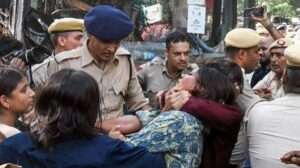
In a politically charged environment, words such as “molestation” and “sexual harassment” carry enormous consequences. A physical act occurring during a chaotic confrontation—such as moving, restraining or pushing someone away from a restricted area—cannot automatically be characterised as sexual misconduct without establishing the circumstances, intent and manner in which it occurred. That is precisely why the investigation must examine the complete sequence rather than isolated claims or competing narratives. There should therefore be no hesitation in examining every piece of available evidence—CCTV footage, mobile-phone recordings, television footage, eyewitness accounts, police body cameras if available, the location of the officers and journalists, and the precise circumstances immediately before and after the alleged incidents. The statements of the complainants must be taken seriously. The statements of the accused officers and independent witnesses must also be heard. Nor, should the professional or political affiliations of the complainants be treated as proof either of credibility or otherwise. Journalists may work for media organisations with different editorial positions. That does not make their allegations true—or false. Evidence alone must decide. This becomes particularly important because the Jantar Mantar confrontation did not occur in a political vacuum. The protest was part of a highly charged campaign against Chief Election Commissioner Gyanesh Kumar and the Election Commission over the Special Intensive Revision of electoral rolls. The Opposition has already raised successive allegations—from EVM manipulation to “vote chori” and now SIR. Competing claims over the scale of voter deletions have themselves become a political battlefield. In such an atmosphere, every incident can quickly be converted into a political weapon. Orangenews9 had itself cautioned against allowing Jantar Mantar to become another flashpoint. The disturbing scenes witnessed during earlier protests—including clashes involving police, provocative social-media content and the participation of minors—should be a warning to everyone. But none of that provides the police with a licence for misconduct. Equally, neither should the political temperature provide anyone with a licence to convert an unproven allegation into a settled verdict. The Crime Branch must establish the truth. If the allegations are substantiated, the guilty must face exemplary action. If the evidence does not support them, that truth too must be stated clearly. The uniform deserves respect. So does the dignity of every woman. The only way to protect both is to let evidence—not politics, outrage or propaganda—speak.

