Vinay Rao
A complaint against the BCCI and others, a High Court appeal, and now a fresh Ombudsman order dated 9th September 2026 — the paper trail in Complaint No. 22 of 2026 has grown quickly over the past month. Laid out in sequence, it tells a fairly clear story about how the matter has actually been proceeding, and about a procedural question that reaches well beyond this one case.
The office in question
The BCCI Ombudsman is a position created under Chapter Nine of the BCCI’s Memorandum of Association — a retired judge of the Supreme Court or a retired Chief Justice of a High Court, appointed annually at the BCCI’s Annual General Meeting, for a term capped at three years, to provide what the rules describe as “an independent dispute resolution mechanism.” The current Ombudsman is Justice Arun Mishra (Retd.), formerly of the Supreme Court of India. The office’s decisions are final and binding, taking effect the moment they are pronounced — which is precisely why the rules also build in checks on who can bring a matter before it in the first place.
How it started
Mr. Gourav Sharma filed a complaint against the BCCI and others before the Ombudsman on 20th January 2026 — later registered as Complaint No. 22 of 2026. The Hyderabad Cricket Association, noticed as a respondent, filed a reply raising a preliminary objection: that the complaint was not maintainable before the Ombudsman at all. The Ombudsman’s docket order dated 10th August 2026 recorded pleadings as complete and posted the matter directly for a final hearing on 17th August, without first ruling on that objection.
Under Rule 41(1)(a) of the BCCI’s Memorandum, disputes are “automatically referred” to the Ombudsman only between or among the BCCI, its Members, IPL Franchisees, Zones and the Cricket Players’ Association. Complaints from anyone outside that list — misconduct complaints under Rule 41(1)(c), or complaints from the public under Rule 41(1)(d) — are routed first through the BCCI’s CEO for a preliminary enquiry, and reach the Ombudsman only once there is a prima facie case. The rulebook itself, in other words, expects a threshold check before most complaints proceed to a hearing — a design that matters given how many people, across roughly three dozen state and zonal cricket associations in India, could plausibly describe themselves as having some stake in the game.
The High Court stage
HCA moved the Telangana High Court (W.P. No. 27009/2026) against the Ombudsman’s proceedings, seeking certiorari on the ground that they were without jurisdiction. On 14th August 2026, the writ court granted an ex parte interim stay, taking the preliminary view that the complaint fell outside the Ombudsman’s purview under Rule 41 and that the maintainability question ought to have been decided first. The Ombudsman kept his proceedings in abeyance by order dated 17th August, pending that writ.
The complainants appealed the stay (W.A. No. 945/2026), arguing they had been shut out of a proceeding affecting their rights without ever being heard. On 3rd September 2026, a Division Bench headed by the Chief Justice heard both sides and lifted the interim stay — finding it had been obtained ex parte, without notice to the complainants, and that it had pre-empted the Ombudsman from ruling on the objection himself. The Bench also corrected the writ’s party array, adding the State of Telangana (a party before the Ombudsman that HCA’s writ had, in the Bench’s words, “surprisingly” left out) and dropping the Union of India, which had no stake in the dispute. It expressly declined to comment on the merits of the complaint or on maintainability itself. But it did direct one thing specifically: that the Ombudsman “shall decide the preliminary objection of the writ petitioner… before proceeding to hear the matter on merits.” The appeal itself remains listed for 28th September 2026.
Where it stands now
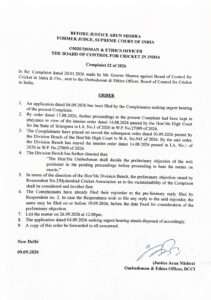
That direction has since been carried into the Ombudsman’s own proceedings. On 9th September 2026, disposing of an urgent-hearing application the complainants had filed, the Ombudsman passed an order recording the Division Bench’s direction in full and ruling: “the preliminary objection raised by Respondent No.2/Hyderabad Cricket Association as to the maintainability of the Complaint shall be considered and decided first.” The complainants have already filed their rejoinder to HCA’s preliminary reply; any further reply from the respondents is due by 19th September 2026. The maintainability question itself is listed for consideration on 26th September 2026, at 12:00pm — a separate date from the High Court appeal.
Both dates fall after the BCCI’s own elections on 18th September 2026, and a related matter continues before the Bombay High Court in the meantime.
What the sequence shows
Strip away the procedural back-and-forth and one thing has been constant since HCA’s very first reply in this complaint: its position that the maintainability question needed to be settled before anything else. That is now precisely what has been ordered — not as HCA’s own submission, but as a Division Bench’s direction, restated in the Ombudsman’s own docket. It is also, on the text of Rule 41 itself, closer to how the mechanism was designed to work in the first place. Whether the complaint is ultimately held maintainable is still an open question, to be taken up on 26th September. What is no longer open is the sequence in which that question gets decided.
(The author’s article on Hyderabad cricket administration and governance represents his personal views and understanding of the unfolding crisis within the Association.).