Science Correspondent
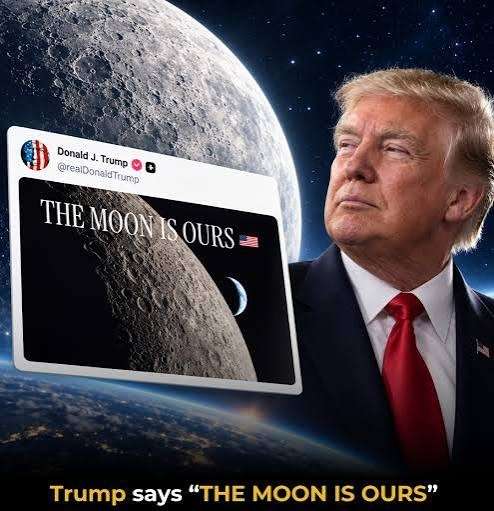
The United States may not be preparing to plant weapons on the Moon, but there is little doubt that Washington under President Donald Trump is preparing for something much bigger: establishing American strategic superiority across the Earth-Moon system.
That distinction matters.
The 1967 Outer Space Treaty, ratified by the United States, prohibits placing nuclear weapons or other weapons of mass destruction on celestial bodies and expressly forbids military bases, fortifications, weapons testing and military manoeuvres on the Moon and other celestial bodies. At the same time, the treaty does not prohibit military personnel from undertaking peaceful scientific work, nor does it ban the use of military-derived equipment for peaceful exploration.
It is precisely in this grey zone that the next great space race appears to be unfolding.
Trump’s December 2025 executive order, “Ensuring American Space Superiority,” goes considerably beyond the traditional language of space exploration. It directs the United States to return astronauts to the Moon by 2028, establish the initial elements of a permanent lunar outpost by 2030 and develop nuclear reactors for use on the lunar surface and in orbit. More significantly, it calls for America’s ability to detect, characterise and counter threats to US interests from very-low Earth orbit through cislunar space.
That is not merely a scientific programme.
The administration’s language is revealing. The objective is not simply to explore the Moon, but to secure American “vital national and economic security interests in, from, and to space”. The policy also envisages ground, space and lunar infrastructure, standards and a stronger space-industrial base.
In other words, Washington increasingly views the region between Earth and the Moon—known as cislunar space—as a strategic theatre.
The latest policy developments reinforce that conclusion. A new US National Space Transportation Policy issued in August 2026 directs Washington to develop transportation capabilities extending from very-low Earth orbit to the lunar surface, Lagrange points and deep space. It calls for more than 1,000 launches and reentries annually by 2030 and explicitly asks the US Department of War to consider in-space transportation services and novel military architectures.
The creation of the United States Space Academy, also ordered in August, is another piece of the emerging architecture. Its mandate is to develop the next generation of astronauts, engineers, scientists, entrepreneurs, civil servants and “warfighters” required to advance and protect American interests in space.
The strategic logic is straightforward. Whoever establishes the most capable infrastructure around the Moon could gain enormous advantages in communications, navigation, surveillance, logistics, scientific exploitation and eventually access to lunar resources.
And America is not operating in a vacuum.
China is pursuing its own crewed lunar programme with a target of landing astronauts by 2030. Beijing, together with Russia, is also developing the International Lunar Research Station, with a basic version envisioned around 2035 and plans involving nuclear power.
That competition explains Washington’s urgency.
The military dimension is already visible in Earth’s orbit, where the US and China are developing increasingly sophisticated spacecraft capable of manoeuvring near other satellites, surveillance and potentially interfering with or protecting space assets. Recent assessments describe an accelerating space arms race involving hunter satellites, orbital manoeuvring and counter-space capabilities.
The Moon, therefore, may become less a battlefield than a strategic high ground.
The real danger is not necessarily a missile battery being installed on the lunar surface tomorrow. It is the gradual militarisation of the infrastructure surrounding the Moon—tracking systems, communications networks, navigation, propulsion, logistics, surveillance and dual-use nuclear power—under the justification of protecting civilian and commercial assets.
That could produce a new strategic reality without formally violating the Outer Space Treaty.
The coming lunar race may consequently be less about who plants the first flag and more about who controls the infrastructure that makes the Earth-Moon system operationally accessible.
Trump’s America clearly wants that country to be the United States.
The question for the rest of the world is whether the Moon will remain a shared domain for peaceful exploration—or become the next arena of great-power competition, with military power only one step behind technology.