
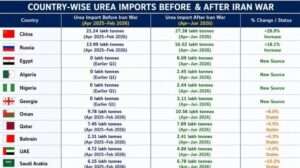
The Narendra Modi government’s aggressive move to secure urea imports and build adequate buffer stocks may look, at first glance, like an expensive exercise. It is anything but that. It is strategic insurance for Bharat’s farmers—and yet another example of Narendra Modi’s instinct to prepare for a crisis before it becomes one. The geopolitical environment leaves little room for complacency. Conflicts and disruptions in West Asia, alongside the continuing Russia-Ukraine war, have rattled energy markets, shipping routes, insurance costs and global fertilizer supply chains. Fertilizer production is heavily dependent on energy and gas, making urea particularly vulnerable to disruptions. A government that waits for international prices to explode before acting would inevitably leave farmers paying the price. Modi has chosen the opposite course. The government has been securing supplies in advance, diversifying import sources and building stocks precisely to prevent the kind of fertilizer shortages and black-marketing that can cripple farmers during peak sowing seasons. In July, the government said it had already secured 42.7 lakh tonnes of urea through global tenders, including 25 lakh tonnes in April and another 17.7 lakh tonnes in June. The numbers tell the story. During Kharif 2026, up to July 19, Bharat had 163.78 lakh tonnes of urea available against a requirement of 109.40 lakh tonnes, with 69.01 lakh tonnes still in closing stock. This is not crisis management. It is advance planning. Most importantly, the farmer has been insulated from the international price shock. Urea’s statutory retail price has remained extraordinarily low compared with its actual delivered cost because the Centre absorbs the difference through subsidy. The government has repeatedly reaffirmed that farmers will not be forced to bear the burden of global volatility. This is where Modi’s larger foresight becomes evident. Importing urea indefinitely would merely postpone the problem. The real objective is to reduce dependence on imports by expanding domestic capacity.
Since 2014, Bharat has added 76.2 lakh tonnes per annum of urea production capacity through six new plants, taking reassessed indigenous capacity from 207.54 lakh tonnes to 283.74 lakh tonnes. These include plants at Ramagundam in Telangana, Gorakhpur, Sindri, Barauni, Panagarh and Gadepan. The revival of long-shuttered fertilizer plants is therefore not just an industrial policy—it is agricultural security policy. And there is another dimension that deserves greater attention: stockpiling is only the first line of defence; diversification is the second and self-reliance the ultimate objective. The government is simultaneously working on domestic production, long-term international supply arrangements and more efficient fertilizer use. India has even entered long-term arrangements for phosphatic fertilizers, including an agreement for 31 lakh tonnes annually of DAP/NPK from Saudi Arabia during 2025-26 to 2029-30. But Modi’s approach cannot be reduced to “more fertilizer at cheaper prices”. Excessive dependence on chemical nitrogen has consequences for soil health and nutrient balance. Hence the simultaneous push for balanced fertilizer application, nano-fertilizers and improved nutrient-use efficiency. That is the real Modi model: protect the farmer today while preparing the country for tomorrow. Critics may question the subsidy bill. They should. Public money must always be scrutinised. But the relevant question is whether the expenditure buys national resilience. When a farmer can continue sowing because the government anticipated a global fertilizer shock, secured supplies and absorbed much of the price burden, the answer is difficult to dispute. Indeed, the government’s latest figures show that despite geopolitical turbulence, Bharat has maintained comfortable fertilizer availability. That did not happen by accident. It happened because someone planned for the disruption before it reached the farmer’s doorstep. For Modi, urea is not merely a bag of fertilizer. It is a question of food security, farmer security, energy security and strategic autonomy. That is foresight: pay a little more today to ensure that Bharat’s farmer does not pay an unbearable price tomorrow.