Shrikant Rao
There is a certain curiosity around Nevin Aslan-Özkan’s arrival as the new Managing Director of Continental India. Unlike many senior corporate appointments that arrive with an immediate public narrative, interviews and leadership profiles, her entry has been relatively understated, leaving the industry with limited visibility into her personal leadership style and creating interest around how she will shape Continental’s next phase in India.
That understated beginning may actually suit the industry she has entered.
The construction equipment business has always been a demanding judge of performance. A machine may attract attention when it is displayed at a major exhibition, surrounded by technical specifications and engineering claims, but its reputation is built much later when it is operating in mines, quarries, infrastructure projects and industrial sites where heat, dust and operating pressure determine whether technology delivers real value.
The final judgement comes from customers, operators and OEMs who ask practical questions: does the machine perform, does it remain reliable and does it improve productivity?
That is the environment in which Nevin Aslan-Özkan takes charge.
Her appointment comes at an important stage for Continental India because the role of suppliers in the Off-Highway equipment ecosystem is changing. India’s construction equipment market has expanded on the back of infrastructure development, mining activity, urbanisation and manufacturing growth, but the next phase of competition will not be decided only by products and pricing.
OEMs and customers are increasingly looking for partners who understand applications, contribute engineering knowledge and help improve machine performance through the complete lifecycle.
For Continental, this creates an opportunity beyond its traditional identity as a tyre manufacturer.
Hanover Heritage
The story begins in Hanover, Germany.
From its headquarters there, Continental AG has evolved over more than a century from a tyre company into a global technology organisation with capabilities across mobility, materials science and industrial solutions.
That journey represents one of the defining strengths of German industrial companies — specialised expertise built over decades and applied across demanding markets.
The relevance of that experience is becoming clearer as India’s equipment sector becomes more advanced. A modern excavator, mining truck or construction machine is no longer only a mechanical product. It combines engineering, electronics, software, data and service capability, increasing the importance of suppliers who understand the larger operating environment.
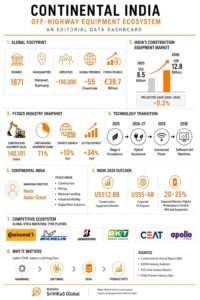
Continental’s global scale provides the foundation for this conversation. The group reported sales of €39.7 billion in FY2024 and employs approximately 190,000 people worldwide. Its Tires business contributed €13.9 billion, while ContiTech generated €6.4 billion through industrial technologies and engineered solutions.
For the Off-Highway industry, the significance is not only financial scale but experience in applications where reliability directly influences operations.
A tyre fitted to a mining truck, wheel loader or construction machine affects traction, safety, operating costs and availability. Similarly, industrial systems supporting demanding environments are judged by their ability to perform consistently.
This gives Continental India a wider conversation to have with the equipment ecosystem.
India’s Equipment Moment
India’s construction equipment market has reached a stage where global companies cannot rely only on international credentials. They need to understand local applications, operating conditions and customer expectations.
According to ICEMA data, India’s construction equipment industry recorded sales of 140,191 units during FY2024–25, with earthmoving equipment accounting for approximately 71 per cent of the market. Exports grew by around 10 per cent during the same period, reinforcing India’s growing importance as both a market and a manufacturing base.
The ecosystem supporting this growth has also become more competitive.
Companies such as JCB India, Tata Hitachi, Volvo Construction Equipment, Caterpillar, Komatsu, Hyundai Construction Equipment, SANY, BEML, ACE, Schwing Stetter and Epiroc are strengthening their presence, while component suppliers are increasingly expected to participate earlier in product development.
The old supplier relationship was largely built around specifications, quality and delivery. The emerging relationship is different. OEMs increasingly want partners who understand applications, contribute engineering expertise and help create better-performing machines.
That is where Continental India’s opportunity lies.
The company brings Hanover engineering heritage, global technology capability and industrial experience across demanding applications. The challenge is translating those strengths into solutions that Indian customers and OEMs recognise as valuable.
For Nevin Aslan-Özkan, the task is not only managing a business operation but helping define how Continental India participates in the next stage of India’s Off-Highway journey.
Beyond The Component
The construction equipment industry is gradually moving away from the traditional supplier model where companies were primarily measured on quality, cost and delivery. The emerging expectation is different. Suppliers are increasingly required to contribute earlier in the product development process, bringing application knowledge, engineering capability and a deeper understanding of how individual components influence the performance of the complete machine.
India makes this transition particularly important because the market combines enormous scale with operating diversity. A machine working on a highway project, inside a mine, at a quarry or in an industrial operation may belong to the same equipment category, yet face completely different challenges depending on geography, workload and application.
The technology has to work across all these environments.
This is why the conversation around tyres, industrial systems and connected solutions has expanded. Customers are increasingly evaluating equipment through productivity, reliability and lifecycle economics rather than focusing only on individual components.
A contractor managing a fleet is not simply buying machines; the larger concern is whether those machines continue delivering over years of operation. A mining company is not only looking for capacity; it needs predictable production. An OEM is not merely searching for suppliers; it wants partners who can contribute towards developing more competitive equipment.
This is where Continental’s broader capabilities become relevant.
The Uptime Challenge
Uptime has become one of the most important measures in modern equipment operations because every hour of avoidable downtime has a direct impact on productivity.
A tyre failure on a large mining truck, for example, is not just a maintenance issue. It can affect loading cycles, transportation schedules and production targets. Similarly, industrial systems supporting critical operations are valued because they help improve reliability and reduce interruptions.
This has increased interest in predictive maintenance, telematics and connected equipment solutions.
The principle is straightforward: understand equipment condition earlier, plan maintenance more effectively and reduce unexpected failures. The challenge is adapting such solutions to India’s diverse customer base.
Large mining operators may have sophisticated monitoring systems and specialised technical teams, while smaller contractors may require solutions that are practical and commercially viable. Both represent important parts of the equipment ecosystem.
Technology succeeds when it improves the reality of operations.
Through ContiTech, Continental brings experience in engineered materials and industrial systems used in demanding applications where reliability is critical. This allows the company to participate in a broader discussion around machine performance and operational efficiency rather than remaining limited to the tyre category.
That distinction matters because customers do not view their operations through separate supplier categories.
A mining operator is not managing a tyre challenge independently from a production challenge. A contractor is not evaluating technology separately from project economics. The requirement is a complete operating solution.
Companies that understand this larger equation become more valuable partners.
A Competitive Landscape
Continental enters India’s off-highway tyre market at a time when competition is already well established.
Global companies such as Michelin and Bridgestone bring international technology platforms and extensive experience, while Indian companies such as Balkrishna Industries Limited, CEAT Limited and Apollo Tyres have developed strong positions through local understanding and application focus.
BKT has built significant credibility in specialised off-highway segments, particularly construction, agriculture and mining, by focusing on customer-specific requirements. Michelin and Bridgestone bring global research capabilities and established networks, while Indian manufacturers bring manufacturing flexibility and market proximity.
Continental’s opportunity lies in combining tyre expertise with wider industrial technology capability.
The company’s differentiation will not come only from competing within tyres. It will come from connecting materials knowledge, engineering experience and industrial understanding with the productivity challenges faced by equipment owners and manufacturers.
That positioning becomes more important as OEMs themselves evolve.
Companies such as JCB India, Tata Hitachi, Volvo Construction Equipment, Caterpillar, Komatsu, Hyundai Construction Equipment, SANY, BEML and others are strengthening their engineering capabilities in India while developing more advanced machines. Their expectations from suppliers are also changing because they increasingly want involvement during design, testing and application development.
The relationship is moving towards collaboration.
The Indian Industrial Test
The meeting point between German engineering discipline and Indian market realities will define Continental India’s next phase.
German industrial companies have traditionally built strength through precision engineering, specialised expertise and long-term relationships. India adds another dimension through its scale, diversity and constant demand for solutions that combine technology with commercial practicality.
The companies that succeed will be those capable of bringing together global knowledge and local understanding, advanced technology and operational simplicity, engineering capability and customer relevance.
For Nevin Aslan-Özkan, the opportunity is to understand how a global industrial company can become more deeply connected with an ecosystem where OEMs, customers and suppliers are evolving together.
The next stage of that conversation will unfold at bauma CONEXPO INDIA 2026, where the industry will gather not only to showcase machines and technologies, but to discuss the partnerships shaping the future of equipment.
The Real Test Begins Beyond The Exhibition
For Continental India, bauma CONEXPO INDIA 2026 comes at a point when the construction equipment industry is moving towards a more integrated future. The exhibition will bring together OEMs, component manufacturers, technology companies, contractors, mining operators and industry stakeholders at a time when machine performance is increasingly being shaped by how effectively the entire ecosystem works together.
Trade shows remain important meeting points for the industry. They provide a platform for companies to introduce technologies, demonstrate capabilities and begin conversations that influence future products. But the exhibition floor is only the beginning.
The real test starts after the machines leave the venue.
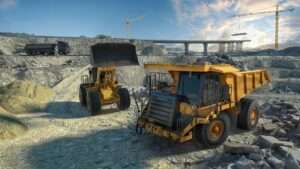
Construction equipment eventually returns to highways, mines, quarries and industrial sites where reliability, productivity and operating economics determine success. Technologies that attract attention during launches must ultimately prove their value through customer experience and sustained performance.
That is where industrial credibility is built.
For Continental India, bauma CONEXPO INDIA 2026 provides an opportunity to demonstrate how its global engineering capabilities can become more relevant within India’s equipment ecosystem. For Nevin Aslan-Özkan, it offers a platform to engage with OEMs and customers who are increasingly looking for partners capable of contributing beyond traditional product categories.
India’s role in global manufacturing has changed significantly. The country is no longer viewed only as a consumption market; it has become an important centre for engineering, production, exports and industrial development. The construction equipment sector reflects this transformation, with manufacturers expanding local capabilities and global companies increasingly integrating India into their long-term strategies.
The industry itself is becoming more connected.
Machines, components, software, data and service networks are influencing each other more closely, creating opportunities for companies that understand the complete operating environment.
The Larger Opportunity
The significance of bauma CONEXPO INDIA 2026 will extend beyond the machines displayed on exhibition stands because the deeper story will be about collaboration.
An equipment manufacturer, a tyre company, an industrial technology provider and a component supplier may approach the machine from different directions, but they are ultimately addressing the same customer priorities — productivity, reliability, safety and efficiency.
This is where Continental’s wider capabilities become relevant.
Its tyre expertise provides an understanding of one of the most important interfaces between a machine and its operating environment. Its ContiTech business adds experience in engineered materials and industrial systems. Its global technology capabilities create opportunities to participate in discussions around connected equipment, predictive maintenance and future industrial applications.
The challenge for any global company is ensuring that these capabilities translate into measurable value in local conditions.
Indian customers are practical decision-makers. They welcome innovation, but they evaluate innovation through outcomes. A contractor wants equipment that improves project execution. A mining operator wants predictable production. An OEM wants suppliers who understand engineering requirements and contribute throughout the product lifecycle.
Technology matters when it improves operations.
Nevin’s Leadership Chapter
This brings the focus back to Nevin Aslan-Özkan.
Her relatively limited public profile means the industry will understand her leadership through Continental India’s actions in the coming years — the partnerships it develops, the customers it works with and the way it adapts global capabilities to Indian requirements.
Industrial leadership is built over time through decisions around investment, customer relationships, technology priorities and market understanding.
The opportunity in India is substantial.
Infrastructure development, mining expansion, urbanisation, renewable energy projects and manufacturing growth will continue creating demand for construction equipment and supporting technologies. At the same time, the industry is preparing for changes involving electrification, automation, telematics and increasingly intelligent machines.
India’s path will not simply replicate other markets. Adoption will depend on economics, infrastructure readiness and customer requirements. The transition will be shaped by local realities, but the direction is clear: future equipment development will require closer cooperation between OEMs, suppliers and technology companies.
For Continental India, the opportunity is to become part of that evolving industrial conversation.
The Final Measure
When bauma CONEXPO INDIA 2026 concludes and the exhibition grounds become quiet, the real assessment of every company will continue outside the venue.
Machines will return to operating sites. Customers will continue measuring performance through experience. OEMs will continue evaluating which partners can help them build better equipment for the future.
That is where Continental India’s next chapter will be written.
The company brings the engineering heritage of Hanover, global technology capabilities and experience across demanding industrial applications. India brings scale, complexity and one of the world’s most important equipment opportunities.
For Nevin Aslan-Özkan, the task is connecting these two realities and ensuring that Continental’s strengths translate into meaningful value for Indian OEMs, customers and operators.
Because in the Off-Highway equipment industry, the final judgement is always made where the machine is working. Not in the presentation, but in performance.