Lakshmanrao Upadhyayula
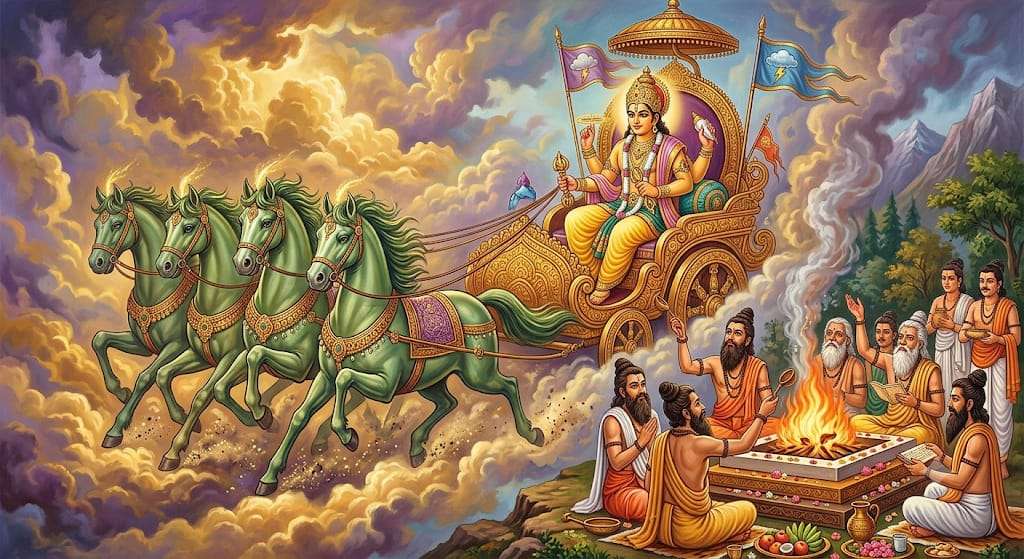
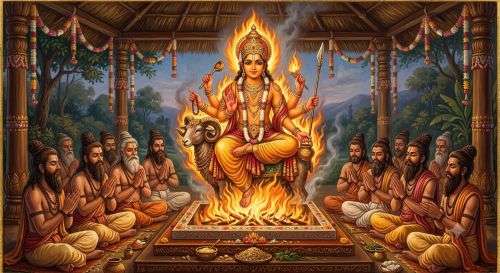
In the sacred hymns of the Rigveda, the sage Grutsamada invokes Agni not merely as a physical flame, but as the conscious mediator between the human and the divine, expressed through the rhythmic meters of Jagatī and Triṣṭubh. Upon the consecrated altar, Agni arises as Samidhā, the kindled fire, embodying the principle of initiation. He is the organiser of the yajña, the purifier of all offerings, ancient yet ever-new, luminous and benevolent, bearing within him the intention of universal welfare. In this form, Agni becomes the priest who invokes the gods, aligning human aspiration with cosmic intelligence.
As Narāśaṁsa, Agni glows with ordered brilliance, encircled by flames that reflect harmony and structure. His radiance illumines the sanctified halls of ritual, symbolising not only physical light but the awakening of higher consciousness. He manifests the three worlds—earth, atmosphere, and heaven—suggesting a profound cosmological insight that energy connects all layers of existence. Scientifically viewed, this reflects the transformative nature of fire as energy that bridges matter and motion, linking the terrestrial with the celestial through heat, light, and vibration.
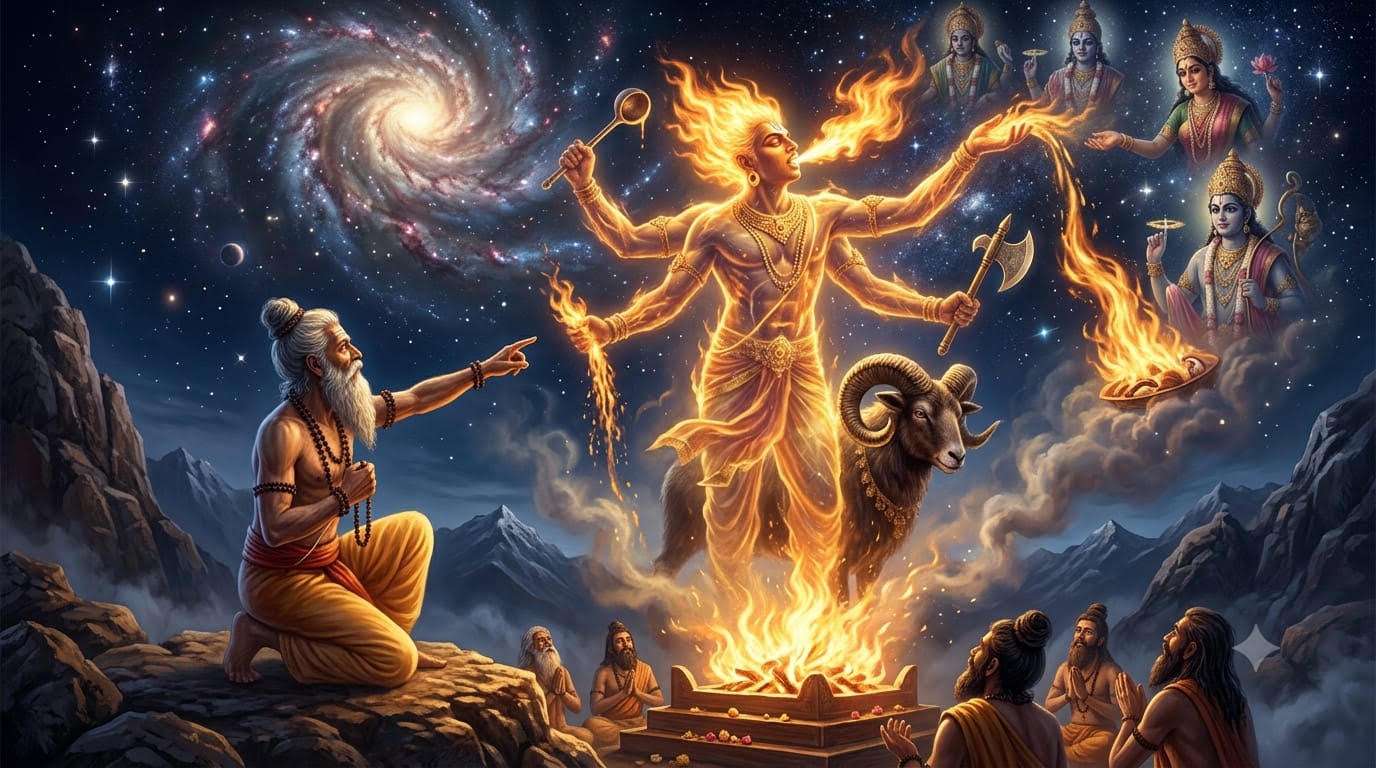
Agni, invoked to receive clarified butter, becomes the carrier of offerings, transmuting matter into subtle essence. The act of pouring ghee into the fire represents a precise thermodynamic process, where material substances are converted into energy and dispersed into the environment. This is both symbolic and empirical, illustrating the Vedic understanding that transformation is the essence of existence. As Ilā, Agni turns inward, focusing consciousness upon the present moment, guiding the ritual with clarity and discipline. He stands among humans as the divine witness, conducting the deva-yajña and establishing sacred relations with deities such as Indra and the Maruts, who represent dynamic forces of nature.
Spread upon the altar as Barhis, symbolised by sacred kusa grass, Agni prepares the ground for divine presence. This act signifies ecological awareness, where natural elements are respectfully integrated into ritual practice. The Vasus, Viswadevathas, and the Adityas are invited to partake, seated upon sanctified spaces, reflecting a vision of harmony between cosmic forces and human intention. Agni, as the shining gateway, becomes the threshold through which devotion flows, and through which the divine responds.
In the poetic imagery of Uṣā and Night, Agni is perceived as the continuum of time itself. Dawn and dusk, like two skilled weavers, interlace the fabric of existence, creating cycles that sustain life. This metaphor reflects an early understanding of periodicity and natural rhythms, akin to circadian cycles recognised in modern science. Their mutual cooperation forms the pattern of yajña, where each moment becomes an offering, and each action a thread in the tapestry of cosmic order.
The divine priests, embodiments of disciplined intellect and ethical conduct, perform the yajña with precision and devotion. Their chants resonate with vibrational energy, suggesting an intuitive grasp of sound as a force capable of influencing both mind and environment. At the Uttara Vedi, the northern altar, three sacred fires are established, representing layered dimensions of existence. Agni manifests here as Saraswati, Ila, and Bharati—the triad of wisdom, articulation, and inspiration—governing the purity and efficacy of the ritual.
As Tvaṣṭṛ, Agni becomes the divine artisan, shaping life and form. He is invoked to bless humanity with strong and courageous progeny, ensuring continuity and vitality. This reflects an early awareness of heredity and the importance of sustaining lineage. In the form of Vanaspati, Agni resides within vegetation, symbolising the latent energy stored in organic matter, released through combustion. This aligns with modern understanding of biomass energy and the role of plants in storing solar energy through photosynthesis.
Agni, in his comprehensive nature, knows all forms of oblation—food, ghee, and soma—and conveys them to the gods. He is the fulfiller of vows, the bestower of gifts, and the sustaining force of ritual order. The tenfold forms of Agni—Samidhā, Tanūnapāt, Narāśaṁsa, Ilā, Barhis, Devadvāra, Uṣas, the divine pair of night and dawn, Sarasvatī-Iḷā-Bhāratī, Tvaṣṭṛ, Vanaspati, and Svāhā—represent a complete system of transformation, communication, and manifestation.
Thus, Agni is not merely a deity of fire but a profound symbol of energy, consciousness, and order. He embodies the unity of spiritual insight and scientific temperament, where ritual becomes a disciplined exploration of natural laws, and devotion becomes a pathway to understanding the universe. In invoking Agni, the Vedic seers were not only worshipping a divine presence but engaging with the fundamental principles that govern existence itself.