



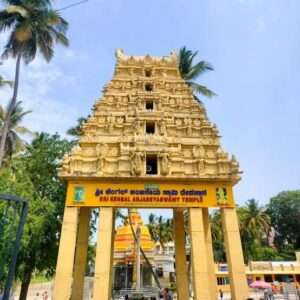
Sri Kengal Anjaneya Swamy Temple is situated at Vandaraguppe village, near Channapatna in Ramanagara district, Karnataka. The temple is surrounded by the scenic granite hills of Ramanagara and is one of the most revered Hanuman temples in Karnataka.
The temple is believed to be over 800 years old, with its origins tracing back to the Hoysala period (12th–13th century CE). It attained prominence during the Vijayanagara period when the great saint Sri Vyasaraja Tirtha is traditionally believed to have consecrated the Swayambhu idol in the 16th century. The temple was later renovated by former Karnataka Chief Minister Sri Kengal Hanumanthaiah, while preserving its ancient sanctity.
The presiding deity is Sri Kengal Anjaneya Swamy, worshipped as a Swayambhu manifestation of Lord Hanuman. The idol stands about 5½ feet tall and naturally emerged from a single block of reddish stone, giving rise to the name “Kengal” (Kempu Kallu – Red Stone).
Hanuman is depicted with a prominent moustache, the right hand in Abhaya Mudra and the left hand holding the sacred Sougandika flower. A bell at the tip of the tail is another distinctive feature. Devotees believe the idol is slowly growing in height and gradually turning towards the east, although this remains a matter of traditional belief
The temple reflects Hoysala and Vijayanagara architectural influences. The sanctum is simple yet spiritually powerful, while the beautifully maintained Pushkarini in front of the temple is uniquely designed in the shape of Hanuman’s Gada (mace), a rare feature among Hanuman temples. The peaceful surroundings add to the temple’s spiritual ambience.
According to temple tradition, the self-manifested idol was worshipped locally for centuries before gaining prominence during the Vijayanagara period. The temple later received significant patronage from Sri Kengal Hanumanthaiah, a native of the region, who undertook extensive renovations and developed it into an important pilgrimage centre while retaining its traditional heritage.
It is believed that after the events of the Ramayana, Lord Hanuman travelled across Bharata protecting devotees and upholding Dharma. During these travels, he meditated in the forests of present-day Vandaraguppe. The immense spiritual energy of his penance became permanently established in a naturally occurring red rock, from which the present Swayambhu form of Anjaneya manifested.
Many years later, the sacred rock was recognised as divine, and worship at the site began. The temple derives its name “Kengal” from the reddish stone in which the deity manifested.
A popular local legend narrates that merchants travelling through the dense forest were often troubled by a tiger. One night, after the tiger carried away one of their oxen, Hanuman appeared in their dream and assured them that the animal would be safe. The next morning they found the ox unharmed beside a large red rock bearing the divine form of Hanuman. Taking this as a divine command, the merchants cleared the area and established worship at the site. This legend continues to be cherished by local devotees as the origin of the temple.
Devotees also believe that the deity is a Jagruta Devata who fulfils sincere prayers. Performing twelve pradakshinas around the sanctum with devotion is believed to remove obstacles, grant courage and fulfil righteous wishes. These beliefs are part of the temple’s living tradition and are based on local faith.
Hanuman Jayanti is celebrated with great grandeur and attracts thousands of devotees. Makara Sankranti, Rama Navami and special pujas on every Tuesday and Saturday are observed with Abhisheka, Alankara, Vada Mala Seva, Hanuman Chalisa chanting and Annadanam. The temple witnesses its largest gatherings during these occasions.


