Why the city that once defined India’s infrastructure industry is now the cornerstone of a much larger industrial story.
Shrikant Rao
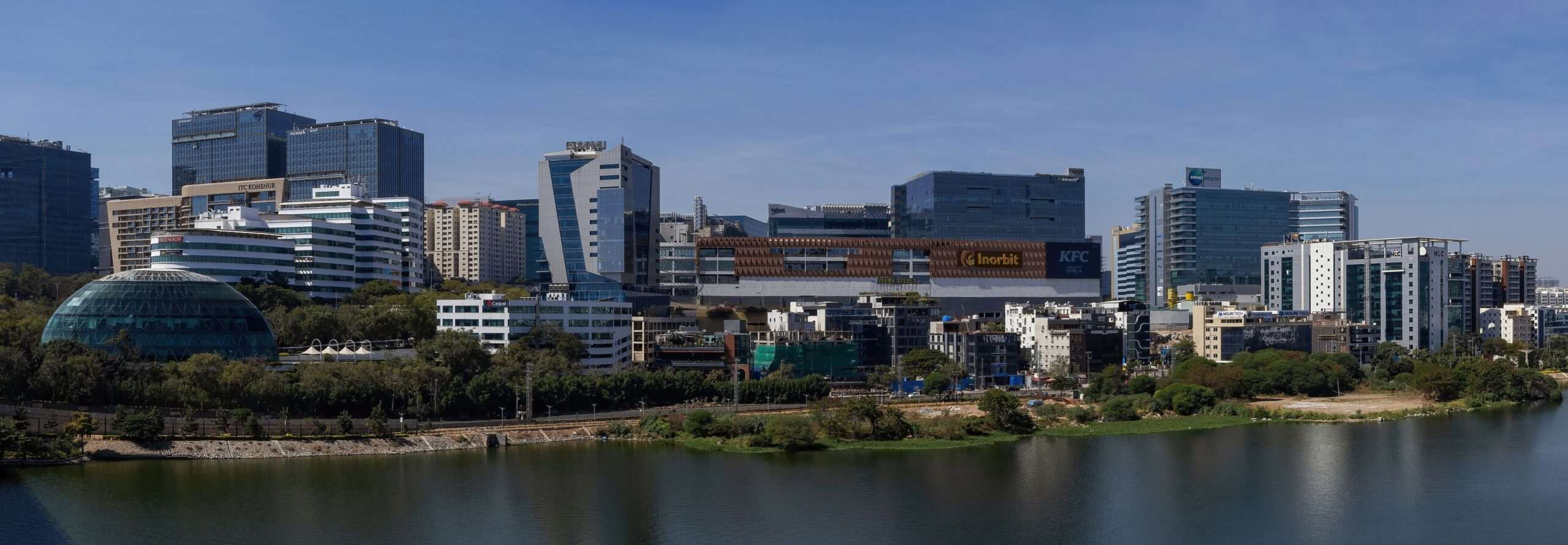
There was a time when understanding India’s infrastructure business required little more than a boarding pass to Hyderabad and a diary with enough blank pages. Somewhere between Begumpet, Banjara Hills and the city’s expanding corporate corridors stood an extraordinary concentration of contractors whose projects stretched from irrigation canals in Andhra Pradesh to airports in Delhi, highways in Rajasthan, tunnels in the Himalayas and power projects across the country. Journalists knew it instinctively. Equipment manufacturers certainly were aware of it. Foreign delegations learnt it soon enough.
Spend two days in Hyderabad and you could meet enough chairmen, project directors and site engineers to fill an industry conference without ever leaving the city. The only challenge was deciding whose invitation to postpone until the next visit.
The conversations were equally revealing. Nobody appeared particularly interested in market capitalisation or quarterly guidance. Instead, they spoke about mobilisation advances, arbitration claims, geological surprises, delayed clearances, imported equipment stranded at ports, concrete grades, monsoon schedules, tunnel boring machines that refused to cooperate and whether the next major order would emerge from Odisha, Gujarat or the North-East. Somewhere between cups of coffee that grew cold over project schedules and hurried airport departures, India’s infrastructure boom was quietly being negotiated. Looking back, Hyderabad was never simply home to contractors. It had become the country’s unofficial project office.
Contractor City
Its rise was neither accidental nor orchestrated. Successive irrigation programmes in undivided Andhra Pradesh created a generation of entrepreneurs who learnt engineering not in air-conditioned boardrooms but on canal embankments, dam sites and unforgiving construction schedules. The Roads & Buildings Department became an unlikely finishing school, while institutions such as Osmania University and Jawaharlal Nehru Technological University produced a steady stream of civil, mechanical and electrical engineers. Many chose to build companies rather than careers. That distinction proved decisive.
Out of this fertile ecosystem emerged companies that reshaped India’s physical landscape. NCC, Megha Engineering & Infrastructures (MEIL), GMR Group, Navayuga Engineering, KNR Constructions, Gayatri Projects, Soma Enterprise, Madhucon Projects and, during its spectacular ascent, IVRCL built highways, airports, metros, irrigation systems, transmission corridors, pipelines, industrial projects and ports worth several lakh crore rupees.
Long before “EPC” became fashionable corporate shorthand, these companies had mastered the art of executing complex projects across multiple geographies, often under conditions that tested endurance as much as engineering.

Hyderabad, therefore, became something far more valuable than a corporate address. It became a mindset. Contractors from the city developed a reputation for tackling projects others quietly avoided, whether because the terrain was unforgiving, the timelines unrealistic, or the logistics daunting. If India’s infrastructure sector had an unofficial operating manual, much of it seemed to have been written somewhere between Hyderabad’s engineering offices and its project sites.
For almost two decades, few cities anywhere in Asia exercised comparable influence over infrastructure. If Mumbai financed India, Bengaluru coded it, Pune manufactured for it, Hyderabad executed it. International equipment manufacturers looking for local partners inevitably knocked on doors here, while overseas investors searching for execution capability often began their India visits in the city. There was a time when Hyderabad’s unofficial business card wasn’t a visiting card at all. It was a white safety helmet resting on the rear seat of an SUV.
Changing Map
Curiously, Hyderabad itself gave very little indication that anything had changed. Offices continued expanding, companies kept winning projects, and engineers continued boarding early morning flights to distant construction sites. There was no dramatic corporate exodus, no sudden collapse in order books, and certainly no shortage of ambition. Yet beyond the city’s boundaries, India’s infrastructure economy was quietly changing shape.
The first clues appeared in Pune. Better known for automobiles, machine tools, and engineering colleges, the city gradually attracted one global construction equipment manufacturer after another until the concentration became impossible to ignore.
Today, OEMs like the Wirtgen Group, JCB, Liebherr, Hyundai Construction Equipment, SANY, Atlas Copco, and a growing network of component suppliers, including Cummins, Kirloskar, and Bharat Forge, have transformed Pune into one of Asia’s most significant construction equipment clusters.
India’s construction equipment industry continues to expand, with strong domestic demand, rising exports and deeper localisation reinforcing Pune’s emergence as one of Asia’s most significant manufacturing hubs.
Twenty years ago, the industry’s centre of influence lay largely where the contractors were headquartered. Today, excavators, wheel loaders, pavers, compactors, batching plants, crushing equipment and asphalt plants destined for projects across India, Africa, the Middle East, and Southeast Asia increasingly roll out of factories around Pune. Cities usually issue press releases when they reinvent themselves. Pune simply built another factory.
Factory Shift
The implications are larger than they first appear. The contractor may still negotiate the project from Hyderabad, but increasingly the machine arriving at site has been designed, manufactured and tested somewhere in western Maharashtra. Around those factories has grown an ecosystem of suppliers, foundries, hydraulics specialists, fabrication companies, electronics manufacturers and export logistics providers. Quietly, almost without announcing itself, Pune has become the workshop of India’s infrastructure ambitions.
Digital Layer
Travel further south and another transformation comes into view. Bengaluru, once regarded with mild amusement by old-school contractors who measured engineering in cubic metres of concrete rather than lines of software code, has quietly become one of the industry’s intellectual engines. Infrastructure today extends far beyond earthmoving and civil construction to embrace digital twins, Building Information Modelling, predictive maintenance, AI-assisted asset management, embedded electronics, engineering simulation and industrial software. India now hosts well over 2,000 Global Capability Centres, employing well over two million professionals, and Bengaluru remains their undisputed capital. Even German industry, traditionally associated with manufacturing excellence, now operates more than 150 GCCs in India, employing over 130,000 engineers and specialists, many of them supporting global operations from Bengaluru, Pune and Hyderabad.
The old contractor who instinctively reached for a soil investigation report now finds himself discussing sensor data, remote diagnostics, and digital dashboards. One could argue, only half in jest, that the hard hat has quietly acquired a headset. Even the bulldozer now seems to have a software update waiting for it.
Capital Flows
Mumbai, meanwhile, continues to perform the role it has always understood best. Long before an expressway is inaugurated or a metro train carries its first passenger, someone has to arrange financing, raise debt, manage risk and balance increasingly complex project economics. Infrastructure Investment Trusts, project finance specialists, commercial banks, sovereign funds, private equity investors and consultants continue gravitating towards India’s financial capital because balance sheets remain every bit as important as batching plants. Contractors may pour the concrete, but capital still decides how much concrete eventually gets poured.
Delhi exercises another form of influence altogether. Somewhere between the Ministry of Road Transport & Highways, the National Highways Authority of India, Indian Railways, the Dedicated Freight Corridor Corporation, metro rail agencies, NITI Aayog and multilateral institutions, decisions involving lakhs of crores are taken long before the first excavator reaches site. The National Infrastructure Pipeline, originally conceived with an investment pipeline of around Rs 111 lakh crore, and the PM Gati Shakti National Master Plan, integrating the planning efforts of 16 ministries, have fundamentally changed how projects are conceived and coordinated. India’s national highway network has expanded from 91,287 kilometres in 2014 to more than 1.46 lakh kilometres, while operational metro rail systems now exceed 1,000 route kilometres, placing the country among the world’s fastest-growing urban transit markets.
Western Rise
Further west, Ahmedabad has emerged with equal confidence. Integrated infrastructure groups, ports, airports, logistics platforms, renewable energy investments and transmission projects have transformed Gujarat into one of the country’s most dynamic industrial ecosystems. The state’s ambitions align with India’s goal of creating 500 GW of non-fossil electricity capacity by 2030, an undertaking already reshaping investments in transmission corridors, substations, battery storage and grid modernisation. Chennai and Coimbatore continue strengthening southern India’s manufacturing base, while industrial corridors, semiconductor investments, data centres and multimodal logistics parks broaden the country’s infrastructure landscape.
Let me say this to the doomsayers: Hyderabad has not shrunk. India has expanded.
Second Innings
Ironically, Hyderabad is already writing its next chapter. The city that once became synonymous with EPC contracting is steadily strengthening its position in aerospace, defence manufacturing, electronics, life sciences, Global Capability Centres, precision engineering and digital technologies. Companies continue executing some of India’s largest infrastructure projects even as the city’s industrial ecosystem diversifies into sectors that barely figured in boardroom conversations two decades ago. Hyderabad is no longer merely building infrastructure. Increasingly, it is helping engineer, digitise and manage it. Its expanding aerospace, defence and digital engineering ecosystem suggests the city may be entering a second industrial innings rather than winding down the first.
Seen through that lens, the question itself begins to sound outdated. Has Hyderabad really lost its status as India’s infrastructure capital? Only if we mistake monopoly for leadership.
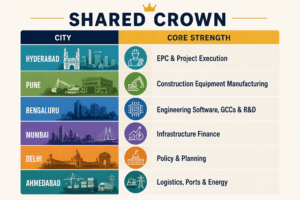
Hyderabad still punches comfortably above its weight in EPC contracting, just as Pune has become synonymous with construction equipment manufacturing, Bengaluru with engineering software, Global Capability Centres and industrial R&D, Mumbai with infrastructure finance, Delhi with policy and planning, and Ahmedabad with integrated logistics, ports and renewable energy. The surprise is not that Hyderabad has weakened. The takeaway is that India has quietly produced half a dozen infrastructure capitals instead of one.
Shared Crown
There is another lesson hidden beneath the statistics. Mature industrial economies rarely depend upon a single city. Germany distributes engineering excellence across Munich, Stuttgart, Frankfurt, Hamburg and the Ruhr. The United States long ago stopped expecting Detroit to be everything to everybody. Japan spread manufacturing capability across complementary industrial regions rather than concentrating it in one metropolitan centre. India, perhaps for the first time since Independence, is beginning to display similar characteristics.
Perhaps that is the greatest compliment the city could receive. The generation of contractors who emerged from Hyderabad demonstrated that Indian engineering companies could execute projects of astonishing complexity, compete internationally and think at a scale that once seemed improbable. Their success encouraged equipment manufacturers to invest, financiers to participate, technology companies to innovate, and engineering talent to build new ecosystems across the country.
History rarely remembers cities for holding on to industries. It remembers them for creating industries that outgrow them.
Hyderabad did not lose its place on India’s infrastructure map. It simply drew a larger map for everyone else.
(The author is a Mumbai-based Editor, Industrial Analyst and Chronicler with over four decades of experience covering India’s construction, infrastructure, manufacturing, mining and equipment sectors. He is the Founder of SriViKaS Global, a media and strategic intelligence initiative focused on manufacturing, infrastructure and cross-border industrial collaborations. Connect with him on LinkedIn or write to shrikant.rao.professional@gmail.com.