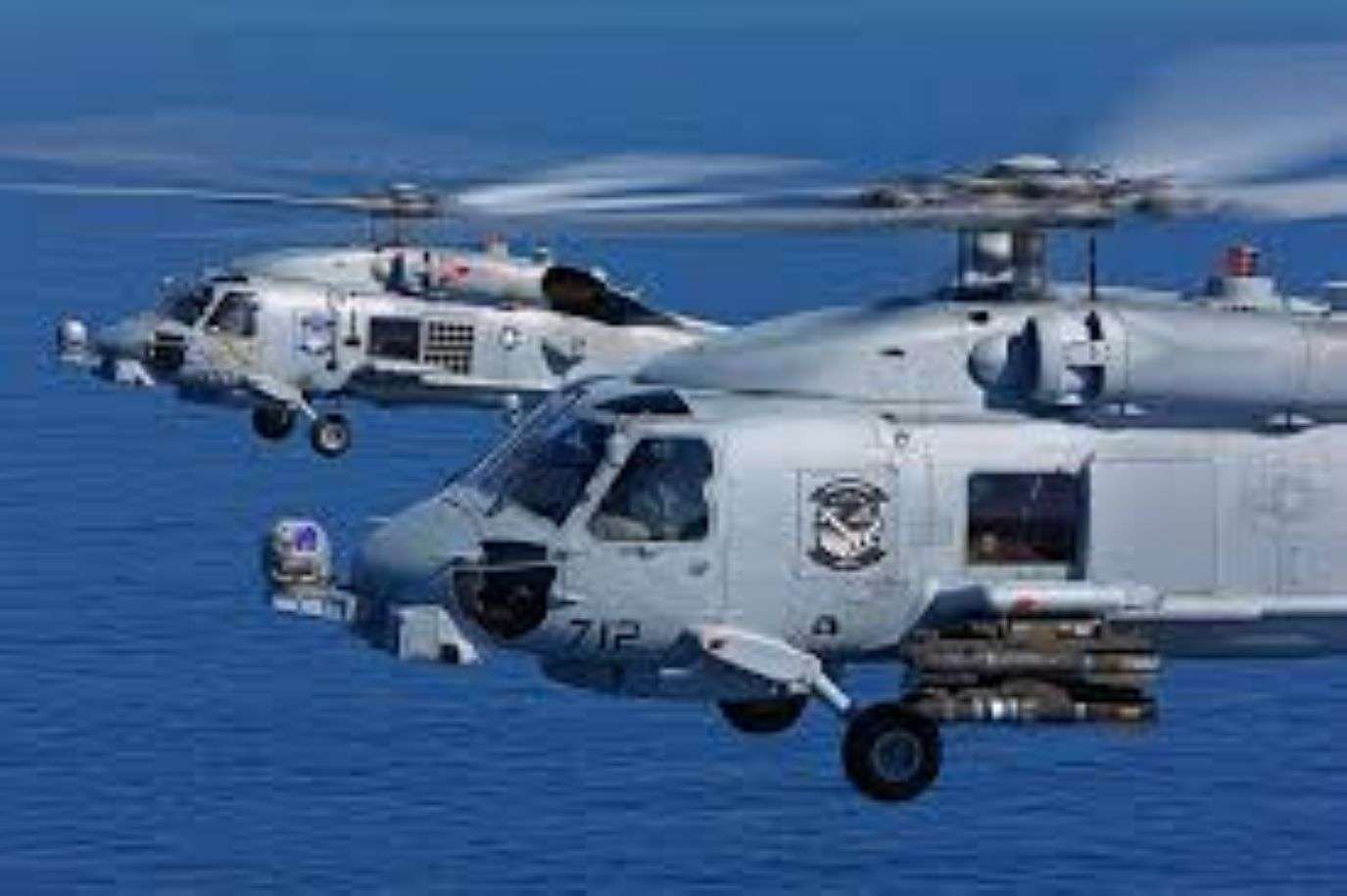
New Delhi: As China expands its underwater presence in the Indian Ocean Region (IOR) and Pakistan moves closer to inducting advanced Chinese-built submarines, the Indian Navy has received 21 of the 24 MH-60R ‘Romeo’ multi-role helicopters contracted from the United States to strengthen its anti-submarine warfare (ASW) capabilities.
Of the 21 helicopters delivered so far, 15 are operational with the Navy. Three are currently being used for training Indian aircrews in the United States, while another three are undergoing India-specific modifications and certification before entering active service.
The induction of the MH-60R fleet comes at a critical time when India’s maritime security environment is becoming increasingly complex. The Navy continues to face a significant shortage of anti-submarine and multi-role helicopters, with its overall requirement estimated at more than 100 aircraft.
Sources said the Navy is considering a follow-on order for additional MH-60R helicopters to partially bridge the capability gap. The helicopters currently in service will also be rotated to the United States in phases to receive the same India-specific upgrades.
Officials clarified that the ongoing modifications are not linked to any technical deficiencies. Instead, they involve the integration of indigenous electronic warfare suites, secure communication systems and Indian weapons to enhance operational effectiveness.
The Navy has already commissioned two MH-60R squadrons — INAS 334 at Kochi in March 2024 and INAS 335 at Goa in December 2025.
India signed the Rs 15,157-crore contract for 24 Lockheed Martin-Sikorsky MH-60R helicopters through the US Foreign Military Sales route in February 2020. While all deliveries were originally scheduled to be completed by 2025, the programme has faced delays, with three helicopters yet to be handed over.
The twin-engine Romeos represent a major technological leap over the Navy’s ageing Sea King and Kamov-28 helicopter fleets. Equipped with advanced multi-mode radars, low-frequency dipping sonars, sonobuoys and electro-optical sensors, the helicopters can detect, track and engage threats both above and below the sea surface. They are armed with Mk-54 lightweight torpedoes and Hellfire missiles.
However, even the full fleet of 24 helicopters will address only a fraction of the Navy’s long-standing requirement for 123 Naval Multi-Role Helicopters (NMRH). The ambitious procurement programme, first initiated in 2011 and later revived under the Strategic Partnership model, remains stalled without a final contract.
The capability shortfall is expected to persist for several years, as Hindustan Aeronautics Limited’s proposed deck-based naval variant of the Indian Multi-Role Helicopter (IMRH) project is still in the design and development stage.
The urgency of strengthening India’s underwater warfare capabilities is underscored by growing regional developments. China’s navy, now the world’s largest, operates more than 60 submarines, including nuclear-powered attack submarines capable of extended deployments far from Chinese waters. Chinese submarines, often accompanied by research and survey vessels, have become increasingly active in the Indian Ocean.
Pakistan, meanwhile, is inducting eight Hangor-class diesel-electric submarines from China. Equipped with Air Independent Propulsion (AIP) systems, these submarines can remain submerged for significantly longer periods, enhancing their stealth and combat effectiveness. The first Chinese-built Hangor submarine is reportedly en route to Karachi for induction and crew training.
India’s own submarine force faces capability challenges. The Navy currently operates no nuclear-powered attack submarines (SSNs), while the leased Russian Akula-class submarine, Chakra-III, is now expected only in 2028 after multiple delays. The government has approved the construction of indigenous SSNs under Project-77, but these remain years away from operational deployment.
India is also working to equip its conventional submarines with an indigenous fuel-cell based AIP system developed by DRDO. The technology is expected to be integrated into INS Khanderi later this year, with the submarine likely to return to service by 2028.
Against this backdrop, the induction of the MH-60R Romeo helicopters is being viewed as a crucial step in bolstering India’s maritime surveillance and anti-submarine warfare capabilities amid a rapidly evolving security landscape in the Indian Ocean.