



The anguish and harsh words of Duryodhana pierced the ears of the Grandsire Bhishma, who spoke in sorrowful composure. “Duryodhana, the present danger that has descended upon the Kauravas is nothing but the accumulated storm of anger, humiliation, and frustration, now manifesting as war and inevitable defeat. I, along with Dronacharya and Vidura, repeatedly cautioned you and vividly described the destruction that would engulf races, clans, kings, warriors, and soldiers alike. When the fruits of sin ripen, Time devours both the valiant and the coward without mercy. Yet you paid no heed either to wise counsel or to righteous advice. To stand against the united might of the Pandavas is impossible even for the great Lord Shiva himself; where then do ordinary mortals like us stand? If any prince or kinsman of the Kauravas encounters Bhima in battle, no chivalry or valor can save him. None among the Kauravas can be protected from Bhimasena once he enters the field. Let us therefore not waste time in futile lamentation for the past or anxious wailing for the future. Wage war with the resolve of attaining heaven through the royal gate of a heroic death. Cast aside the hope of ruling the kingdom and fix your mind solely upon battle. As for me, I shall fight with adventurous spirit until the final grain of energy drains from my body and mind. If victory should descend upon us, we shall welcome it.”
Sanjaya then narrated this conversation to the blind king Dhritarashtra. The king spoke with deep sorrow: “When the master of archery Dronacharya and the invincible hero Bhishma fight on our side, how is it that so many of my sons perish? The catastrophe that now unfolds was clearly foretold to Duryodhana by me and by Gandhari, yet he turned a deaf ear. Now he reaps the bitter fruits of his disobedience. It is like attempting to raise a bridge over waters that have already flowed away. Tell me, Sanjaya, after the fall of the Kuru princes, what actions were taken by Bhishma and Drona?”
Sanjaya replied: “O King, Bhishma, blazing with anger and steadfast resolve, rushed toward Bhima like a ferocious warrior aflame. At the command of Yudhishthira, the valiant Dhrishtadyumna, Satyaki, and Shikhandi advanced to confront Bhishma. Meanwhile Arjuna engaged in fierce combat with innumerable chariot warriors who had been instigated by Duryodhana. Chekitana fought against the sons of Draupadi, while Ghatotkacha and Abhimanyu courageously battled Duryodhana with bounding spirit and chivalrous demeanor. Thus, three formidable divisions from both armies clashed violently. The Kaurava forces fought with confidence and did not retreat despite the fierce resistance of their enemies. With remarkable dexterity in archery, Dronacharya shattered the strategic formations arranged by Drupada. Celestial beings watching from the heavens applauded the supreme skill displayed by Drona, declaring that such combat would remain forever remembered by warriors of future generations.”
“O King,” continued Sanjaya, “the volleys of arrows released by Bhimasena paralyzed great herds of elephants. Their trunks and limbs were severed, and the fallen beasts lay in heaps like shattered mountains. Streams of blood flowed across the field, and when pierced by the rays of the sun they shone crimson, dispelling the darkness created by the cloudy masses of fallen elephants. At the same time Nakula and Sahadeva broke into the cavalry divisions of the Kauravas, cutting down countless horses whose bodies fell in clusters like hillocks upon the plain. The battlefield became crowded with the slain horses and warriors, so that chariots from either side struggled to find passage. Arjuna meanwhile destroyed many chariot warriors with relentless showers of shafts. The field gleamed with the ornaments and jewels of fallen heroes and with severed limbs scattered across the ground, appearing strangely like a vast garden in full bloom with flowers of many colors.”
“At that moment,” Sanjaya continued, “Iravan, the valiant son of Arjuna and the Naga princess Ulupi, daughter of the serpent king Kauravya, charged into the Kaurava forces like a powerful hawk descending upon a flock of birds. His army moved like a host of hunting hawks, while the Kaurava soldiers scattered like frightened birds. The courage of Iravan and his mastery of archery deeply disturbed the Kaurava ranks. Soon the six sons of Shakuni advanced against him with a strong cavalry force. Their combat was astonishing, resembling the collision of two immovable mountains. The sons of Shakuni rained arrows upon Iravan and struck him with sharp spears. Yet, like a mighty elephant maddened by the goad of its driver, Iravan released a storm of arrows upon the Kuru forces. Warriors on both sides praised the valor of this young fighter from the serpent race.”
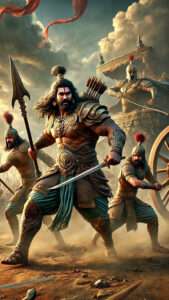
“In the heat of battle the horses of Iravan’s chariot were slain by the shafts of Shakuni’s sons. Leaping swiftly to the ground with sword in hand, Iravan continued the fight with remarkable skill. The Gandhara princes surrounded him with the cruel intention of slaying him upon the ground, thrusting their spears again and again. But Iravan sprang upon them with dazzling agility and with his flashing sword cut down the six princes of Gandhara into pieces. Standing victorious, he roared with fearless chivalry.”
“When Duryodhana beheld a single warrior slaying six princes, his anger soared like a kite rising into the sky. Enraged, he commanded the demon Alambusha to destroy Iravan, thus setting in motion a dark and ruthless deed. Reporting this to Dhritarashtra, Sanjaya said: ‘The demon Alambusha rushed against the forces of Iravan. By the power of illusion and sorcery he created a phantom army equal in number to that of Iravan. These forces born of dark magic devoured the soldiers of Iravan and vanished once their dreadful task was done. Iravan alone stood boldly before Alambusha. He shattered the demon’s weapons and bow with swift arrows. The demon rose into the sky and harassed him with deceptive magic. Possessing transcendental powers inherited from his serpent lineage, Iravan also ascended into the sky and struck Alambusha into pieces. Yet the demon instantly revived and continued the battle, while Iravan remained steadfast and undaunted.’”
“To break the demon’s sorcery, Iravan remembered his mother and prayed to the serpent race. At once, he assumed a colossal form, shining like Adishesha, and rushed upon Alambusha. The demon in turn, transformed himself into a monstrous bird and devoured the serpent warriors, tearing them apart with savage cruelty. Iravan found himself cornered. Seizing that vulnerable moment, Alambusha struck fiercely and severed the head of Iravan, which fell upon the ground. Even in death, the face of Iravan shone with a strange vitality, radiant like the full moon. Sanjaya declared that the fall of Iravan occurred around midday.”
Hearing this, Dhritarashtra asked what the Pandavas did after the death of Iravan. Sanjaya answered that Ghatotkacha, enraged by the death of his brother, advanced with terrible fury. Accompanied by fierce demonic forces, he descended upon the Kuru army like vast thunderclouds rolling across the sky, and thus the battle raged on with dreadful intensity.

