



For decades, Bharat was mocked as a country that would forever remain energy-hungry, import-dependent, and technologically trailing behind the developed world. Those predictions now lie shattered under the blazing Indian sun.
Bharat, under the able and decisive leadership of Narendra Modi, has officially emerged as the world’s second-largest solar power market in terms of annual deployment, overtaking the United States and trailing only behind China. The numbers are staggering. In 2025 alone, Bharat added nearly 50 Gigawatts (GW) of new solar capacity — a historic achievement that has transformed the country’s energy profile and altered the global clean-energy balance.
Bharat’s total installed solar capacity has now crossed 150 GW. What makes this story extraordinary is not merely the size, but the speed. The first 50 GW took India nearly 11 years to achieve. The next 50 GW came in just three years. The latest 50 GW — the phase that pushed Bharat past the United States in actual deployment — took barely 14 months.
That is not incremental growth. That is an energy revolution.
For a country once accused of moving slowly on infrastructure, Bharat is now building solar capacity at one of the fastest rates anywhere in the world. According to data from the International Energy Agency and Ember Energy, Bharat today ranks among the top nations in renewable energy expansion, with solar accounting for the bulk of fresh power generation additions.
The implications go far beyond climate diplomacy or carbon targets. This is about national security, economic sovereignty, and geopolitical leverage.
The global energy map is undergoing violent changes. Wars in Europe disrupted gas supplies. The conflict in West Asia and rising tensions around the Strait of Hormuz threaten oil shipping lanes that carry nearly one-fifth of the world’s petroleum supplies. Any disruption there can send crude prices skyrocketing overnight.
Bharat, which imports over 85 percent of its crude oil requirements, understands this vulnerability better than most nations. Every geopolitical crisis exposes the dangers of excessive fossil-fuel dependence. Solar energy is no longer merely an environmental slogan; it is strategic insurance against global instability.
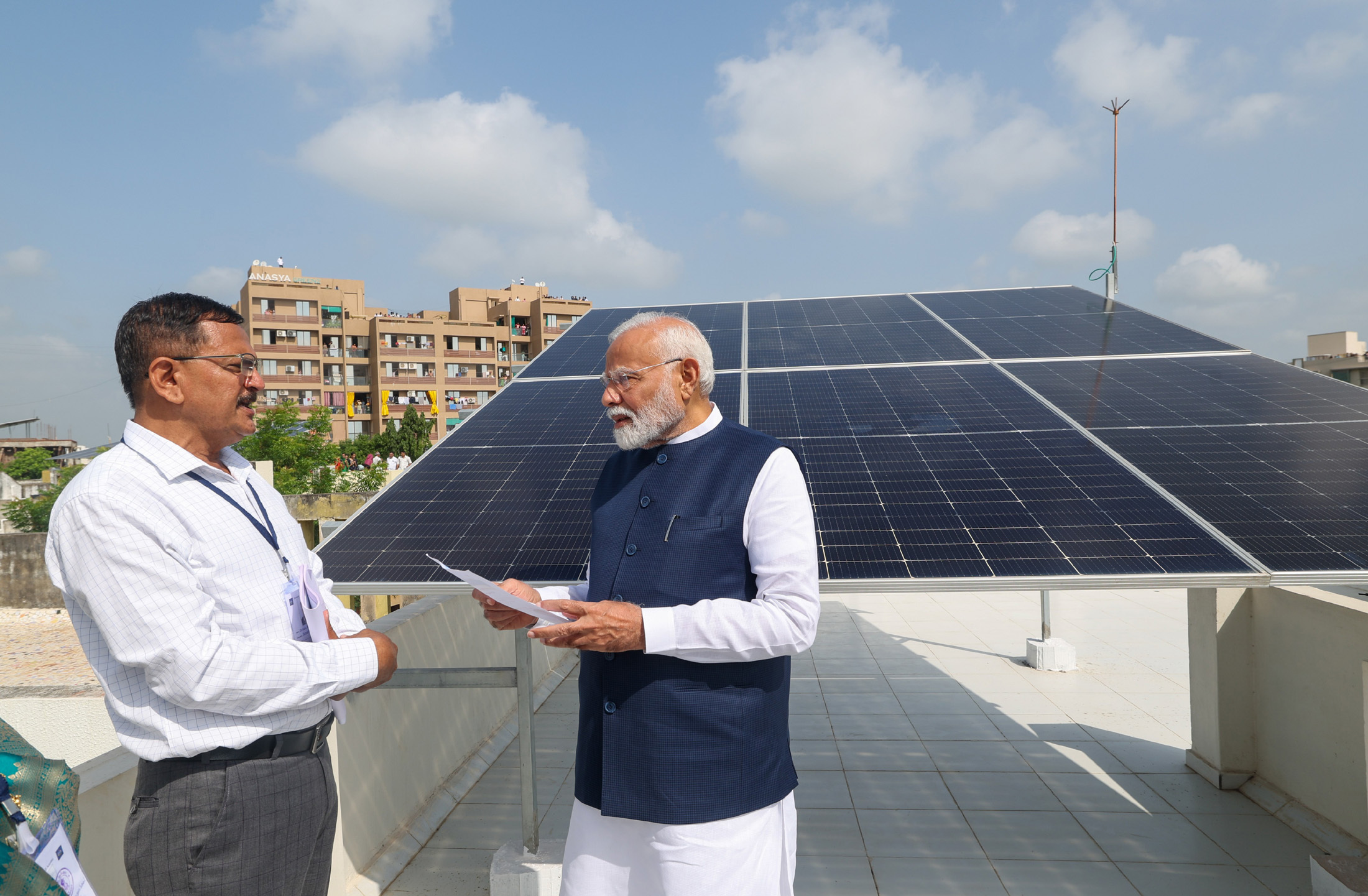
That explains the urgency behind India’s aggressive solar expansion.
The Narendra Modi government deserves substantial credit for converting renewable energy from a talking point into a national mission. Large-scale solar parks, production-linked incentives for domestic manufacturing, rooftop solar schemes, green energy corridors, battery-storage projects, and massive private-sector participation have together created momentum unmatched in India’s energy history.
The scale is breathtaking. Bharat now has some of the world’s largest solar parks, including the massive Bhadla Solar Park in Rajasthan, which alone exceeds 2.2 GW capacity. Solar tariffs in India have fallen dramatically over the last decade, becoming among the cheapest globally. Simultaneously, Bharat’s renewable energy sector has attracted billions of dollars in foreign and domestic investments.
Critics who once claimed developing countries could never balance growth with clean energy now face an uncomfortable reality: Bharat is proving them wrong.
Ironically, while many Western nations lecture the world on climate responsibility, their own renewable expansion has slowed because of political polarization, regulatory bottlenecks, and high project costs. The United States may still hold a higher cumulative installed base overall, but Bharat has overtaken it in actual annual deployment pace — the metric that truly reflects momentum and future direction.
China remains far ahead at number one, but Bharat’s trajectory suggests the gap could narrow significantly over the next decade if current growth rates continue.
More importantly, Bharat’s solar rise is democratizing energy access. Villages once plagued by unreliable electricity are seeing a transformation. Farmers are increasingly benefiting from solar pumps. Industries are gradually shifting toward cleaner and cheaper power sources. Urban consumers are adopting rooftop solar to escape rising electricity costs.
Of course, challenges remain. Battery storage, grid modernization, land acquisition, dependence on imported solar modules, and transmission infrastructure still require urgent attention. Bharat must also ensure that renewable growth translates into manufacturing strength, not merely assembly dependence on foreign supply chains.
Yet, despite those hurdles, one fact is undeniable: Bharat is no longer a passive player in the global energy conversation. It is shaping it.
The sun is doing for Bharat what oil once did for the Gulf — creating strategic relevance, economic opportunity, and global influence.
And this time, the world is watching Bharat not as a developing nation struggling to catch up, but as a rising power setting the pace.

