


Just as the Sun — the eye of the entire world is not tainted by the perceptual and external impurities, so worldly sorrows do not taint the Atman in all beings; it transcends.
As per Advaita philosophy, whenever we hear the word Atman, we should attribute it to ourselves.
As a student of the Advaita school of thought, Tat Tvam Asi, ‘You are That’. Atman is not tainted by sorrow, and we must say, ‘I will truly remain above all the sorrows the world puts me through’. Aham Brahmaasmi ‘I am that Self’.
Advaita school of thought says, do not look at Atman as a third entity. Do not separate Atman and say it is a witness. By saying it, you are in duality. The Upanishad says, ” You are the very Truth itself. The moment you think you are that Atman, nothing in the world will disturb you.
Bhagavad Gita, chp. 2 V 70
आपूर्यमाणमचलप्रतिष्ठं समुद्रमापः प्रविशन्ति यद्वत्।
तद्वत्कामा यं प्रविशन्ति सर्वे स शान्तिमाप्नोति न कामकामी
āpūryamāṇamachalapratiṣṭhaṃ samudramāpaḥ praviśanti yadvat।
tadvatkāmā yaṃ praviśanti sarvē sa śāntimāpnōti na kāmakāmī ॥ 70 ॥
He attains peace into whom all objects of enjoyment enter as waters enter the ocean, which filled from all sides, remains unmoved, but not the ‘desirer of objects’.
All the sorrows are no sorrow, and the greatest of joy is no joy. It will not affect you, because you have become one with the very Atman. The Atman in you is expressed in the various actions you perform. Otherwise, little things will bother you.
Whenever the shastras talk of that Atman, say ‘I am that Truth’. We should think that way because the law of attachment says, “As you think, so you become.” You keep thinking of the Atman, you become the Atman. You will have the traits of Atman and exhibit its characteristics. Everything matters to us because we are not identifying with Atman but with the Vasanas and gunas.
Mantra says ‘the eye of the entire world’ which means, without the sun, the world is plunged in darkness. Shastras say, you enter the sunless world. The sun is the presiding deity of the eye.
These are based on the theory of superimposition and the theory of maya. The unreal does not affect reality.
- A boy sees a snake in a rope. The rope is not affected by the snake.
- The boy sees a ghost in a post. The post is not affected by the ghost.
- A man sees a mirage in a desert. The dessert is not affected by the mirage.
Similarly, whatever situations the world presents, you should tell yourself, ‘I will remain above it and not be affected by it’. When you make the unreal as real, the unreal has an effect on you. We have made the Maya a reality, and it affects us. All the suffering is because of the identification with the unreal. At the absolute level, it is maya, and at the relative level, do not identify. This is the sadhana we have to take.
In Bhaja Govindam, we learn this concept:
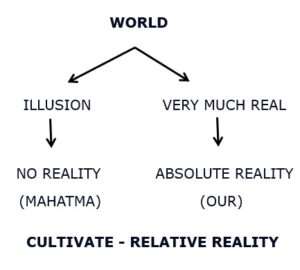
CULTIVATE – RELATIVE REALITY
The world is no reality from the standpoint of mahatmas. They look at it as an illusion. For us the world is very much real. We have to move away from absolute reality and cultivate a sense of relative reality.
Absolute reality is when you give an exaggerated black market value and are affected by the world. Give the world the right value and keep continuing your sadhana. Ultimately, you come to a point of seeing the world from absolute reality to no reality. The world will not matter to you at all. This is the progression.
It is not physical identification or abstinence from the world. One should not have the mental identification. The principle of Vedanta is apply your mind wherever you are, which is to keep your mind in the present.
Masters do not identify with the world because, for them, the world is maya, mithya. The world is very much real for us. Masters tell us, not to identify with it so much as to give an absolute reality. We cannot give a state of no reality nor absolute reality. Play by the rule of that particular experience and give a status of relative reality.
Sadhana is to operate from a state of relative reality and move from absolute reality to relative reality and then to no reality. You can make a list of things you are giving absolute reality, downgrade them. This way, you will move from absolute to relative reality. Ultimately, no rating at all, and give it, no reality.
Atman is manifesting in the world, but you cannot limit it to it. It is in it and beyond it. It is immanent and transcendent.
The sun is unaffected and not tainted by external impurities. Similarly, Atman is not affected or tainted by worldly sorrows. Shastras when they talk of not being tainted, it does not mean tamas but the highest of action, which is sattva.
Tamas:
You are not affected by another person’s challenges because you do not identify with that person. This state of mental attitude of being uninvolved and unaffected gives peace, arising from tamas.
Rajas:
When you are performing actions out of obligation for family, society and it affects you, it is rajas. You identify with the objects or beings and get involved in action, which is rajas.
When the shastras talk of not being affected, they are talking about sattva.
A sattvic action has two aspects:
Firstly, the sattvic state is where you participate in performing your action or dharma. Shastras uphold karma and not the abandonment of your action. When the Sun is performing its duty, it remains unaffected, and it is enlivening the world. It is being true to its nature by giving radiance and lustre. Under its light, whether people moan or celebrate, the Sun is not affected by the joy or sorrow. When we talk of Atman, we have to assert ‘I am the Reality’. To the extent you are established in the Atman, to that extent you will remain unaffected by whatever happens around you.
Eg: A spider spins its own web. It is the creator, and the web is its creation. The spider creates the web to catch its prey in the web, but the spider itself never gets caught in its own creation of the web.
Similarly, we have created a world, but our creation of the world should not come and haunt us. The moment my creation causes me stress, then I am stung by my own creation. The spider analogy indicates that we must be masters of our creation and not victims.
Secondly, this mantra is trying to indicate that the world you have created should not be an instrument of your sorrow. You should not be affected by your creation. The moment you are affected by it, you are in a state of rajas and when you abandon action, you are in tamas. Sattva is to keep yourself active, perform your duties, and while you are acting, ensure you are not affected. This is the principle of Vedanta. Atman is not affected, but it enlivens all.

