

Nobody thinks they are going to fall for it. That is the first thing to understand. Every investor who has ever bought near a top or sold near a bottom was, at that exact moment, completely certain they were making the right call. The market does not need you to be careless. It just needs you to be human.
What gets called a market cycle in textbooks is really something much simpler and much harder to deal with: it is a feeling, spreading through millions of people at once, each of them convinced their version of it is personal and considered and different from the crowd. It is not. It never has been.
Disbelief is where it starts.
After a bad bear run, when prices finally start edging back up, the first reaction most people have is not relief. It is suspicious. They have been burned recently. The rally looks fake. Too neat. The kind of move that lures you back in before the next drop arrives and finishes the job. So people wait. They sit on their hands and watch the market rise without them.
At some point, waiting stops feeling smart and starts feeling costly.
That is hope arriving. Quiet, a little embarrassed, not yet willing to be called optimism. Just a growing sense that maybe the recovery is real this time. That there is something underneath holding prices up. It is the first genuine emotional shift of the new cycle, and almost nobody recognises it for what it is when it is happening.
Then things start moving.
Optimism is a warmer feeling than hope. More settled. The market keeps grinding higher and the gains, while still modest, start to feel less like luck and more like logic. Then comes the moment, again with no exact timestamp, where belief takes over from optimism. People stop asking whether to buy and start buying. The narrative solidifies. The trend rises partly because enough people now believe in the trend, and that belief is self-reinforcing in a way that is very difficult to see clearly from the inside.
This is the exact point where it gets dangerous. Not the next phase. This one.
Because thrill follows belief, and thrill is when the stories start.
Your colleague who never talked about markets is now talking about markets. Group chats that were once about cricket or weekend plans have a new topic. The returns are too good not to mention. Financial media, which spent the early rally hedging every sentence, starts speaking with considerably more confidence. The overall mood tips from cautious to openly bullish, and it tips quickly once it tips at all.
Euphoria is what comes next, and it is genuinely the most destructive phase of the entire cycle, not because of what it feels like but because of what it causes people to believe. At the top of every sustained bull run, the people who have simply been holding assets during a rising market quietly begin to believe they have skill. Not luck, not timing, not the accident of having entered during a recovery. Skill. They start looking further out, projecting the recent past forward into what feels like a logical, permanent future. Risk starts to feel like a concept that applies elsewhere, to other people, to worse investors.
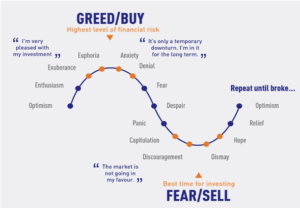
The peak does not come with a warning. It arrives while the party is still going.
Complacency is the phase that does the quiet damage.
Prices start slipping. Not dramatically, just persistently. The dominant read in the room is that this is normal, healthy even, a chance to add to positions before the next leg higher. The bull case that everybody spent the last year building is too recent and too personally profitable to revise. So people hold. Some even buy more.
But the slide keeps sliding.
Anxiety is different from complacency in one specific way: the question changes. It moves from where to add, to whether something might actually be wrong. That shift in the question is the signal. By the time most investors are openly asking whether they should be worried, they almost certainly should be.
Denial is durable. Far more durable than people expect.
The identity of the long-term investor is very useful here, not in a cynical way exactly, but as a psychological shelter. I hold quality. I am not a trader. Short-term noise does not change the thesis. All of that may be true in principle. In practice, it often becomes the story a person tells themselves to avoid making a decision that the evidence is asking them to make.
Eventually the market stops waiting for that decision.
Panic is when the original thesis stops mattering.
Not because the thesis was necessarily wrong, but because the loss has crossed some invisible threshold past which stopping it feels more important than being right. People who had genuinely convinced themselves they were patient, long-term, unfazed by short-term volatility discover something uncomfortable: their actual time horizon was considerably shorter than their stated one. The portfolio that was “money I will not need for years” suddenly needs to stop going down today.
Capitulation is when fear wins completely. The selling accelerates. The people who held the longest, the ones who prided themselves on sitting through the volatility, tended to sell near the bottom, because they simply ran out of capacity to absorb more pain. This is the part that is genuinely cruel. The investors who were most disciplined through the fall often exit at the worst moment.
Then anger. Then the long, grey period of depression, which involves replaying every decision, every exit that was not taken, watching gains that felt permanent dissolve back into the market. This phase gets far less attention than panic or capitulation. It is also where a lot of investors make their most lasting mistake: deciding they are done with equities entirely, missing the recovery that follows.
Because recovery does follow. It always has.
The early rallies get dismissed. Investors who were recently burned read every upward move as a trap, another false start, a bounce before the real bottom. The market is recovering and they do not trust it.
Which puts them right back at disbelief. Where this whole thing began.
This repeats across every market and every generation not because people are foolish but because the wiring that makes us seek reward, avoid pain, follow consensus, and treat recent experience as permanent truth is not a bug. It is the design. The market, in a very specific sense, is built to use that design against you at enormous scale. It does not do this with any intention. It does not need any.
The practical point is not to feel differently. You cannot.
Emotions do not have an off switch and pretending they do is its own form of wishful thinking. The question worth asking is not how to stop feeling things but how much authority you give those feelings when actual decisions need to be made.
The investors who consistently hold their own over long periods tend to share one structural habit. They made the decision before the emotion arrived. The entry criteria was written when the market was quiet. The exit rule existed before the losses started stacking. The position size was calculated to stay psychologically manageable, not sized up because things were going well and confidence was running high.
When everything is going up and every instinct says add more, the rule says reduce. When everything is collapsing and the instinct says sell and stop the pain, the rule says hold or accumulate. Neither instruction feels right in the moment it needs to be followed. Both tend to look correct in hindsight.
The market will always produce a completely convincing reason to buy at the top and an equally convincing reason to sell at the bottom. It has been doing exactly this for as long as organised markets have existed. The genuine edge belongs to the person who wrote their rules on a calm afternoon, put them somewhere they could not easily ignore, and then followed them when everything said otherwise.
Not complicated. Just genuinely hard.
Where Investors Are in the Market Cycle: May 2026
The honest answer is: somewhere between anxiety and denial, with pockets of the market flirting with cautious hope.The investors who bought in the euphoria of mid-2024 are in denial or depression. The investors who stayed systematic through SIPs are somewhere between anxiety and cautious hope. The ones sitting on cash since late 2024 waiting for “the real bottom” are likely to be sitting through the early stages of the next disbelief rally without participating, which is exactly how the cycle extracts its toll.
The Nifty at roughly 24,000 is no longer at the peak-of-cycle pricing it wore in September 2024. The setup is closer to the early hope phase than most investors are currently willing to admit.