



Śrī Kṛṣṇa, as the spiritual master, displayed a natural patience and understanding that equaled his intellectual daring, and he readily dispelled every doubt that arose in Arjuna’s mind. Yet he chose to go deeper, to burn the very seed of doubt, which is the greatest impediment to noble action. No mortal birth, he taught, is the result of mere accident. Every soul enters the world as part of a vast evolutionary movement, and each embodied life marks a long journey of ego through countless forms, finally reaching its present station. In every life, as soon as the ego expresses itself in a new field of activity, it mercifully forgets the past, carrying forward only subtle impressions that flavor the present experience. But the divine intelligence of Kṛṣṇa knew that both he and Arjuna had passed through innumerable phases of existence; he remembered them all, while Arjuna did not.
The Supreme, by the freedom of his own perfect will, assumes the conditions of matter and manifests in a particular form to serve and awaken a deluded generation. For the Lord, ignorance is only a posture assumed, not a reality endured. A mortal is bound by ignorance, but the Lord is master of his own apparent delusion. Thus, though unborn, changeless, and ever sovereign over matter, he enters the world by his own will, fully conscious of his divine nature and unchallenged authority. He does not come into being as others do, compelled by past deeds and bound by nature, nor is he enslaved by mental impressions; he remains ever free from the mischief of delusion. In this freedom lies the model for humanity, for one who masters personal appetites and remains under perfect self-control gains command over every situation.
Whenever virtue declines, the Lord declares, he assumes a form. The law of being is sacred truth, and when a community neglects it, society descends into domination by mere creatures of appetite rather than a cooperative and dignified family of human beings. In every dark period of history, a great master arises to restore the standard of life and its moral values. This renewal is accomplished not only by strengthening noble principles but also by the firm removal of destructive tendencies. For this purpose, the Infinite from time to time wears the garment of matter and enters the field of human activity, moving through the shadowed atmosphere of mortal life to cleanse and reorganize the human heart. His task is not the destruction of individuals but the removal of wrong tendencies, refitting the world by clearing space for nobler patterns of thought and conduct. Thus he encourages the good, reforms the erring, and at times removes the poisonous elements from the garden of life.
Kṛṣṇa explained this about himself because it was clear that Arjuna had not yet grasped his divine nature. Arjuna had addressed him earlier as a human companion, and only later, with childlike simplicity, said, “Teach me, I am your disciple.” This revealed deep reverence, yet still no clear recognition of him as the Supreme. Kṛṣṇa then declared that those who contemplate and understand the divine birth and actions of the Lord transcend limitation and attain godhood, the supreme state of perfection, a state of deathlessness that is also birthlessness. From this state flows pure dynamism, the source of all activity and achievement. Through intelligent self-application, human beings are given the means to invoke the infinite mind and reach the divine source of their actions.
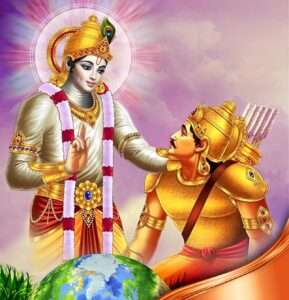
The Lord affirmed that he lends his power to all without partiality; in whatever form people approach him, in that form he serves them. The prevalence of sensuality in the world arises because many live by animal passions, believing that success is quickly gained through action alone. Yet he is not the author of their deeds, for action arises from temperament, which itself requires correction. Actions do not stain him, nor does he anxiously seek their fruits. In offering a fresh interpretation of the ancient disciplines of self-perfection, he set no mere precedent but revealed an eternal principle. Arjuna confessed that he could act because of this guidance, and the Lord replied that action is movement and inaction is its absence; to sit idle offers little to learn, for life is activity and its absence is death. Only through active living can one rise or fall, for life is dynamic and never ceases to function.
Complete cessation of activity is impossible. Life consists of alternating moments of activity and rest; even deep sleep and apparent pauses in existence are intervals that neither advance nor hinder the soul’s progress. It is during periods of action that the individual is shaped, and this creative process depends on whether one’s activities are constructive or destructive. These activities fall into two broad classes: rightful action and forbidden action. One must abandon the forbidden, engage in what fosters self-development, and reject idleness without reservation. Hence Kṛṣṇa teaches that life itself is a bundle of actions. Every outward deed is the gross expression of subtle desires, known and unknown, residing in the intellect. A state entirely free of desire is the state of infinite divinity.
Kṛṣṇa therefore advised Arjuna to engage in war without calculation or desire for results, for planning rooted in craving becomes a chain upon freedom. The fruits of action ripen only in the future, and to chase them is to flee the present and dwell in what is yet unborn. Since effects depend entirely upon causes, sincerity and completeness in present action are the greatest guarantees of success. The perfect sage acts without desire for results and without bondage to plans. This does not mean neglecting intelligence or skill, but rather refusing to waste energy on anxious speculation and sentimental fear about outcomes. Kṛṣṇa thus offers a more efficient path to action and achievement by cultivating higher intelligence and focused application. Whatever a perfected master undertakes brings no binding consequence, good or evil, for he acts only as a divine instrument. Therefore, Kṛṣṇa instructs Arjuna to act, placing all fruits at the feet of the divine and resting in grace.

