M Jaishree
The creation of the universe is an unseen transition and a continuous process of peaceful growth. What appears to the human eye as stillness is, in reality, an immeasurable movement. The cosmos performs its immense duty silently, without announcement, without fatigue and without waiting for an external reminder or command. From the movement of galaxies to the rhythm of atoms, from the changing seasons to the circulation of water, existence remains engaged in an uninterrupted process of becoming. It does not remain inert or stationary even for the smallest conceivable fraction of a moment. Its movement is perpetual, and its continuity is itself one of the profound mysteries of creation.
The Vedic vision approaches this reality through the idea of ṛta, the cosmic order that sustains the harmony of existence. Creation is not merely an event that happened once in a distant past; it is a continuing manifestation of order. The Ṛgveda repeatedly evokes the relationship between cosmic law, natural rhythm and the movement of life. The Sun rises and sets, waters move, seasons return, plants grow, beings are born and generations succeed one another. What repeats is not necessarily a mechanical duplication of the past; rather, repetition becomes the means through which the universe renews itself. The same principles operate again and again, yet every manifestation appears within a new moment.
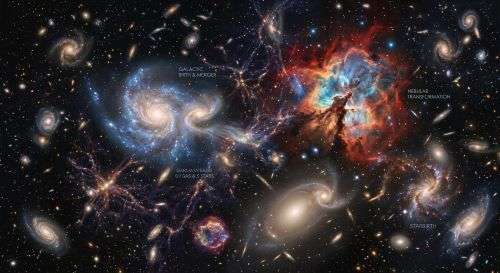
Modern scientific understanding, though expressed in a different language, also reveals a universe characterised by continuous transformation. Matter and energy participate in processes of change; stars are born, evolve and disappear; planets undergo geological transformations; biological organisms reproduce, adapt and perish. At the microscopic level, too, nature is dynamic rather than absolutely static. Science does not require the universe to be interpreted as possessing intention in the human sense, but it demonstrates with remarkable precision that natural processes operate through consistent laws and recurring cycles. The apparent repetition of nature therefore becomes an invitation to understand continuity, causation and transformation rather than merely sameness.
Consider the ocean. Water drawn upward by the heat of the Sun becomes vapour, gathers into clouds and eventually returns to the Earth as rain. The rain enters streams and rivers, flows through tributaries and ultimately reaches the ocean once again. The ocean has not disappeared; its water has travelled through different forms before returning to its source. What appears to be departure is therefore part of return. What appears to be an ending becomes another stage of continuation. The ancient intuition that nature moves in cycles finds a remarkable illustration in what science now describes through the hydrological cycle.
The same mystery is visible in a tiny seed. A seed enters the soil, awakens under appropriate conditions, sends forth a tender sprout and gradually becomes a tree. The tree flowers and bears fruit, and within that fruit are seeds carrying the possibility of another generation. Eventually the tree dries and returns to the elements, while its seeds begin another journey. The tree therefore contains within itself both the memory of what preceded it and the potential of what is yet to come. Nature does not simply reproduce; it renews. Every new tree is recognisably connected with the earlier tree, yet it is never an exact repetition of it.
The same principle is reflected in life itself. Living beings are born, grow, learn, act, create relationships, fulfil responsibilities and eventually depart. The individual life appears temporary, but life as a principle continues. In the Vedic understanding, this continuity is further interpreted through karma, by which action is connected with consequence. The Bhagavad Gita presents action not as an isolated occurrence but as part of an interconnected order in which intention, conduct and consequence are related. Thus, the seed becomes an appropriate metaphor for karma: an action may disappear from immediate sight, yet its consequences can continue to unfold.
This conception does not mean that every event is predetermined or that human beings are powerless before destiny. On the contrary, the Gita places great importance on conscious action, discernment and responsibility. The human being participates in the order of existence through choices. Karma therefore becomes not merely an explanation of the past but also a discipline for the present. What is planted through thought, speech and action influences what may emerge later. The quality of the seed matters because the quality of the future depends, in part, upon what is sown today.
Bharatha varsha has preserved this sense of continuity through a spiritual civilisation that repeatedly renews itself while remaining connected to its deepest foundations. Like the sacred Ganga, whose waters continue to move while remaining recognisable as the same sacred river, its spiritual current has passed through countless generations, languages, teachers, schools of thought and forms of worship. The river does not remain sacred because its water is physically unchanged; its sacredness is associated with the continuity of meaning, reverence and spiritual aspiration carried through time.
New thoughts arise. New practices emerge. New philosophical interpretations appear. Theories are proposed, examined, challenged and replaced. Institutions rise and decline. Doctrines acquire influence and sometimes lose it. Even the names and forms through which people approach the Divine may change according to time, place and human understanding. Such change need not be regarded as a weakness. A living civilisation must possess the capacity to examine itself, absorb experience and respond to new knowledge without surrendering its fundamental search for truth.
The Vedic tradition itself demonstrates this intellectual movement. The hymns of the Vedas, the philosophical inquiries of the Upanishads, the ethical and spiritual dialogue of the Bhagavad Gita, the systems of darśana, the epics, Puranic traditions and innumerable later interpretations reveal a civilisation in which questioning and continuity have existed together. The search for Brahman, the nature of the Ātman, the relationship between action and liberation, the meaning of knowledge, devotion and discipline, and the nature of reality have been examined through many intellectual pathways. The existence of different approaches does not necessarily destroy unity; it can demonstrate the breadth of the search.
This is where the metaphor of flowing water becomes spiritually significant. Water that moves remains fresh through circulation, while water deprived of movement may become stagnant. In the same manner, thought that is willing to examine itself can remain alive, whereas unquestioned attachment to form can gradually produce stagnation. The ancient Vedic prayer, “Tamaso mā jyotir gamaya”—from darkness, lead me towards light—expresses not merely a request for comfort but an aspiration for movement from ignorance toward knowledge. Spiritual life, in this sense, is a journey rather than a frozen conclusion.
The scientific temperament can coexist with this spiritual aspiration when both are understood as disciplined searches for truth. Science asks nature questions through observation, measurement, experimentation and reason. Spiritual inquiry asks questions concerning consciousness, existence, meaning and the nature of the self through contemplation, ethical discipline and philosophical investigation. Their methods are not identical, and they should not be confused, but both can encourage intellectual humility: the recognition that reality is greater than any single human explanation. Genuine inquiry does not fear questions; it becomes stronger through them.
The peaceful repetition of creation therefore carries a deeper lesson. The Sun does not announce its rising. The river does not seek recognition for reaching the sea. The seed does not proclaim that it will become a tree. The universe performs its processes silently, continuously and precisely. Its grandeur lies partly in the absence of noise. Creation does not need applause to fulfil its order.
Human beings, however, often disturb this natural rhythm through impatience, excessive desire and attachment to permanence. We expect everything to remain as it is, although nature itself teaches that everything visible is subject to transformation. The body changes, circumstances change, relationships change, knowledge changes and societies change. Yet change does not necessarily mean destruction. Just as water changes form without ceasing to participate in the water cycle, existence changes its visible forms while continuing through deeper relationships and processes.
The enduring foundation of Sanātana Dharma can be understood within this framework—not as a doctrine dependent upon one historical moment, but as a continuing spiritual inquiry into eternal principles such as ṛta, dharma, karma, consciousness, truth and liberation. Its vitality lies in its capacity to remain connected to foundational questions while allowing successive generations to encounter those questions in their own circumstances. Forms may change; expressions may change; interpretations may evolve; but the search for truth need not cease.
Creation is therefore a peaceful repetition, but it is not monotonous repetition. Every sunrise resembles another sunrise, yet no human being experiences the same morning twice. Every river follows the logic of flowing water, yet every drop travels through a different circumstance. Every seed carries the pattern of its species, yet every tree grows within a unique environment. Repetition provides continuity; variation provides freshness. Together they constitute the living rhythm of creation.
The universe seems to teach that permanence does not necessarily mean remaining unchanged. Sometimes permanence is found in the law that allows change to continue. The ocean remains through the movement of its waters; the forest remains through the succession of trees; life remains through generations; knowledge remains through questioning; and a spiritual civilisation remains alive through its ability to rediscover its eternal foundations in changing circumstances.
Thus, what repeatedly appears before us should not be dismissed as ordinary. The returning rain, the emerging seed, the flowing river, the birth of life and the renewal of thought are all reminders that existence is continuously recreating itself. In that ceaseless movement there is neither absolute beginning nor simple ending, but transition, transformation and renewal. The deepest spiritual wisdom of Bharatha varsha lies perhaps in recognising this rhythm: to remain alive is to move, to remain pure is to flow, and to remain illumined is to continue seeking truth.