



For decades, Bharat watched successive industrial revolutions unfold from the sidelines. We became consumers of many breakthrough technologies rather than their creators. The semiconductor race was largely missed. The internet revolution was dominated by American companies. China surged ahead in manufacturing. The lesson was unmistakable—late entry into strategic technologies comes at an enormous national cost.
Prime Minister Narendra Modi’s National Quantum Mission appears to be an attempt to ensure that history does not repeat itself.
With an allocation of over ₹6,000 crore for the period 2023-2031, Bharat has entered one of the world’s most consequential scientific races. While China and the United States remain the undisputed frontrunners, Bharat has chosen not to remain a spectator. Better late than never.
Quantum technology is not merely about building faster computers. It represents the next technological revolution that will redefine national security, cyber warfare, artificial intelligence, drug discovery, financial systems, climate modelling, logistics, aerospace and defence. Nations that master quantum technologies will enjoy strategic advantages comparable to those enjoyed by countries that led the nuclear and space revolutions.
Today, China leads the world in government investment, quantum communication infrastructure and patent filings. The United States continues to dominate private-sector innovation, commercial quantum hardware, software ecosystems and cutting-edge academic research. Their competition resembles a technological Cold War, with the rest of the world racing to avoid being left behind.
Bharat’s response deserves attention
Within less than two years of launching the National Quantum Mission, India has reportedly established a 1,000-kilometre quantum communication network—halfway to its ambitious target of 2,000 kilometres set for completion over eight years. Such progress demonstrates that with clear policy direction, adequate funding and institutional collaboration, Bharat can compress timelines that once seemed unrealistic.
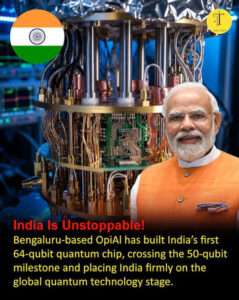
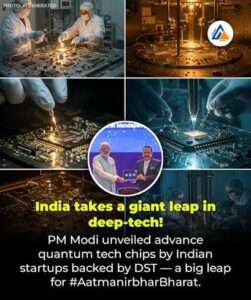
Equally encouraging is the emergence of indigenous quantum hardware. Bharatiya deep-tech startups and research institutions have developed superconducting quantum processors, including 25-qubit and 64-qubit systems, signalling that Bharat is no longer content with importing advanced technologies. Research centres at the Indian Institute of Science, Bengaluru, along with quantum testbeds being developed across the country, are nurturing an ecosystem capable of competing globally.
ISRO’s growing interest in quantum technologies further underlines their strategic importance. Secure satellite communications, next-generation navigation systems and mission-critical simulations will increasingly depend upon quantum capabilities. In an era where cyberattacks have become instruments of geopolitical warfare, quantum-secure communications could prove indispensable.
The benefits extend far beyond defence
Quantum computing promises revolutionary advances in pharmaceutical research by dramatically accelerating drug discovery. It could optimise supply chains, strengthen banking security, improve weather forecasting, transform materials science and significantly enhance artificial intelligence. Contrary to popular misconceptions, artificial intelligence and quantum computing are not rivals. They are complementary technologies, each amplifying the strengths of the other.
There is also a profound historical irony
Long before the phrase “quantum computing” entered scientific vocabulary, Bharat’s physicist Satyendra Nath Bose laid the foundations of quantum statistics in the 1920s, giving the world the Bose-Einstein framework that remains central to modern quantum mechanics. Today, scientists such as Professor Arun Kumar Pati have carried that legacy forward by pioneering quantum computing research in Bharat. The intellectual roots have always existed; what was missing was sustained national investment.
Some observers also draw philosophical parallels between quantum mechanics and the non-dualistic principles of Advaita Vedanta. While Hindu scriptures did not describe quantum physics in scientific terms, the conceptual similarities regarding interconnectedness and the nature of reality continue to intrigue physicists and philosophers alike. Such comparisons should inspire curiosity rather than substitute for rigorous science.
Bharat’s quantum journey has only just begun. It still trails the United States and China in funding, commercial deployment, research output and industrial scale. Bridging that gap will require long-term political commitment, world-class universities, greater private-sector participation, skilled talent, international collaboration and patient capital.
Yet every technological superpower begins with a first decisive step
The National Quantum Mission reflects a strategic recognition that future geopolitical influence will belong not merely to nations with large populations or powerful militaries, but to those that command the technologies defining the twenty-first century. If Bharat sustains this momentum, quantum technology could become another chapter in the country’s transformation from a technology consumer into a technology creator.
The twenty-first century will not be defined merely by who has the biggest economy or the largest army. It will be defined by who controls the technologies of the future. Quantum technology is one such frontier. Bharat may have entered the race later than the United States and China, but under Prime Minister Narendra Modi’s National Quantum Mission, it has finally chosen to run. History rarely remembers those who watched from the sidelines—it remembers those who dared to compete.


