



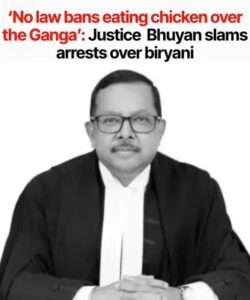
The Bharatiya judiciary commands enormous respect because it is the final guardian of our Constitution. Judicial observations often travel much farther than the confines of a courtroom. They shape public discourse, influence societal perceptions and, at times, leave deep emotional impressions on millions of citizens. It is for this very reason that judges must exercise not only judicial wisdom but also cultural sensitivity while making oral observations. Over the years, concerns have repeatedly been raised whenever judicial remarks touching upon matters of faith appeared selective or dismissive. Irrespective of whether such observations carry legal consequences, they inevitably invite public scrutiny. The recent observation reportedly made by Justice Buniya that “no law prohibits eating chicken on the Ganga” has once again reopened a larger debate. Legally speaking, the proposition may well be correct. But constitutional morality is not always confined to what is expressly prohibited by law. Civilized societies are equally governed by conventions, sensitivities and mutual respect. For millions of Hindus, the Ganga is not merely a river flowing across northern Bharat. It is revered as Ganga Mata—a sacred embodiment of purity and divinity. Constitutional secularism cannot demand that citizens abandon such sentiments merely because they are not codified in statutory provisions. The larger question, therefore, is not whether an act is legally permissible, but whether constitutional institutions ought to display equal sensitivity towards the religious sentiments of every community. Bharat has, for decades, witnessed restrictions imposed upon Hindu religious processions in the name of maintaining law and order. Routes are altered, music is regulated and administrative limitations are routinely justified on grounds of preserving peace and communal harmony. Whether one agrees or disagrees with such restrictions, they demonstrate an important constitutional reality—that governance often accommodates social sensitivities even in the absence of explicit statutory prohibitions. If administrative authorities can legitimately invoke public order considerations while dealing with one community’s religious practices, it is not unreasonable for citizens to expect equal sensitivity towards the sentiments of the majority community as well. This debate, however, must not be reduced to judges versus Hindus or one religion versus another. Such binaries do disservice to both constitutionalism and democracy. The overwhelming majority of judges faithfully discharge their constitutional responsibilities without prejudice. Yet judicial institutions, like all institutions in a democracy, remain open to fair criticism when citizens perceive inconsistency in the application of principles.
The Constitution guarantees equality before law—not equality selectively administered. Perhaps the recurring controversies surrounding matters of personal laws, religious practices and judicial interpretations also expose another uncomfortable truth. Seventy-nine years after Independence, Bharat continues to grapple with differential legal frameworks governing its citizens. The framers of our Constitution consciously incorporated the Uniform Civil Code under Article 44 as a Directive Principle of State Policy. It was not inserted as an ornamental provision but as a constitutional aspiration. Successive governments have either lacked the political will or found themselves constrained by electoral considerations to address the issue comprehensively. Ironically, the judiciary itself has, on several occasions, reminded governments of the desirability of moving towards a Uniform Civil Code. A common civil framework applicable equally to every citizen—without discrimination based on religion—would significantly reduce ambiguities and recurring controversies surrounding competing claims of faith, customs and legal rights. The debate over the Uniform Civil Code is not about diminishing anyone’s religious identity. It is about ensuring that citizenship, rights and obligations flow from a common constitutional framework. Equality before law cannot remain an abstract slogan if laws themselves are perceived to operate differently across communities. Democracy also imposes obligations upon political parties. Parliament remains the appropriate constitutional forum for debating transformative legislation. Persistent disruptions that prevent legislative business do little service either to constitutional governance or to those whom political parties claim to represent. Governments must accommodate dissent, but oppositions too carry an equal responsibility to permit democratic institutions to function. Bharat’s constitutional journey cannot be held hostage indefinitely by political calculations. Respect for the judiciary does not require silence from citizens. Equally, criticism of judicial observations must never descend into disrespect towards the institution itself. Constitutional democracies flourish when institutions remain accountable and citizens remain responsible. The real issue, therefore, is neither chicken on the Ganga nor courtroom rhetoric. It is whether Bharat is willing to honestly confront the constitutional questions that have remained unanswered for nearly eight decades. Perhaps the time has come to move beyond selective sensitivities and reaffirm the principle that the Constitution envisioned from the very beginning—one nation, equal citizenship and equal laws for all.

