



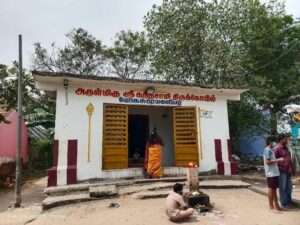
Sri Kandaswamy Temple is located at Vayalanallur (also known as Voyalanallur), near Pattabiram and Poonamallee in Thiruvallur district of Tamil Nadu. Nestled amidst peaceful surroundings, this little-known shrine is revered as one of the rarest Murugan temples in India due to the unique form of the presiding deity.
The temple is believed to be over 1,100 years old and dates back to the early Chola period, around the 9th century CE during the reign of Aditya Chola I. Ancient Tamil inscriptions found within the temple record donations made for daily worship and temple maintenance, confirming its antiquity and its importance as a centre of Murugan worship during the Chola era.
The presiding deity is Sri Kandaswamy (Lord Murugan), worshipped in the rare Brahma Shasta or Gnana Skanda form. The majestic idol, standing about seven feet tall, is one of the very few Murugan idols in India where the Lord appears without his Vel, peacock, or his divine consorts, Valli and Devasena.
Instead, he holds an Akshara Mala (rosary) and a Kamandalu (water pot), the traditional symbols of Lord Brahma. This extraordinary form signifies Murugan as the embodiment of supreme wisdom and the divine teacher who assumed the responsibility of creation after Brahma failed to explain the meaning of the sacred Pranava Mantra.
Built in the characteristic style of the early Cholas, the temple has a simple granite structure with an ancient sanctum that houses the original deity. Though renovated over the centuries, it still preserves several stone inscriptions and retains its traditional spiritual ambience.
The temple flourished under the patronage of the Chola rulers and local chiefs, who endowed lands and supported its daily rituals. Despite the passage of more than a millennium, uninterrupted worship has continued here, preserving one of the rarest traditions of Murugan worship in Tamil Nadu.
The sacred legend of this temple is narrated in the Skanda Purana and highlights Lord Murugan’s role as the Supreme Guru.
Once, Lord Brahma visited Mount Kailasa to worship Lord Shiva. On his way, he failed to pay proper respects to the young Lord Murugan. Murugan stopped him and asked him to explain the meaning of the sacred Pranava Mantra, “Om,” which forms the essence of the Vedas.
Although Brahma was the creator of the universe and the guardian of Vedic knowledge, he could not explain its true significance. Realising that one who lacked complete spiritual knowledge was unfit to carry out the work of creation, Murugan imprisoned Brahma.
With creation unable to stop, Lord Murugan himself took over Brahma’s duties. Holding the Akshara Mala and Kamandalu—the symbols of creation and divine knowledge—he governed the universe with perfect wisdom. Because he performed the role of Brahma while remaining the supreme teacher, he came to be worshipped as Brahma Shasta.
The Devas, worried about Brahma’s imprisonment, appealed to Lord Shiva. Shiva asked Murugan the reason for his actions. Murugan explained that true authority must be founded on true knowledge and that even the creator must understand the deepest meaning of the Pranava Mantra.
Pleased by his son’s divine wisdom, Lord Shiva requested Murugan to release Brahma. Before doing so, Murugan personally instructed Brahma on the true meaning of “Om,” thereby becoming the Guru even to the creator of the universe. Brahma, humbled by this experience, resumed his duties with a renewed understanding of divine knowledge.
To commemorate this extraordinary episode, Lord Murugan is enshrined at Vayalanallur in the unique Brahma Shasta form. The deity reminds devotees that wisdom is superior to power, knowledge is the foundation of creation, and the ultimate teacher is Lord Murugan himself. This rare manifestation makes the temple one of the most spiritually significant Murugan shrines in India.
Vaikasi Visakam, Skanda Sashti, Thai Poosam, Panguni Uthiram, Karthigai Deepam, and the monthly Kritika Nakshatra are celebrated with special abhishekams and pujas. Devotees visit this temple to seek blessings for education, wisdom, spiritual progress, and success in life, as Lord Kandaswamy here is revered as the bestower of divine knowledge.


