
For millions of people born in Bharat after Independence, Jawaharlal Nehru was simply ‘Chacha Nehru ’-the benevolent architect of modern India whose vision shaped a young nation.
School textbooks left us with little reason to think otherwise. They celebrated his achievements, his ideals, and his affection for children. Rarely did they encourage us to examine his words critically or question his judgments.
Then came the internet. And now, digitised archives and fact-checking tools have made it possible for anyone – not just historians – to verify speeches, documents and quotations in a matter of seconds.
History, once locked away in dusty archives, is now available at our fingertips. That is how a speech Nehru delivered at a seminar on architecture in New Delhi on March 17, 1959 has gone viral on social media.
One had to read it twice. ‘Some of the temples of the South, however, repel me in spite of their beauty. I just can’t stand them. Why? I do not know. I cannot explain that, but they are oppressive, they suppress my spirit. They do not allow me to rise, they keep me down. The dark corridors – I like the sun and air and not dark corridors.’
The quotation is genuine. What was astonishing was not that Nehru admired the Taj Mahal. Everyone is entitled to personal aesthetic preferences. What is surprising is that he found some of humanity’s greatest architectural achievements ‘oppressive’. That deserves reflection.
A quote that deserved verification
The temptation in today’s social media world is either to dismiss an uncomfortable quotation as fake or to weaponise it without checking its authenticity.
The speech survives in official archives. Nehru did describe some temples in the south as oppressive because their dark corridors, he said, suppressed his spirit. He preferred sunlight, openness and air.
He was perfectly entitled to that personal response. But public figures who shape a nation’s cultural outlook must also expect their judgments to be examined.
Civilisation carved in stone
Temples in southern Bharat are not merely places of worship. They are encyclopaedias carved in granite. They embody mathematics, geometry, structural engineering, acoustics, metallurgy, sculpture, iconography, astronomy and urban planning in ways that continue to astonish scholars.
Consider the Kailasa Temple at Ellora. Long before cranes, laser-guided cutters or computer modelling, an entire mountain was carved from the top down into a freestanding temple with astonishing precision.
Walk into the Vittala Temple at Hampi. Its famous stone pillars demonstrate an understanding of resonance that continues to fascinate engineers and conservationists.
Stand before the Brihadisvara Temple in Thanjavur. Its towering vimana has dominated the skyline for over a thousand years, standing as testimony to extraordinary planning and engineering.
Many temples were aligned with the movement of the sun and significant celestial events, demonstrating a sophisticated understanding of astronomy.
These monuments were not built merely to impress. They were conceived as cosmic diagrams in stone. Every measurement had meaning, every sculpture conveyed philosophy, and every corridor was part of a spiritual journey.
They functioned as centres of learning, music, dance, philosophy and community life long before the modern university emerged.
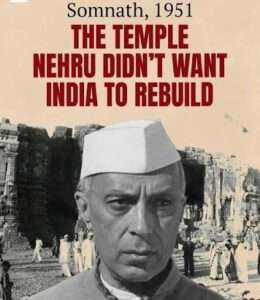
A tomb is not a temple
Nehru was, of course, entitled to his personal preferences. But it was rather unfair to contrast some of the world’s greatest temple complexes with the Taj Mahal, however beautiful that monument may be.
The Taj Mahal is unquestionably one of the world’s finest works of architecture. It is an exquisite mausoleum built to house the mortal remains of Mumtaz Mahal and, later, Emperor Shah Jahan. Its purpose is fundamentally different.
Hindu temples, by contrast, remain living institutions. Their bells still ring, their rituals continue, and their architecture still inspires pilgrims, historians, architects, and engineers alike.
They are living monuments to an entire civilisation’s spiritual, artistic and scientific genius. They deserve to be appreciated on their own terms, not measured against an altogether different architectural tradition.
What did Nehru fail to see?
If these masterpieces did not elevate Nehru’s spirit, that tells us more about his personal sensibilities than about the monuments themselves.
The darkness of a temple corridor is not merely an architectural choice. In many traditions, it symbolises the human journey from ignorance to enlightenment, culminating in the illuminated sanctum.
The irony is difficult to ignore. A leader celebrated for promoting scientific temper appeared unable to appreciate the remarkable scientific and engineering achievements embodied in these temples.
One may not share that symbolism. But to dismiss such spaces as merely oppressive is to overlook the profound philosophical and architectural thinking behind them.
Admiration without blindness
One’s admiration for Nehru’s contribution to Bharat’s democratic foundations remains. But admiration should never demand blindness. The mature citizen does not worship historical figures. He evaluates them.
Perhaps the greatest service that digitised archives and fact-checking tools have rendered is this: they allow us to encounter our national icons through their own words rather than through carefully curated narratives.