
MS Sparsha
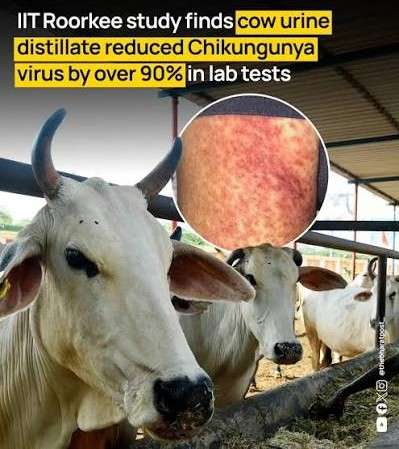
India’s centuries-old traditional knowledge systems are increasingly finding validation in modern scientific laboratories, and a recent breakthrough by researchers at IIT Roorkee has added another significant chapter to this journey. In a remarkable study, scientists have identified key bioactive compounds in Ayurvedic Cow Urine Distillate, commonly known as Gau Mutra Ark, that exhibit strong antiviral activity against the Chikungunya virus.
The study, led by Professor Shailly Tomar and her team from the Department of Biosciences and Bioengineering at IIT Roorkee, has opened up promising possibilities for developing affordable, natural, and effective antiviral therapies by combining ancient Ayurvedic wisdom with cutting-edge biotechnology.
Published in the prestigious journal ACS Agricultural Science & Technology, the research reported impressive laboratory results. The team observed more than a 90 per cent reduction in viral load when Cow Urine Distillate was used. Even more encouraging was an optimized formulation developed from naturally occurring compounds, which achieved a staggering 99.85 per cent reduction in viral load under controlled laboratory conditions.
Chikungunya remains a major public health challenge in several tropical countries, including India. Spread primarily through the bite of infected Aedes mosquitoes, the disease causes high fever, severe joint pain, fatigue, headaches and, in some cases, prolonged debilitating symptoms that can persist for months. Despite its widespread impact, there is currently no specific antiviral drug available to treat Chikungunya, making preventive measures and supportive care the primary treatment options.
This is where the IIT Roorkee study assumes enormous significance.
For decades, traditional remedies such as Gau Mutra Ark have been part of Ayurvedic practices, often generating intense public debate between proponents of traditional medicine and advocates of evidence-based science. However, the IIT Roorkee researchers have taken a rigorous scientific approach, moving the conversation beyond beliefs and assumptions toward empirical evidence.
The study does not advocate blind acceptance of traditional practices. Instead, it demonstrates how ancient formulations can be subjected to modern scientific scrutiny to identify active compounds and evaluate their therapeutic potential.
This scientific validation is crucial.
India possesses one of the world’s richest repositories of traditional medicinal knowledge. Yet, much of this treasure remains underexplored due to inadequate scientific investigation and a historical tendency to either dismiss traditional remedies outright or promote them without sufficient evidence. Both extremes are counterproductive.
Research such as this creates a balanced pathway that respects traditional knowledge while adhering to global scientific standards.
The findings also align with the Narendra Modi government’s broader emphasis on integrating traditional Indian systems of medicine with contemporary healthcare research. Institutions across the country are increasingly being encouraged to explore the scientific basis of Ayurveda, yoga and other indigenous practices.
However, experts caution that these findings are still at the laboratory stage. While the results are highly promising, extensive clinical trials involving human participants will be necessary before any treatment can be recommended for widespread medical use. Safety, dosage, efficacy and potential side effects must all be thoroughly evaluated through multiple phases of research.
Nonetheless, the discovery represents an important milestone.
It showcases India’s ability to create globally relevant healthcare solutions by leveraging its unique civilizational strengths and world-class scientific institutions. More importantly, it reinforces the idea that innovation does not always require reinventing the wheel; sometimes, it involves rediscovering and scientifically validating knowledge that has existed for centuries.
IIT Roorkee’s breakthrough serves as a powerful reminder that tradition and technology need not be adversaries. When ancient wisdom is examined through the lens of modern science, it can potentially yield transformative solutions to contemporary health challenges.
As the world searches for new antiviral therapies to combat emerging diseases, India’s fusion of Ayurveda and biotechnology could emerge as a valuable contributor to global healthcare, offering hope that some answers to future medical challenges may lie hidden in the wisdom of the past.Top of Form