



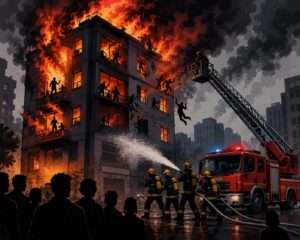
A massive fire broke out in a hotel in Malviya Nagar, Delhi, on June 3, 2026, shocking the entire nation. The tragic incident, which claimed the lives of twenty-one people and injured many more, stunned not only the capital but the entire nation. People were seen jumping from high-rise buildings to escape the flames. The scenes broadcast on social media and the news media were deeply traumatic for any sensitive individual. This was not just an accident; it was a horrific testament to the failure of the system designed to ensure the safety of citizens.
Every major accident is followed by a few days of mourning, condolences, investigations, and announcements of compensation. Then, the matter gradually fades from public memory. But the Malviya Nagar tragedy is not something to be simply condoled and forgotten. It points to deep structural flaws that have become more dangerous with the rapid urbanization of India’s metropolitan cities. This accident forces us to ask—are our buildings truly safe? Are fire safety regulations limited to paper only? And is the role of the administration limited to distributing relief after an accident?
In the event of a fire in any multi-story building, the most important elements are safe exits, firefighting equipment, and timely rescue. If people inside a building have to jump from windows and balconies to save their lives, it indicates a complete failure of the security system. Fire not only destroys the building, it also exposes the reality of safety claims and administrative preparedness. This is what happened in the Malviya Nagar incident.
According to preliminary information, several foreign nationals were also staying at the hotel. This fact makes the tragedy even more serious. India’s capital welcomes tourists, businessmen, and investors from around the world. If security standards in the capital are so poor that even foreign nationals feel unsafe, it not only represents a failure of the local administration but also a question mark on the country’s international image. A modern metropolis is not defined solely by tall buildings and glitzy hotels, but by the security and disaster management systems in place.
Following the incident, Prime Minister Narendra Modi and Delhi Chief Minister Rekha Gupta expressed condolences and announced financial assistance for the deceased and injured. Such condolences are necessary, and the families of the victims deserve support in this time of crisis. But it is equally true that compensation cannot bring back a lost life. Financial assistance cannot lessen the intensity of grief. A family member, a child’s father, a parent’s child, or a person’s spouse cannot be replaced by a single sum of money. Therefore, the real question is not one of compensation, but of prevention.
The Delhi Police filing an FIR against the hotel owner under sections related to culpable homicide not amounting to murder indicates that investigating agencies are not treating this incident as a mere accident. If safety regulations were ignored, fire safety standards were not followed, or building construction rules were violated, this is not merely an administrative error but criminal negligence. Fixing responsibility in such cases is crucial, as in the absence of accountability, rules become mere formalities.
But the fault can’t lie solely with the building owner. We also need to examine where the inspection officials were. Were fire safety certificates renewed promptly? Did any inspections uncover deficiencies? If so, why wasn’t action taken? If not, were the inspections conducted properly? Answers to these questions are essential not only for this case, but for understanding the functioning of the entire city administration.
Most of India’s metropolitan cities today grapple with haphazard urbanization. Narrow streets, illegal construction, overcrowding, parking chaos, and disregard for safety standards have become common sights in almost every city. These shortcomings go unnoticed as long as everything remains normal. But as soon as a disaster strikes, these shortcomings prove fatal. The difficulties faced by fire engines in navigating the narrow streets of Malviya Nagar once again highlighted the serious lack of coordination between urban planning and disaster management.
Delhi is not alone. Mumbai, Kolkata, Bengaluru, Chennai, Hyderabad, and other metropolitan cities face similar challenges. Many buildings either lack fire extinguishers or have not been inspected for years. Emergency exits are often blocked. Many commercial establishments compromise safety standards to maximize profits. Sadly, even the administration often remains indifferent to these violations.
Fire safety isn’t just a technical matter of building construction; it’s fundamental to protecting civilian life. In developed countries, violating fire safety regulations is considered a serious offense. Regular inspections, mandatory mock drills, and strict penalties are enforced. India also has regulations, but the problem lies in their effective implementation. Unless there’s prompt and strict action against violations, paper provisions cannot translate into actual safety.
This tragedy raises another important question: Are ordinary citizens sufficiently aware of fire safety? Most people don’t know what to do and what not to do in case of a fire. Panic, rumors, and misjudgment often exacerbate the loss of life and property. Regular fire safety training and mock drills should be made mandatory in schools, colleges, offices, hotels, and residential complexes. Safety isn’t just the government’s responsibility; it’s also society’s collective responsibility.
This incident mustn’t be simply a news story. Special safety audits should be conducted on all high-rise hotels, guest houses, and commercial establishments. Buildings found to violate regulations should be immediately closed. The fire department should be provided with modern technology, adequate resources, and trained manpower. Local bodies and town planning agencies must also fulfill their responsibilities to ensure that emergency vehicles are given access in the future.
Governments must understand that development and security are not contradictory, but complementary. Development is not simply about building new buildings. Building safe buildings is true development. Simply promoting tourism is not enough; ensuring the safety of tourists is equally essential. Attracting investment is not the only important thing; protecting the lives of citizens and visitors is even more crucial.
The Malviya Nagar fire is a warning. This warning is not just for Delhi, but for the entire country. If we don’t wake up today, a similar tragedy could be repeated tomorrow in another city, another hotel, hospital, school, or residential building. Then there will be the same condolence messages, the same compensation announcements, and the same questions will remain unanswered.
The dead cannot be brought back. The pain suffered by their families cannot be fully assuaged. But if we learn from this incident, make real improvements to safety, hold those responsible accountable, and make fire safety a national priority, many lives can be saved in the future. This will be our true tribute to this tragedy.
The Malviya Nagar fire didn’t just burn a building; it exposed the weaknesses of our urban system, administrative accountability, and safety culture. Now is not the time to simply mourn, but to take concrete action. Because the biggest question after every tragedy is: have we learned anything? If the answer is ‘no’ this time, the next tragedy may just be waiting in the wings.


