



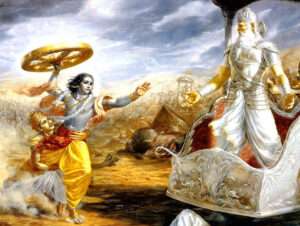
When unrighteousness rose in arrogance, and the balance of dharma trembled upon the field, Sri Krishna, seized by virtuous fury, leapt down from the chariot, the radiant discus blazing upon his right hand. Clad in soft and resplendent silken garments that shimmered amidst the dust of war, he advanced with unrestrained resolve. The Sudarshana shone forth in expanding circles of light, casting brilliant rays in every direction, and the earth itself quivered beneath his stride. The celestial realms beheld his movement with awe, for he appeared as the devourer of sin, pride subdued by virtue, and like a fearless lion springing upon a wild elephant.
His posture, precision, expression, and immeasurable speed bore the semblance of Yama at the hour of cosmic dissolution. The heavens, knowing the immeasurable force that dwelt within him, seemed to tremble at the thought of the impending release of divine wrath. As he descended from the chariot and strode toward the Kauravas ranks, the foremost warriors of that host were seized with astonishment and scattered in dread; they stood as motionless as statues, bereft of speech and direction, and even Duryodhana was confounded, losing for a moment the steadiness of his mind.
Then Bhishma, serene amidst the tempest, addressed him with tranquil dignity. “O lotus-eyed Lord, radiant and ever-gracious, it is my supreme fortune to attain redemption at your hands. Fulfil your purpose without delay; it shall be my honour to meet my final hour in your presence.” Thus, he neither opposed nor resisted the Lord’s advance, but welcomed it with wholehearted devotion, desiring release beneath the glance of the Supreme.
At that critical instant Arjuna, perceiving the peril of the vow, sprang swiftly from the chariot and clasped Krishna firmly with both arms, restraining him with reverent force. With effort like a whirlwind bending a mighty branch, he bore him back several paces and stood resolute upon the earth. “O scion of the Yadu’s,” he pleaded, “calm this righteous anger. You are the refuge of the Pandavas. If you abandon your vow, what shall become of Dharmaraja, who upholds truth even with his breath? Where shall he display his courage if you transgress your word? Valor, fortitude, and honour would fade if you act in divine ferocity upon this field. It does not befit your exalted stature to transcend your sacred pledge while bearing the invincible discus. You have dispatched Satyaki to engage the foe; permit me, with your guidance, to drive back the Kauravas forces. Do not render me futile by your intervention.”
Satisfied by Arjuna’s steadfast adherence to dharma and his unwavering devotion to his oath, Krishna withdrew his wrath and returned to the chariot. Seizing the reins once more, he sounded the divine conch Panchajanya, whose reverberations filled the Pandavas ranks with courage and struck apprehension into the hearts of the enemy. Arjuna, ever ready for battle, answered with the blast of Devadatta; its resounding call shattered the confidence of faint-hearted warriors. He drew the Gandiva, and its thunderous twang carried across the winds, proclaiming to all that Arjuna stood awakened in full might.
The Kauravas host responded with kettledrums, trumpets, horns, and the deep clangour of war-bells, filling the firmament with mingled and unceasing sound. Arjuna then advanced like blazing fire through heaps of cotton, scattering ranks with a relentless shower of arrows. The celestials beheld him restored to his former prowess, breaking through the barriers that opposed him. Bhishma, supported by Bhairavi, Shalya, Duryodhana, and others, unleashed torrents of shafts, hurled maces, and cast shakti’s upon him; yet Arjuna severed their weapons mid-flight and invoked the mighty Indrastra, sanctified by multidimensional force. It multiplied into countless forms, bewildering and tormenting the Kauravas army.
He struck Bhishma with numerous arrows, shattered the bow of Bhurisrava, pierced Shalya with nine keen shafts, and wounded Duryodhana upon the breast. Drupada and Virata joined him, crushing hostile formations. The reverberation of Gandiva’s string sent shockwaves across the field. Sanjaya declared to Dhritarashtra that the pride of his sons had encircled Arjuna’s chariot, yet the Indrastra reduced horses and chariots to fragments; elephants fell gasping, foot soldiers were crushed, and standards, umbrellas, and banners were consumed like dry leaves in flame. Streams of blood coursed across the plain; the slain lay like withered lotuses upon a crimson river, which became a grim feast for spirits and dark beings that hovered above.
Again, Arjuna sounded Devadatta, and Krishna answered with Panchajanya; together they roared like twin lions. As the sun sank beyond the western mountains and twilight spread desolation upon the field, Bhishma, perceiving the devastation wrought by the divine weapon, ordered a withdrawal for the day. Bahlika, Drona, and Bhishma returned to their camps by torchlight, while the Pandavas retired with Krishna in composed satisfaction. The Kaurava warriors, gathered in anxious groups, spoke among themselves of the terrible might of the Indrastra and the ruin it had brought upon their fourfold army.
At dawn the grandsire advanced again at the head of the host, his banner gleaming like a self-luminous star. The Kauravas forces moved behind him like waves of the ocean in ordered ranks, joined by Drona, Duryodhana, and Bahlika. The trumpeting of elephants, the neighing of steeds, and the rumble of chariot wheels filled the field. Opposite them stood Krishna and Arjuna, radiant as sun and moon together. Conches blared, swords flashed, spears clashed, and both armies hurled maces, axes, iron-headed lances, and countless weapons with fierce determination, advancing and retreating in shifting tides of courage and despair.
Bhishma, guardian of the Kuru line, shone forth and burst against Arjuna with unrelenting force, supported by Duryodhana, Drona, Kripa, Somadatta, Shalya, and others. Abhimanyu, undaunted and radiant as a youthful sun, engaged the foremost warriors and earned the admiration of the celestials. Like blazing fire he entered the fray, restraining seven mighty heroes at once. Bhishma pressed forward and loosed sharp arrows at Arjuna, who shattered them effortlessly. The encounter between the grandsire and the son of Pandu drew the gaze of all, for upon it seemed to rest the destiny of the realm.
Meanwhile Bhurisrava, Ashvatthama, the sons of Shalya, and Chitrasena surrounded Abhimanyu as elephants encircle a lion. Smiling amidst peril, the valiant youth struck Ashvatthama and wounded him deeply, cut down the banner of Shalya, and severed the bow of Duryodhana. Enraged, the assembled warriors united against him, yet Abhimanyu fought with astonishing courage, his valour becoming the chief subject of discourse throughout the Kaurava ranks. Thus, Sanjaya’s narration flowed onward like a gentle breeze, recounting the splendor, terror, and destiny woven upon that fateful field.

