



The warriors of the Kaurava ranks, enraged and stung by the fierce resistance of Abhimanyu, pressed forward in wrath. O King, though they were proficient archers and veterans in the craft of war, they could not equal the son of Arjuna. Thus reported Sanjaya. Arjuna, beholding the splendid valour of his son as he contended with the foremost heroes of the Kauravas, roared with resolute pride. By his skill, he bewildered the hostile ranks, casting upon them the illusion that they faced Arjuna himself, and thereby shook their courage and disturbed their composure.
Provoked by Duryodhana, the king of the Trigartas, Kruthavarma, and the Kekayas, along with thirty-six thousand charioteers, surrounded Arjuna and Abhimanyu. Observing Arjuna thus hemmed in, Drustadyumna, son of the king of Panchala, hastened swiftly to the field and, with a storm of arrows, shattered the gathered unity of the foe. Displaying extraordinary valor, he checked the advance of the Kaurava warriors. Crossing before Arjuna, he struck Krupa with three keen shafts, pierced the king of Madra with ten, and with a single arrow felled the steeds and shattered the chariot of Kruthavarma. Then the son of Salya countered Drustadyumna with ten arrows and struck his charioteer in proud defiance. His face flushed with anger, and Drustadyumna, grandson of Vrushatha, enraged beyond measure, released serpent-like arrows of deadly force. He brought the son of Salya into grievous distress, slew his steeds, and laid low his charioteer.
Though deprived of his chariot, the son of Salya, sustained by pride and honor, seized sword and shield and rushed upon the Pandava warriors, swift as a flying serpent. Both armies marveled at his courage and extolled his chivalry. In that encounter, the sons of Arjuna and Salya alike displayed astonishing prowess. The son of Salya, though unnamed, added luster to his father’s renown, even as Abhimanyu enhanced the glory of Arjuna. Their deeds etched enduring marks upon the scroll of war. With his shield, he warded off the arrows of Drustadyumna and, brandishing his gleaming sword, charged forward. Still, Drustadyumna, lifting his mace, shattered the shield with one mighty blow and with another crushed his head, casting him to the earth. Yet even as life ebbed, the fallen warrior clutched his sword and fought until his final breath. He fell like a shattered hill, and his fall sent tremors through the Kaurava host, leaving them dismayed and shaken.
The death of his son inflamed Salya with grief and fury, and he burst upon Drustadyumna, loosing a fierce volley of arrows. Then said Drutharastra to Sanjaya, “Why speak of human effort? All rests under the governance of the Divine. Behold, the Kaurava forces are mighty in number, strength, and arms, yet the Pandavas prevail. When weighed against divine grace, numerical strength is but dust.” Thus, he uttered the ancient conviction of the sages, that where the favor of Heaven abides, there victory must follow. “It is now evident,” he lamented, “that our warriors cannot escape the pangs of death. Fortune, triumph, and welfare shall garland the sons of Pandu. By the misguided resolve of Duryodhana, I am condemned to hear tidings of sorrow, and no path to victory appears before us.”
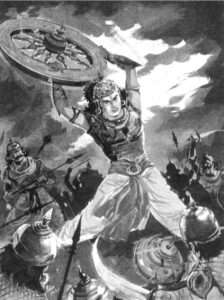
Sanjaya replied, “Steady your heart and listen. Indeed, many armies have perished, and mighty lords have been dissolved by Time. Drustadyumna, in retaliation, broke the bow of his adversary and showered arrows upon Salya. Seeing him wearied, the youthful lion Abhimanyu hastened to his aid and struck at Salya with renewed vigor. At Duryodhana’s command, Durmukha, Dussaha, Durmarshana, Satyavratha, Chitrasena, Purumithra, Vivimsathi, and Vikarna assailed Drustadyumna with simultaneous volleys, yet he withstood them all single-handed. Meanwhile, Nakula and Sahadeva were compelled to confront their maternal uncle, Salya, king of Madra, who fought on behalf of the Kauravas. Though opposed in battle, Salya marveled at the chivalry of his youthful nephews. Such was the irony of fate that affection yielded to duty, and love gave way to the stern demands of war. They rained arrows upon him, while Drupada and Virata came to their support. The sun stood high at midday as the struggle raged with unrelenting fury.
Then Bheemasena, tempestuous as a storm, brandishing his mace, drove his chariot toward Duryodhana and declared that the war must be concluded that very day. In wrath, he struck down the Kaurava soldiers who barred his path. At his fury your sons trembled, said Sanjaya. The king of Magadha, skilled in mace combat, was sent forth against Bheema. With bounding zeal, he entered the fray, while Bheema, leaping like a swelling tide, smote the elephant forces with his mighty mace, resembling Indra of old who sheared the wings of mountains. His roar scattered the elephants and drew praise from the celestial spheres. Unrestrained he strode across the battlefield, guarded on either side by Nakula and Sahadeva, supported by Drustadyumna, Abhimanyu, and the sons of Droupathi, who dispersed the elephant ranks with piercing shafts. Sataneeka, son of Nakula, felled elephants with his spear. The king of Magadha, mounting his trusted elephant, rushed against Abhimanyu; but with a single arrow Abhimanyu slew the king, and with another struck down the beast, so that both fell lifeless to the ground. Drustadyumna, wielding arrows tipped with eight keen points, wrought terrible havoc among the elephants, for once released in anger they seldom spared either man or beast. Such was his dreadful art, said Sanjaya.
Yet the blind monarch’s concern lay not in destiny but in bewilderment. He could not comprehend how vast numbers and formidable arms failed to yield swift triumph. Instead of examining the frailty of their cause, he cast the burden upon fate. His partiality remained unshaken, his cunning unaltered; searching for excuses, he waited restlessly for a favorable turn of war that would not come.

