This is an article series. Please read all previous articles before reading this article. The URLs for all previous articles are located in the SPECIAL THOUGHTS section.
Previously, we had learnt that Indra is the highest among all the Baahya Prapancha Devata-s. Baahya Prapancha refers to the outer world. As we had seen earlier, Ganapati, Vishvaksena and the Devata-s in level 19 and below are referred to as Bhootaabhimaani Devata-s, since they are Abhimaani-s for the primordial elements. Most of the Devata-s in level 18 and above are Indriya Abhimaani Devata-s. Be it the Indriya-s or the primordial elements experienced through the Indriya-s… they are outside of the Jeevaatma and we can reference them specifically. Therefore, they are categorized as Baahya Prapancha Devata-s.
Moving up higher, the Devata-s in Level 7 and up are referred to as the Aantarika Prapancha Devata-s. Here, there seems to be an order of hierarchy within hierarchy. For example, when we go to a movie theatre or a stadium, the tickets we buy will have a row number and a seat number… such as A-1, A-2, A-3… B-1, B-2, B3… C-1, C-2, C-3 and so on. Similarly, the hierarchical Levels 7 through 3 have 100 “seats” in each level. Each seat or position has a specific name. However, let’s focus on the positions 100, 99 and 98. Why start with 100 and not 1? We’ll learn about it in future.
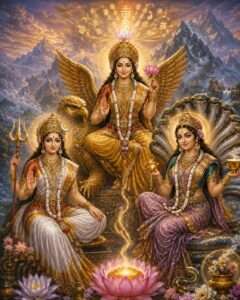
The Devata in the 100th position in level 7 is referred to by the name “Suparni”, Devata in the 99th position in the same hierarchical level is referred to as “Vaaruni”. And, the Devata in the 98th position in the level 7 is referred to as “Parvati”. Among the above, I’m sure that most of us have heard the name “Paarvati”, who is the consort of “Shiva”. But most Hindu’s will not have heard of “Vaaruni” and “Suparni”. Vaaruni is the consort of Shesha, the one on whom Vishnu is seen reclining). And Suparni is the consort of Garuda, who is Vishnu’s Vaahana. Here in, Suparni (100th position in level 7) is superior to Vaaruni (99th position in level7) who is superior to Paarvati (98th position in level 7).
Earlier, we learnt that each of the Pancha Bhoota-s (5 primordial elements) and each Indriya associated with that particular primordial element has an Abhimaani Devata. These Devata-s are at a lower level in the hierarchy, and Indra is the overall Abhimaani Devata for all Indriya-s. Similarly, Suparni, Vaaruni, and Paarvati are the Abhimaani Devata-s for the Tanmaatra-s i.e., Shabda (sound), Sparsha (touch), Roopa (form), Rasa (taste), and Gandha (smell), though there are individual Abhimaani Devata-s for each Tanmaatra at lower levels in the hierarchy. In other words, the Devata-s in higher hierarchical levels are Abhimaani Devata-s, sort of at a directorial level, for everything that the various Devata-s below them have Abhimaana over. This is symbolically shown as all the Devata-s offering up their strength to Durga Devi, an Avataara of Paarvati.
In addition, Suparni, Vaaruni, and especially Paarvati are Abhimaani Devata-s for Vaak Tatva. The Sanskrit word Tatva means “Fact”. The English word “That” seems to have originated directly from the Sanskrit word “Tat,” which means “That”. So, “Tatva” would mean something like “Thatness” … or more simply a “Fact”. Further, the Sanskrit word “Vaak” refers to “Vocal,” i.e., the words we speak. Earlier, we had learnt about Vaak Indriya, i.e., the vocal organs. It involves everything that is necessary to be able to speak, such as the abdominal muscles, the diaphragm, the lungs, the vocal cords, the facial muscles, the tongue, and everything else in between. However, the actual words spoken are to be formed in the “manas” (mind), which functions in unison with the other internal faculties, Buddhi (intellect), Ahankaara (awareness of the self), Chitta (memory) and Chetana (super-consciousness).
In the ancient Vedic Shaastra-s, the great Rushi-s have opined that one is considered really fortunate if he/she can express his/her thoughts in words. If we think deeper into this, we realize that a thought is like a seed with so much potential. It takes such a short time for a thought to occur in the mind. But to express them precisely in words is an extremely difficult task and takes way too long. Take, for example, the words of Shree Krishna in Bhagavad Gita, Chapter 15, Verses 15-18. We had learnt earlier that the quintessence of the entire reality of the Vedic way of life is captured in the verses 15-18 of Chapter 15 of Shreemad-Bhagavad-Gita, and started elaborating on it. After several articles spanning over 100 pages, we still have not reached a point where we can understand why the aforesaid verses are the quintessence. It will take us several more articles and pages to get a clearer picture.
Coming back to the topic of thoughts transforming to words, the sound originates in its subtlest form at the Naabhi (Navel or the Belly Button). This aspect of Paarvati is referred to by the name Paraa. The sound comes up to the heart/chest and expands further, gaining the basic energy to force out through the vocal cords in the throat and the mouth. This aspect of Paarvati is referred to by the name Pashyanti. The sound comes up to the vocal cords in the throat. This is where the words get interlaced with all the intonations, stress, emphasis, and/or Swara-s (musical notes) necessary for effective communication. This aspect of Paarvati is referred to by the name Madhyamaa. And finally, the sound is actually spoken out as words using the aid of tongue, cheek, and facial muscles. This aspect of Paarvati is referred to by the name Vaikhari. In many languages of Indian origin, a great orator is often lauded as a person with great “Vaak Vaikhari”. This expression is in reverence to Paarvati, the Devata whose Anugraha on the orator has enabled the transformation of great thoughts into great words with commendable intonations and emphasis.
As popularly known, Paarvati is the mother of Skanda (level 8 in the hierarchy) and also Ganapati (level 18 in the hierarchy). But what’s not so popular is the fact that Paarvati is the Guru for Indra. We seem to understand this, but we don’t realize we understand it until our spiritual mentor points it out to us. Annually, we perform Swarna Gauri Vrata on the 3rd Tithi of Shukla Paksha of Bhaadrapada Maasa. On this day, we make a thread with 14 knots, invoke Paarvati in her Swarna Gauri form into the 14 knots in the thread and tie it in our wrist. Now, we have already learnt that Indra is the Abhimaani Devata for our hands. The thread tied in the hand is to be taken with the thought “May mother Paarvati guide Indra in all the actions that happen through our hands”. This should make sense because, as had been explained earlier, Karma has 3 components to it i.e., Manasaa (involving the mind), Vaachaa (involving the words), Kaayaa (involving the body and the Karmendriya-s). The thought of doing a certain Karma sprouts first in the mind. This thought further manifests into the words as appropriate for that particular Karma. And the hands and other Karmendriya-s will follow the instructions from the mind and guidance from the words spoken while doing that particular Karma.
As mentioned earlier, Agni is the Abhimaani Devata for our Vaak Indriya (vocal organ). Agni can be warm and soothing when we maintain a distance and ensure that the flame is contained and controlled. But the flame will burn us if it becomes too large and/or if we try to get too close to it. Thinking along the same lines, Paarvati is the Abhimaani Devata for Vaak Tatva. The words we speak are graced by Swarna Gauri, the words become golden. But, when graced by Durga, the words we speak can become immensely vitriolic, hurtful and scar the mind.
My take is that the word Vaaruni means “something about Varuna”. Varuna refers to something that covers us up or engulfs us… such as how the darkness engulfs us as the sun sets. We can think of Varuna as Aavarana i.e., a covering or enclosure. Varuna, being Abhimaani Devata for the night, covers us with his protective embrace as the night falls. Vaaruni, being several levels higher than Varuna in the hierarchy, is several levels more compassionate. When she embraces us with Vaatsalya, our words will be filled with humility.
The word “Parna” means “leaf”. In the philosophical context, “Parna” refers to the Vedic wisdom. Sruva, the ladle used to offer ghee to Agni in Havan, also looks like a leaf… thus implying that the Vedic wisdom we received is being offered to God in the Agni. I’ve also seen some priests offering ghee to the Agni using a mango leaf. Vedic wisdom gives us the ability to pursue spiritual upliftment and seek liberation from the cycle of birth/death. So, the word “Parna” also refers to Moksha and offerings in Agni through Parna is a symbolic gesture of our desire to seek Moksha. Thus, the word “Suparni” means the one who is adorned with Vedic wisdom and demonstrated eligibility for Moksha.
The word “Parna” also refers to a feather. Feathers are what give the birds the ability to fly. Thus, Suparni means the one endowed with great feathers, the feathers of wisdom which bestow the ability to fly high. Indeed, Suparni has demonstrated her eligibility for Moksha. And therefore, when this universe gets recycled upon completion of Brahma’s 100 years, Suparni will attain Moksha. And when she attains Moksha, the 100th position in level 7 will become vacant. In the future, when the universe is again created afresh… Vaaruni, who is in the 99th position in level 7, will be promoted to the 100th position. Similarly, Paarvati will be promoted from the 98th position in level 7 to the 99th position in the same level. All other Devata-s in this level advance one step further. This results in the 1st position in level 7 becoming vacant. This spot will be filled by a Devata who has demonstrated her ability and eligibility to ascend to the 1st position in level 7, thus completing all 100 positions in level 7.
May our words be guided by the wisdom bestowed upon us by Suparni, filled with humility bestowed upon us by Vaaruni and warmth bestowed upon us by Paarvati.