For a long time, tyres occupied an odd position in the construction-equipment business. Everybody needed them, few wanted to talk about them until something went wrong, and purchasing decisions often revolved around price, availability and the promise of reasonable life. The tyre was essentially treated as a consumable attached to the machine rather than as part of the machine’s productivity equation.
That is becoming a rather dated way of looking at the market.
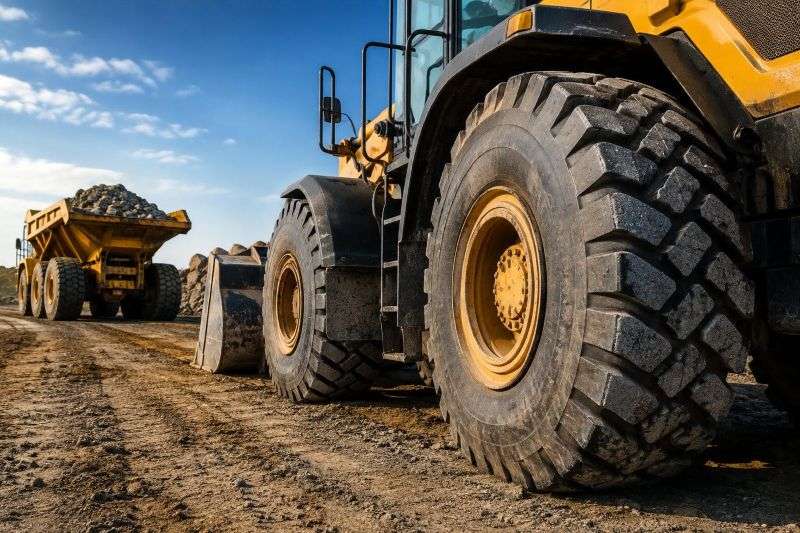
As construction and mining equipment gets larger and is worked harder, tyre performance increasingly affects the economics of the machine itself. Wear, heat, traction, load carrying capability and downtime can influence the cost of keeping equipment productive. A tyre that lasts longer or reduces unscheduled stoppages can have a very different economic value from one that merely costs less when purchased.
That makes the tyre presence at bauma CONEXPO INDIA 2026, being held from September 15 to 18 at India Expo Centre, Greater Noida, more significant than the number of exhibitors alone suggests. BKT, CEAT, JK Tyre, Mahansaria Tyres, MRF, Maxam, Techking and Yokohama Off-The-Road Tires India are among the names participating, alongside Continental Belting and ContiTech India. The exhibition itself brings together construction machinery, mining machinery, construction vehicles and related equipment.
The interesting question, therefore, is not who has brought the biggest tyre to Greater Noida. It is who is positioning itself for the next phase of India’s construction, infrastructure and mining equipment cycle, where the tyre increasingly has to justify itself in terms of machine productivity rather than simply purchase price.
BKT Bet
BKT perhaps offers the clearest example of an established Indian tyre maker trying to stretch its off-highway proposition through scale. The company is continuing with additional investment and debottlenecking aimed at taking its OHT manufacturing capacity to around 425,000 tonnes annually, reinforcing a business that has become central to its global positioning.
The strategy is significant because the OHT market is not a single tyre market. Mining, construction, quarrying, agriculture and industrial applications impose very different demands on rubber, casing strength, heat management and tread performance. The more applications BKT addresses, the more the challenge shifts from simply adding capacity to ensuring that the additional capacity earns its keep.
Its latest reported full-year numbers provide an interesting counterpoint. In the fourth quarter of FY2025-26, BKT’s standalone revenue was about Rs 2,894 crore, while OHT sales volume stood at 85,820 tonnes. Revenue increased modestly year-on-year and OHT volume grew, but EBITDA and net profit declined. For BKT, therefore, the next phase is not merely about becoming bigger. It is about converting scale, product breadth and application knowledge into consistently stronger returns.
CEAT Gambit
CEAT is taking a rather different route into the same territory. Instead of building the entire proposition organically, it has used acquisition to accelerate its move into the global off-highway construction tyre and tracks business.
The company’s acquisition of the Camso construction-equipment bias tyre and tracks business from Michelin for around $225 million was completed in September 2025. The transaction brought with it two manufacturing facilities in Sri Lanka and access to a global customer base that includes more than 40 international OEMs and premium OHT distributors.
That changes CEAT’s proposition considerably. The company is no longer approaching construction tyres simply as another category to be added to a broad tyre portfolio. It has acquired specialist capabilities, manufacturing assets and customer relationships that can potentially shorten the distance between CEAT and some of the more specialised global off-highway markets.
The real test now is integration and execution. Acquisitions can provide a shortcut into a market, but they do not automatically create the economics of a successful business. CEAT’s progress in knitting the acquired business into its larger global strategy will be worth watching.
JK Push
JK Tyre arrives from yet another direction, with manufacturing investment and technology providing much of the story.
The company’s FY2025-26 consolidated revenue rose to Rs 16,384 crore, up 11 percent, while EBITDA increased 25 percent to Rs 2,089 crore and profit after tax rose 50 percent to Rs 774 crore. More importantly for the longer-term construction and commercial vehicle story, the company has been putting substantial capital behind capacity.
Projects worth Rs 1,400 crore for PCR and TBR capacity enhancement have been commissioned, while another Rs 1,130 crore commercial tyre expansion is under implementation. The board has also approved a further Rs 4,980 crore of phased capacity expansion.
There is a technology dimension as well. JK Tyre has introduced a tyre buffing and grinding machine at NATRAX, while its technology and innovation operations continue to support product development and manufacturing improvements. The company’s proposition at bauma, therefore, is less about making a dramatic OTR claim and more about demonstrating how a large Indian tyre manufacturer is strengthening its industrial and technology base for increasingly demanding applications.
Yokohama Move
If BKT represents organic expansion and CEAT acquisition-led acceleration, Yokohama’s India strategy provides another interesting signal: global OTR capacity is being built in India with a long-term horizon.
Yokohama Rubber is investing $130 million in a greenfield OTR tyre plant at Gopalpur in Odisha. The site covers approximately 460,000 square metres and is planned to have annual capacity of 9,150 tonnes of rubber weight. Production is scheduled to begin in the third quarter of 2028.
The plant is intended to manufacture tyres for mining and construction machinery and forms part of Yokohama’s broader effort to strengthen its global OTR network.
That matters because it places India inside a larger global manufacturing strategy rather than treating the country simply as another sales market. It also suggests that international tyre companies increasingly see India not just as a place where construction and mining equipment is being consumed, but as a location from which specialist products can be manufactured for wider markets.
Specialist Play
Around these larger strategies sits a growing group of specialist players that makes the market more interesting than a simple contest between the traditional Indian tyre majors.
Mahansaria Tyres, through its Ascenso brand, is among the specialist names building a stronger presence in mining, earthmoving and other demanding off-highway applications. Techking brings another international OTR specialist presence focused on mining, construction and quarrying, while Maxam adds an established earthmover and mining tyre portfolio.
MRF is also part of the exhibition’s tyre line-up, reinforcing the breadth of Indian participation. Continental Belting and ContiTech India add another major international presence to the gathering, although their presence should be viewed simply as part of the wider industrial ecosystem rather than forcing them into an off-highway narrative they do not necessarily want attached to their India positioning.
The significance of this expanding field is easy to miss. A market becomes strategically interesting when companies begin approaching it from different directions rather than merely copying one another. That is increasingly what is happening in India’s specialist tyre business.
Machine Economics
The larger story emerging from bauma CONEXPO INDIA 2026 may therefore have little to do with tyre size and a lot more to do with machine economics.
BKT is adding capacity and deepening its OHT manufacturing base. CEAT has used acquisition to accelerate entry into global specialist markets. JK Tyre is putting substantial capital into manufacturing capacity while strengthening technology. Yokohama is establishing a sizeable greenfield OTR manufacturing operation as part of a global network. Around them, specialist players are making the market more application-driven.
For equipment manufacturers and fleet owners, this should eventually make the tyre conversation rather more sophisticated. The cheapest tyre at the point of purchase is not necessarily the cheapest tyre to run. Life, downtime, productivity, fuel efficiency, application suitability and replacement cycles all sit somewhere inside the real cost equation.
That is where the tyre industry may be heading, and it is also why its presence at bauma CONEXPO INDIA 2026 deserves more attention than it normally receives.
India’s construction and mining equipment market is becoming too demanding for the tyre to remain an afterthought. The black round object at the bottom of the machine may finally be getting its place at the top table.