

Beijing 1967: Bharat’s Diplomatic Humiliation
Every time the Congress party and its leadership attempt to lecture Bharat about patriotism, sovereignty or accuse Prime Minister Narendra Modi of having “surrendered to America”, I am compelled to revisit history. Not history manufactured through political speeches, but history documented in painful detail.
This is precisely why I feel the Congress party’s spectacular decline in today’s political landscape of Bharat is not accidental. It is the consequence of decades of hypocrisy, diplomatic failures and repeated betrayals of national interest.
One such shameful episode unfolded in 1967 under Prime Minister Indira Gandhi’s leadership.
Long before the current generation of Congress leaders began accusing others of compromising Bharat’s interests, two young Bharateeyan diplomats, K. Raghunath and P. Vijay, became victims of one of independent Bharat’s greatest diplomatic humiliations at the hands of Communist China.
The world was then witnessing the violent phase of China’s Cultural Revolution. Mao Zedong had unleashed his notorious Red Guards, who had virtually become an uncontrolled militia enforcing ideological extremism. Foreign diplomats stationed in Beijing frequently faced harassment, but Bharat’s experience was particularly brutal.
China falsely accused the two Bharateeyan diplomats of espionage over a routine photograph. There was no evidence whatsoever.
Yet, on a Beijing airport runway, hundreds of Red Guards descended upon them. They were dragged by their necks, punched, kicked, stripped, and publicly humiliated before international observers.
The violence did not stop there.
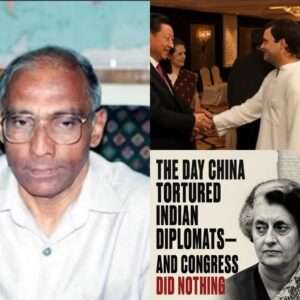
Other Bharateeyan embassy officials who rushed to assist their colleagues were also assaulted. Third Secretary C.V. Ranganathan was forced to bow his head while the mob attempted to make him kneel before them. Red Guards waved Mao’s little red book and shouted slogans as if they were celebrating a conquest.
The image was devastating: representatives of a sovereign nation being physically assaulted while their government watched helplessly.
What was New Delhi’s response?
Paralysis.
Indira Gandhi stood in Parliament and admitted that it was “not possible at this stage to outline the steps the Government might take.”
Imagine such a response today.
Can anyone visualise Prime Minister Narendra Modi merely expressing helplessness if Bharat’s diplomats were beaten on foreign soil?
There would be international outrage, diplomatic retaliation and immediate accountability.
But under Congress rule, indecisiveness had become a governing principle.
This was not an isolated incident either.
The roots of this weakness can be traced back to Jawaharlal Nehru’s disastrous China policy. His romanticised “Hindi-Chini Bhai Bhai” doctrine blinded Bharat to Beijing’s expansionist ambitions. The catastrophic 1962 war exposed Bharat’s lack of military preparedness and strategic foresight.
Thousands of Bharateeyan soldiers paid with their lives because political leadership chose idealism over realism.
Yet Congress never truly learnt from its mistakes.
This is why I feel the great betrayal and hypocrisy of Congress eventually led to its ruin in Bharat’s contemporary political landscape. A party that ruled Bharat for nearly six decades repeatedly failed to defend national interests, but today behaves as though it possesses a monopoly over nationalism.
The contradictions become even more glaring in later years.
In 2008, the Congress party signed a controversial Memorandum of Understanding with the Communist Party of China. The agreement, signed during the UPA era, saw senior Congress leaders, including Rahul Gandhi, engaging directly with the Chinese Communist Party.
The details of that understanding have never been fully disclosed to the Bharateeyan public.
Ironically, the same party now questions the patriotism of its political opponents.
Political amnesia, however, no longer works in Bharat.
Citizens today are better informed and more aware of historical records than ever before.
Congress leaders, particularly those belonging to the dynasty, would do well to introspect before throwing around phrases like “surrendered to the US”. Their own legacy is littered with instances of strategic miscalculations, diplomatic embarrassments and policy failures that compromised India’s global standing.
Nations are not weakened by external enemies alone. They are weakened when their own leaders repeatedly fail to defend national dignity.
The 1967 Beijing humiliation remains a permanent reminder of what happens when indecision replaces leadership and appeasement replaces national resolve.
History has delivered its verdict.
The people of Bharat have delivered theirs too.
Congress did not lose relevance because of one election or one leader. It lost credibility over decades by betraying the very national interests it now pretends to champion.
Before lecturing others about patriotism, Congress must first confront its own record.
History remembers everything, even if dynasties choose to forget.