



The grievous words borne by Sanjaya, declaring the fall of the revered preceptor Dronacharya, descended like a thunderbolt upon the mind of the blind monarch Dhritarashtra, whose heart trembled and whose thoughts were cast into disarray, for he who had long stood as the pillar of Kuru might now lay fallen upon the field of ruin. With a voice shaken by disbelief and sorrow, the king addressed Sanjaya, extolling Drona as supreme among wielders of weapons and celestial missiles, unmatched in resourcefulness, radiant in valour, and adorned with chivalry beyond compare, and he wondered in deep anguish how the warriors of Panchala could have dared to confront such a master, how his mighty bow could have been broken, how his chariot shattered, how his charioteer cast down, whether he had been taken unawares, or wearied by relentless battle, or overcome by neglect of others’ prowess, or veiled by the shadow of fate, and whether indeed the son of Drupada, Dhrishtadyumna, could have slain so exalted a warrior, for such an end appeared less an act of men and more the inscrutable decree of destiny, which stands stronger than mortal strength.
Though the tidings struck him with piercing grief, Dhritarashtra lamented that his heart, hardened like unyielding stone, had not shattered into a thousand fragments, and in his anguish he likened the fall of Drona to the sudden collapse of the lofty Mount Meru, to the sun itself descending from the heavens, and to the vast ocean losing in an instant its immeasurable depth, for Drona, he declared, was a transcendent treasure of bravery, a master of wisdom akin to Brihaspati, and the guide of princes whose fall had come not by fair contest but through the treachery born of his own sons’ designs. In sorrow he reflected that the sacrifice of one’s life for the gain of others is counted the highest fortune, yet the memory of Drona’s splendour now returned like a relentless flame, intensifying his grief beyond the sorrow of the event itself.
The king, his mind clouded by grief and suspicion, conjectured that when even the foremost archers fled before Drona’s might, perhaps Arjuna had, by subtle stratagem, restrained the preceptor for a fleeting moment, enabling the fierce Dhrishtadyumna to strike, or that Drona had been overwhelmed by multitudes as ants swarm upon a serpent, and thus brought down by sheer number, and in this bewilderment he cried out in despair, asking who now remained to uphold the cause of the Kauravas. Trembling in every limb, he foresaw with dread the advancing force of Yudhishthira, growing like the rising sun, and wondered who could restrain him, for Drona, once the dark barrier against that light, had vanished; likewise, he feared the impetuous might of Bhima, raging like a wild elephant, and the thunderous twang of Gandiva in Arjuna’s hands, whose arrows fell like lightning, leaving none able to withstand their fury.
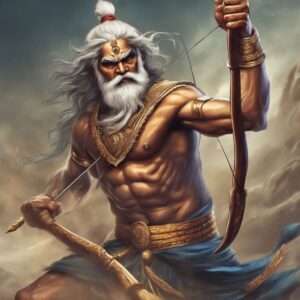
He lamented further that the guardian of their confidence, the trainer of princes, and the destroyer of enemies now lay unprotected amidst the vast army he had once commanded, and questioned how such a calamity had come to pass, for with the fall of Drona he foresaw the rout of the fourfold Kaurava forces and the swift ascent of fortune to the sons of Pandu. Reflecting upon Ashwatthama, he surmised that the mighty son must have been engaged elsewhere or restrained by Arjuna at that fatal hour, else the slaying of his father would not have been possible, and imagining the grief of the son, he himself was overwhelmed, declaring to Sanjaya that his mind had lost its steadiness and that he could hear no more, whereupon despair seized him and he sank into a faint, while the women of the inner chambers raised cries of alarm and hastened to restore him.
Regaining consciousness after a time, yet still trembling and unsteady, Dhritarashtra spoke again with heavy insight, acknowledging the formidable might of the Pandava host, guided by Krishna, the incarnation of Narayana, and led in battle by Arjuna, the embodiment of Nara, whose union was divine and invincible, and he recounted the prowess of Nakula and Sahadeva, the valour of Satyaki, the strength of Uttamauja, the courage of Dhrishtaketu, the steadfastness of Shikhandi, the fierce brilliance of Abhimanyu, the loyalty of Chekitana, the invincibility of the sons of Draupadi, the might of the Kekaya princes, the fury of Yuyutsu, the destined strength of Dhrishtadyumna, and the terrible power of Ghatotkacha, acknowledging that against such an assembly even the greatest warriors would falter.
He proclaimed that Bhima alone could shatter armies with his mace, that Yudhishthira’s righteousness was itself an invincible weapon beyond the reach of gods and demons, and that the supreme refuge of the Pandavas lay in Krishna, the divine protector born in the Yadava line, whose deeds from childhood proclaimed his cosmic nature, and thus he perceived that the unity of Krishna and Arjuna was no mere alliance but a divine mystery, two forms of a single eternal light, rendering the Pandavas unconquerable, and he confessed with bitter clarity that his own blindness and failure of judgment had brought ruin upon his house.
At last, restraining his grief with effort, the king declared that with the fall of Bhishma and Drona, none remained to oppose Arjuna, and that the destruction of the Kauravas was now inevitable, yet, though sorrow weighed heavily upon him, he resolved to hear the truth without ornament or concealment, and thus commanded Sanjaya to recount in full the battle of Dronacharya, even as his heart continued to sway between grief, memory, and foreboding, like a flame trembling in a restless wind.

