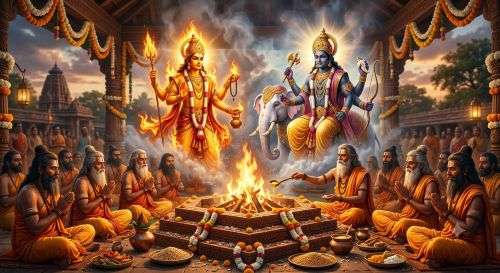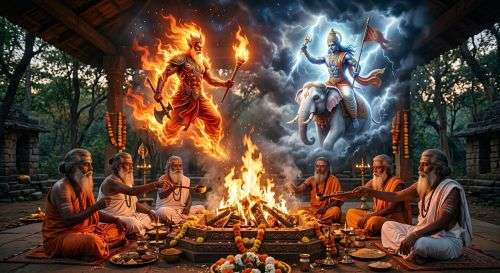
The sage Kakṣīvanta, steeped in contemplative vision, raises a profound and timeless inquiry as he invokes the twin deities, the Aśvins, through a rich tapestry of metres—Gāyatrī, Kakup, Kāvīrāt, Nāstarūpī, Tanuśīra, Uṣṭnik, and the expansive Bṛhatī. His prayer is not merely an act of devotion, but an intellectual and spiritual exploration into the very nature of divine accessibility. He asks with humility and philosophical depth: what form of worship truly reaches them, and which among the twin divinities bestows grace upon the seeker? Such questioning reflects the early Vedic temperament, where knowledge and reverence move together, and where inquiry itself becomes a sacred offering.
The sage recognizes the limitation of human understanding before the vastness of divine glory. Without comprehending the full measure of the Aśvins’ cosmic functions, how can one rightly compose a hymn? Yet this uncertainty does not lead to silence, but to a deeper surrender. The Aśvins, described as omniscient and compassionate, are invoked not only as recipients of praise but as guides who themselves illuminate the path of proper worship. This reveals a refined spiritual insight: that divine knowledge is not constructed solely by human effort but is graciously revealed by the divine to the receptive mind.
Kakṣīvanta affirms that true seekers turn only to the Aśvins, the wise and discerning physicians of the cosmos, who do not respond to hostility or ignorance but reveal themselves to those who approach with sincerity. Their wisdom is both scholarly and intuitive, embodying the union of rational clarity and spiritual intuition. In this way, the hymn reflects a scientific temperament, where disciplined thought and observation align with reverence, and where the laws of nature are seen as expressions of divine intelligence.
The offering of Soma is described with layered symbolism—at once potent, invigorating, and transformative. The Aśvins are invited to partake of their rightful share, fulfilling their cosmic duties. Soma here represents not only a ritual substance but also the essence of vitality and consciousness, linking the physiological with the metaphysical. The act of offering becomes a mutual exchange: humans offer devotion and clarity, while the deities bestow strength, health, and insight.
The sage recalls the lineage of devotion, invoking figures such as Suhastya, the son of Ghoṣā, and the revered Bhṛgu, who had earlier praised the Aśvins and received their grace. Kakṣīvanta aligns himself with this tradition, seeking continuity in sacred knowledge. The reference to Rujāśva, who regained his sight through hymns in Gāyatrī Sāman, illustrates the restorative power of sound and rhythm, suggesting an early understanding of the therapeutic and psychological effects of structured chant.
The Aśvins are further praised as protectors and benefactors, embodying both nurturing and corrective forces. They safeguard devotees from harm, remove adversity, and establish conditions of prosperity. The imagery of cows and calves reflects the agrarian and ecological consciousness of the Vedic world, where harmony between life forms is essential for sustenance. The prayer that cows without calves should not depart signifies a desire for completeness and continuity in life’s cycles.
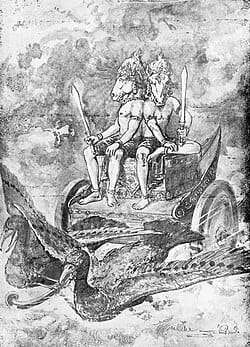
The chariot of the Aśvins, described as swift as thought and radiant with unseen शक्ति, becomes a symbol of transcendental movement—beyond physical constraints, yet deeply connected to the rhythms of nature. Though said to be without horses, it conveys the idea of गति driven by inner ऊर्जा, hinting at a subtle understanding of motion beyond material mechanics. This imagery aligns with the Vedic vision of the universe as a dynamic interplay of forces, governed by both visible and invisible principles.
In the closing reflection, the sage expresses a desire to transcend sorrow, illusion, and miserliness—states that bind the human spirit. By invoking the Aśvins, he seeks not only material prosperity but also मानसिक clarity and ethical elevation. The prayer culminates in a holistic aspiration: for nourishment, protection, wisdom, and inner freedom. Thus, the hymn stands as a luminous blend of devotion, inquiry, and insight, revealing the Vedic mind as both reverent and rational, ever seeking harmony between the seen and the unseen.