Upadhyayula Lakshman Rao
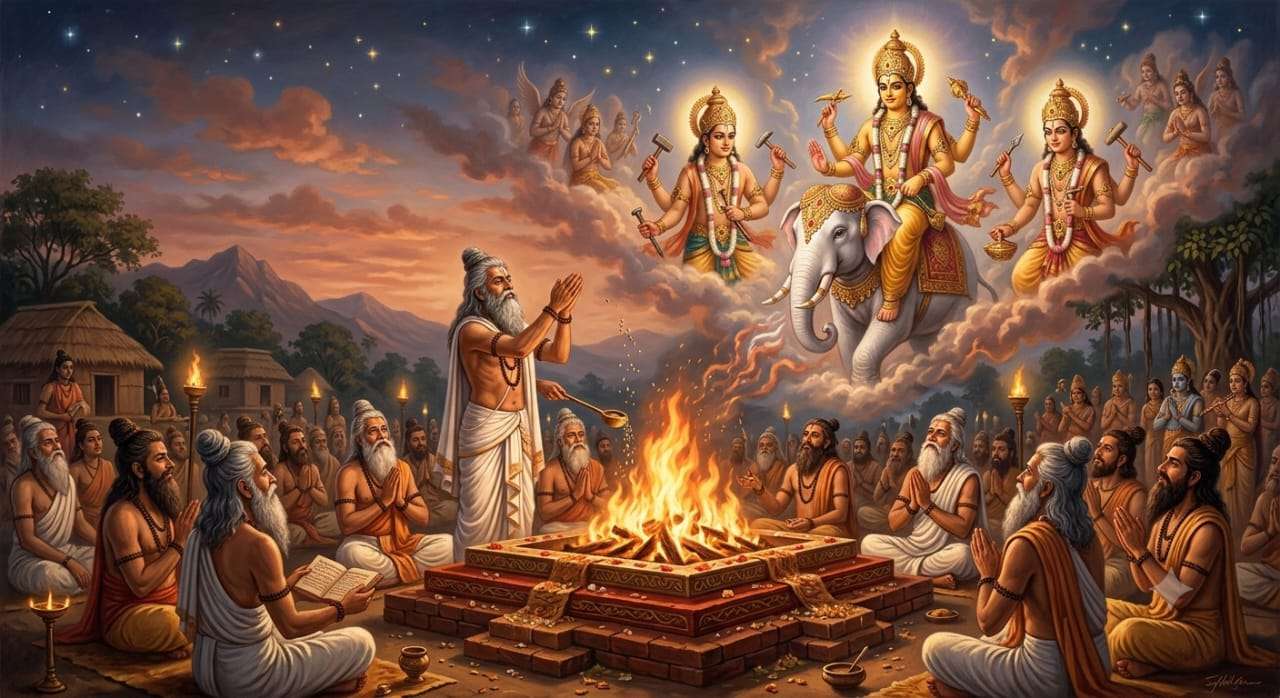
In the Tristubh cadence of the ancient hymns, the sage Parāśara invokes Agni with a vision both intimate and cosmic, where the rhythms of human life mirror the sacred operations of the universe. The prayer unfolds through symbolic parallels: as a devoted wife gently prevails upon her husband through harmony and persistence, so too do the oblations offered in ritual prevail upon the sacred fire, drawing forth its grace. The rays of dawn attend upon Uṣas with reverence, just as the fingers of the priest serve Agni in sacrificial rites, establishing a profound unity between natural phenomena and human action.
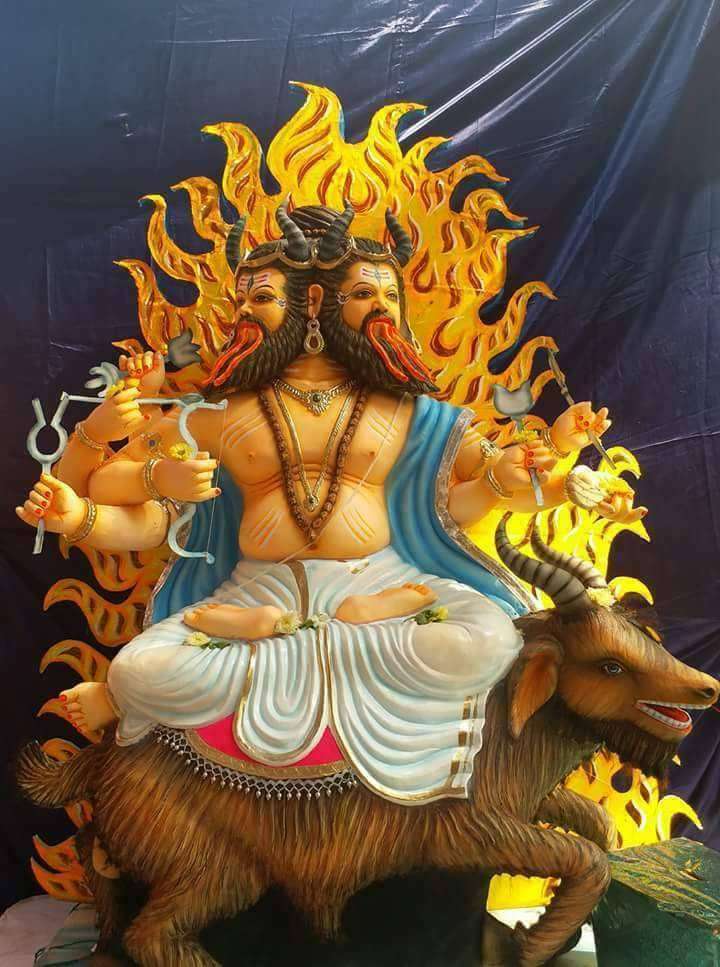
The lineage of the Angirasas emerges as a radiant thread within this sacred tapestry. They are remembered not merely as ancestors, but as discoverers of the luminous path, creators of sanctified spaces wherein Agni could dwell and flourish. Through disciplined sacrifice, they relinquished desire, kindled the fire of knowledge, and attained both material abundance and spiritual wealth. Their offerings nourished both humanity and the divine, forging a mutual ascent wherein gods and mortals were sustained through shared devotion. In their vision, Agni was not only worshipped but realized as the very principle of transformation that animates all existence.
This understanding deepens as the hymn turns inward, contemplating the subtle energies that govern the human body. The vital force, divided into five currents, reflects the same cosmic order perceived in the ritual fire. The inward-moving energy, centered in the heart, chest, and head, governs inhalation and the reception of nourishment, impressions, and awareness, crystallizing experience into conscious vitality. The downward-moving force, rooted in the lower regions, regulates elimination and generative processes, serving as the body’s purifier and renewer. Between these flows, the equalizing energy resides in the navel, harmonizing digestion and assimilation, balancing opposing currents with quiet precision.
Ascending further, the upward-moving energy governs speech, expression, and the awakening of higher faculties, lifting consciousness toward refinement and clarity. Encompassing all is the pervasive circulating force, radiating through countless channels, distributing nourishment and information, sustaining coherence and vitality throughout the organism. This intricate system reveals the body itself as a living altar, where energies are offered, transformed, and redistributed in a ceaseless sacrificial cycle.
From this inner churning arises brilliance, a luminous vitality that fills the ritual space as well as the human frame. Agni becomes the emissary between realms, much like a trusted envoy sent by a king’s companion to a noble lord. The patrons, akin to the ancient seers, dispatch Agni toward the divine through their offerings, seeking communion with the radiant powers that govern existence. Yet this sacred exchange is not without tension; forces of discord, symbolized as jealous beings, attempt to disrupt the harmony, casting destructive impulses against the flow of devotion.
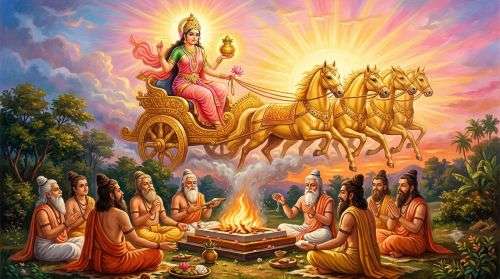
In this cosmic drama, Uṣas, the dawn, is envisioned as the daughter of Agni, inheriting her radiance from the father who kindles light in all realms. The sacred fire, established in ritual spaces, is tended daily with reverence, flourishing in both the external altar and the internal being. It becomes the source of nourishment, the bearer of fortune, arriving like a charioteer who bestows prosperity upon those who invoke it with sincerity. As rivers merge into the ocean, so do offerings converge into Agni, who assimilates them into a unified essence.
Yet the hymn does not shy away from human limitation. The insufficiency of material resources, the longing for shared abundance, and the appeal for divine wealth are expressed with humility. Agni is implored to transform nourishment into vitality, to kindle the digestive fire within, and to transmute essence into progeny, ensuring continuity and strength across generations. The ideal offspring is envisioned as vigorous, flawless, and devoted to sacred duties, embodying the continuity of the luminous tradition.
The imagery extends to the sun, the swift traveler who traverses the cosmos with the speed of thought, gathering fullness and distributing brilliance. Radiance itself becomes a garment, and the sustaining forces of harmony, represented by guardians of order, protect the sources of life, ensuring that nourishment flows abundantly. Agni, as the embodiment of wisdom, contains within itself all knowledge, sustaining a relationship with humanity that spans generations.
In a poignant reflection, the voice of the seeker acknowledges the encroachment of age, likened to shadows spreading across space. Yet even here, Agni is invoked as the knower of all conditions, the one who perceives decline before it manifests, offering guidance and continuity. The hymns, though many and varied in their praise of different divine aspects, converge upon a singular truth: the sustaining forces of life are manifold in expression yet unified in essence.
Thus emerges a vision where observation, imagination, and insight converge seamlessly. The sages perceived the universe not as fragmented, but as an interconnected web of energies, each sustaining the other through a silent exchange. Fire, in its many forms, becomes the central metaphor for this unity, linking physiology, ritual, nature, and consciousness. In this synthesis of subtle perception and disciplined inquiry, one finds an early harmony of scientific temperament and spiritual depth, where the exploration of life’s forces becomes both an act of devotion and a quest for truth.