



Hatisila Ganapati Temple is located at Hatisila near Chandrapur in Kamrup district, Assam, close to Guwahati. The temple lies within the ancient cultural landscape of Pragjyotishapura, a region historically associated with the Brahmaputra valley and the sacred geography of Nilachal Hills and Kamakhya traditions.
The temple has no exact recorded date or inscriptional evidence. Its origin is traditionally linked to early medieval Ganapati worship in Assam, which developed during the Kamarupa period (roughly 8th–12th century CE). The present structure is recent, while the sacred site itself is believed to be much older and originally centered around a natural rock formation considered holy.
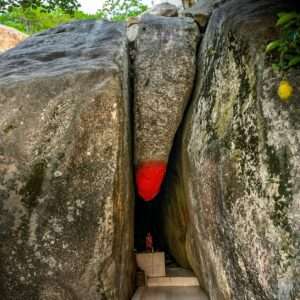
The presiding deity is Lord Ganapati (Ganesha), worshipped in the form of a naturally formed elephant-shaped rock. The name “Hatisila” comes from “Hati” meaning elephant and “Sila” meaning stone. The deity is regarded as Swayambhu (self-manifested). Devotees worship him as Vighnaharta, the remover of obstacles, seeking blessings for education, success, safe journeys, and prosperity.
The temple architecture is simple and natural, built around the sacred rock formation. There is no large structural complex; instead, small shrine elements, stone platforms, and basic prayer space have been added over time. The focus remains on the natural hill rock, which itself is considered the main sanctum.
The temple is part of the ancient sacred landscape of Kamarupa, where hills, stones, and natural formations were often worshipped as divine. Ganapati worship here is linked with Tantric and folk traditions, where Ganesha is seen as a protector of pathways and sacred spaces. The site likely began as a local tribal and folk worship place that gradually evolved into a recognized Ganapati shrine through continuous devotion.
Long ago, the region around Hatisila was covered with dense forests and rocky hills, and very few people traveled through it because the paths were difficult and often unsafe. One day, villagers and travelers began noticing a strange rock formation on a hill. The rock naturally looked like the head and trunk of an elephant. Some people believed it was just a natural shape, but others felt it carried a divine presence.
As time passed, a few travelers who rested near the rock began offering prayers before continuing their journey. They believed that when they prayed sincerely, their difficulties reduced and their journeys became safe. Slowly, word spread that the elephant-shaped stone was not ordinary but sacred.
Local tradition says that even wandering sages and seekers who meditated in the surrounding forests felt a strong spiritual energy at the place. They began worshipping the rock as Lord Ganapati, the remover of obstacles. From then on, people started calling the place “Hatisila” — the Elephant Stone of Ganapati.
Another popular belief says that during floods and difficult times in ancient Assam, people would come to this rock and pray for protection. Many felt their wishes were fulfilled, and the belief grew stronger that Lord Ganapati himself resides there in a self-manifested form.
Over generations, the simple natural worship slowly became a regular shrine. A small temple structure was later built, but even today devotees believe that the true deity is not the building but the ancient elephant-shaped stone itself, which continues to bless and protect those who visit with faith.
The most important festival is Ganesh Chaturthi, celebrated with special pujas, offerings, and devotional gatherings. Sankranti days are also considered highly auspicious for worship. During Bohag Bihu and Magh Bihu, devotees visit the temple for blessings of prosperity and well-being. Daily worship includes lighting lamps, offering flowers and coconuts, incense, and chanting Ganapati mantras.


