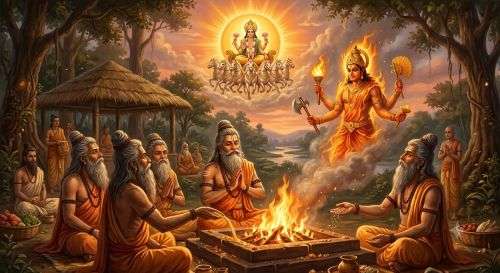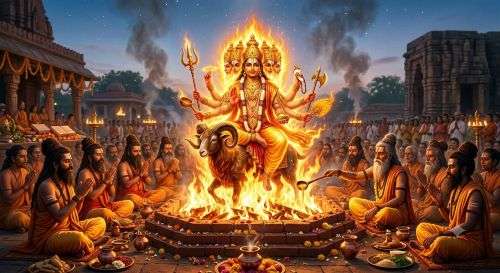
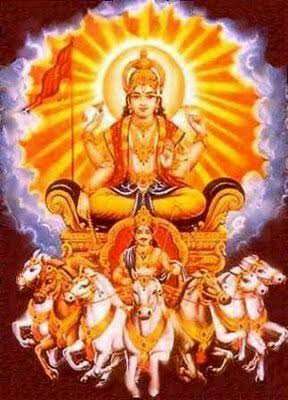
The venerable Kutsa, born of the illustrious lineage of Angirasa, raises his contemplative voice in the sacred verses of the Rigveda, composed in the stately cadence of Trishtubh chandas. His hymn to Surya is not merely an act of devotion, but a profound meditation upon the harmony of nature, the resilience of the human spirit, and the boundless unity of the cosmos. In his vision, faith becomes not passive reverence, but an active force that refines thought, elevates consciousness, and binds the individual soul to the universal order.
Surya, in the sage’s realization, is no mere celestial orb but the seer among gods, the eye of existence, and the regulator of time itself. Alongside Mitra, Varuna, and Agni, he sustains the rhythm of the worlds. Rising with an astonishing effulgence, his clustered rays spread across earth, sky, and the luminous heavens, filling all realms with vitality. He becomes the very soul of settlements and civilizations, the unseen force animating life and guiding the moral and natural order.
The sage beholds the tender relationship between Surya and Usha, where the sun follows the dawn as a devoted husband follows his beloved, with affection and sacred duty. This imagery, gentle yet profound, captures the cyclical rhythm of time and the inseparable interplay between light and awakening. The seekers, devoted to righteous deeds and refined rituals, approach the divine through varied forms of worship, yet all paths converge toward the same cosmic truth illuminated by Surya’s presence.
The rays of the sun, as described by Kutsa, are not merely beams of light but carriers of life and transformation. They absorb the waters, sustaining the eternal cycle of evaporation and rain, and display themselves in manifold hues, enriching the world with color and vitality. They respond to hymns of praise, as though conscious of human reverence, and stand as venerable forces that illuminate both the physical and spiritual realms. Vast and intense in their natural power, these rays are also restrained and moderated, ensuring the flourishing of agriculture, the balance of seasons, and the well-being of all living beings. In this restraint lies Surya’s sovereignty and benevolence—his glory shines not only in brilliance but in balance.
When these rays withdraw toward distant horizons, the world is gently enveloped in night, revealing the cyclical duality inherent in existence. Yet Surya, together with Mitra and Varuna, remains ever-present in the cosmic order, sustaining continuity even in apparent absence. His rays are eternal and unending, luminous channels that both reveal and conceal, bringing forth light and allowing darkness its rightful place in the rhythm of time.
In a deeper spiritual invocation, the sage calls upon Surya to dispel sin, to remove inconsistency and disorder from human life, and to guide beings toward righteousness. He invokes not only Surya, but also Mitra, Varuna, Aditi, the vast ocean, the nurturing earth, and the expansive sky, beseeching their united strength to protect and uplift humanity. This collective invocation reflects a profound awareness of interconnected forces, where divine, natural, and cosmic elements act in harmony.
Thus, within the subtle expressions of Kutsa emerges an astonishing synthesis of spiritual insight and observational wisdom. His hymn reflects an early scientific temperament, perceiving the interdependence of natural phenomena and the unity underlying diverse manifestations. The interplay of sun, water, earth, and sky is not described as isolated events, but as a coordinated system sustaining life. In this vision, the cosmos is not fragmented but whole, and human consciousness finds its highest fulfillment in recognizing and aligning with this unity.