



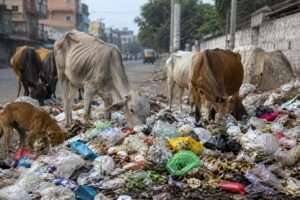
“Cities standing on heaps of garbage and animals swallowing polythene”
These days, cities are overflowing with garbage. Rotting heaps on the roadsides, foul smells permeating the streets, filth trapped in drains, and animals searching for food among them—this scene not only reflects the failure of the sanitation system, but also our collective social consciousness. Often, when sanitation workers go on strike in the city, the entire discussion is limited to the conflict between the administration and the workers. But behind this filth lies another major issue, one that society conveniently maintains silence on—polythene and its associated waste management.
Ironically, polythene is banned by law. The Municipal Corporation periodically issues fines, raids shops, and runs awareness campaigns. Yet, the most common item in every garbage dump in the city is polythene bags, packaging, and plastic waste. It’s natural to ask: how is this widespread when it’s banned? And if it’s so prevalent, why is the ban limited to paper?
In fact, instead of understanding the root of the problem, our system has accepted symbolic action as the solution. Municipal officials occasionally issue challans to shopkeepers, assuming their responsibility is fulfilled. Campaigns last for a few days, photographs are taken, news is published, and then the situation returns to normal. Almost every item in the market, from milk to pulses, snacks to vegetables, online delivery to household items, is available in some form of plastic or polythene packaging. This means that the same system that banned polythene has failed to provide alternatives to the market.
The truth is that polythene isn’t just a shopkeeper’s problem. It’s a result of our consumerist habits. The culture of convenience has accustomed us to such an extent that we consider carrying a cloth or jute bag a “goddamn habit.” Carrying a new bag for every small item has become the norm. The market thrives on this mentality. If consumers demand, there will be supply. Therefore, society cannot absolve itself of its responsibility by simply blaming the shopkeeper or the corporation.
The most worrying aspect is that this very polythene has now become a death trap for animals. The city may have been declared “animal-free,” but the reality is that cows, bulls, dogs, and other animals are seen wandering every street and garbage heap in search of food. They ingest polythene along with rotten food. According to veterinarians, kilograms of polythene have been removed from the stomachs of many cows during operations. This is not just cruelty to animals, but the height of our insensitivity.
The irony is that while society pays emotional respect to the cow by calling it “mother,” it abandons it to die on garbage heaps. Such a stark contrast between religious belief and actual behavior is rarely seen in any other subject. Animals are treated with sentimentality during festivals and events, yet their lives are sustained by garbage and plastic in the city streets. This is not only a failure of the administration, but also a moral failure of society.
The polythene crisis isn’t limited to animals. It has become a serious threat to the environment, health, and urban life. Plastic stuck in drains causes waterlogging during the rainy season. Rotting waste releases toxic gases. Burning plastic increases air pollution. Gradually, this microplastic is mixing with soil and water and reaching the food chain. Scientists are constantly warning that microplastic has now entered the human body as well. This means that the polythene, which we consider a convenience, could become a health crisis in the future.
The other side of the problem is the failure of waste management. In our cities, even today, waste from most households ends up directly on the streets or in dumping sites without proper segregation. Separating wet and dry waste has been advocated for years, but in practice, this practice is virtually nonexistent. Unless waste is segregated at the household level, recycling cannot be effective. Municipal corporations consider mere garbage collection to be cleanliness, whereas true cleanliness implies scientific waste disposal.
It’s also worth noting that while cities frequently announce bans on single-use plastic, industries and large brands remain largely unaccounted for. Most products sold in the market come in plastic packaging. If we truly want to eliminate polythene, cracking down on small shopkeepers alone won’t be enough. Large companies must also be forced to adopt alternative packaging. Unless changes occur at the production level, both consumers and shopkeepers will be left without a choice.
Additionally, the administration must realign its priorities. Cleanliness can’t simply be a photo campaign. The city’s sanitation system must be sustainable and technically robust. Solid systems for door-to-door collection, waste segregation, recycling units, composting organic waste, and safe disposal of plastic waste are essential. Imposing fines alone won’t solve the problem. Unless the system provides practical alternatives, restrictions will fail.
The role of education and public awareness is also crucial. Schools, colleges, and social organizations must focus on behavior change rather than simply running formal campaigns. If children are taught from an early age to use cloth bags, reuse materials, and protect the environment, the next generation can mitigate this crisis. Society must foster an understanding that cleanliness is not just the responsibility of sanitation workers, but of every citizen.
The need today isn’t just to rid the city of garbage, but to change mindsets. No city can be truly clean if citizens continue to throw garbage on the streets, markets continue to sell plastic, the administration continues to take superficial action, and society continues to allow animals to forage in the garbage.
We must acknowledge that garbage isn’t just filth; it’s the result of our habits. Polythene isn’t just a bag; it’s an environmental crisis created in the name of convenience. And animals rummaging through garbage aren’t just stray animals, but the silent questions of an insensitive society that, amid claims of development, has forgotten its basic responsibilities.
If we don’t wake up now, cities will become not just concrete jungles but heaps of plastic and garbage, where both humans and animals will be deprived of their right to a clean life. The dream of a clean city won’t be achieved simply by government slogans. It requires a confluence of administrative will, social responsibility, and personal discipline. Only then will cities be truly clean, animals safe, and the environment protected for the future.


