


The debate over reservations in India is not new, but from time to time, the issue returns to the forefront due to new circumstances and events. Recent controversies surrounding the University Grants Commission (UGC) regarding higher education and institutional policies have further intensified this discussion. While some believe that caste-based reservations have lost their relevance, a significant minority still considers them essential for social justice and equal opportunity. To understand this complex debate, it is essential to move beyond emotional reactions and seriously consider its historical, social, and economic dimensions.
First, we must understand the underlying spirit of reservation. Indian society has grappled with deep social inequalities for centuries. Certain sections of society were systematically deprived of education, resources, and a dignified life. This was not just a question of economic deprivation, but also of social exclusion and inequality of opportunity. Against this backdrop, the framers of the Constitution enacted reservations as a temporary measure to bring the disadvantaged sections of society into the mainstream and provide them with equal opportunities.
However, today’s India is vastly different from the India of 70–75 years ago. Education has expanded, urbanization has increased, and new doors of opportunity have opened up for the new generation. This is why some question whether the same policies enacted decades ago should remain in place. They argue that people from all castes are now employed in various fields, so caste should not be the sole basis for reservation. They also point out that even within the upper caste community, there are a significant number of economically disadvantaged people, for whom the lack of opportunities is just as real.
This argument is not entirely unfounded. In fact, economic inequality has become a major challenge in Indian society today. Many families do not fall into any reserved category, but due to financial constraints, they are unable to provide their children with adequate resources for higher education or preparation for competitive examinations. This raises the demand that economic status be the basis for reservation or assistance, so that assistance can reach those truly in need.
In keeping with this philosophy, the government has also established reservations for the economically weaker sections (EWS). This can be considered an important step, as it acknowledges that poverty is not limited to a single social class. However, the question remains: will providing reservations based solely on economic conditions be sufficient?
On the other hand, a strong argument in support of reservation is that social discrimination and inequality have not yet been completely eliminated. Numerous studies and social experiences show that some sections of society still lag behind in terms of education, employment, and social acceptance. Even though some people have progressed economically, the experience of discrimination based on social identity has not completely ended. This is why reservation for Scheduled Castes (SCs) and Scheduled Tribes (STs) is seen not only as a form of economic support, but also as a form of social representation.
Another important issue arises here—that of the “creamy layer.” This system applies to the Other Backward Classes (OBCs), under which economically advantaged families are denied reservation benefits. Many demand that this principle be applied to SC/ST categories as well, so that reservation benefits reach those truly in need. However, there is disagreement on this issue, as some experts believe that the impact of social discrimination among these classes is so profound that it cannot be ignored even if the economic situation improves.
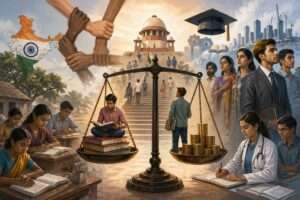
Concerns are often raised about reservations in medical and technical fields, claiming that they could impact quality. This is a sensitive issue, as these fields directly involve human life and safety. However, it should also be noted that ultimate competence and proficiency in any profession are determined by training, hard work, and experience. All students in medical colleges and other institutions undergo the same curriculum, examinations, and evaluation processes. Therefore, questioning quality based solely on reservations may be a biased approach.
Nevertheless, it must be acknowledged that the education system needs reform. If all students receive equal quality education at the primary and secondary levels, inequality in higher education may automatically decrease. Even today, there is a significant quality gap between government and private schools, which further creates a competitive imbalance. Therefore, alongside the debate on reservations, it is important to pay equal attention to improving the education system.
Another aspect is representation. In any democratic society, all sections of society must receive fair representation in decision-making bodies. Reservations serve as a means to this end. If certain sections of society are consistently left behind, it is detrimental not only to them but to society as a whole, as it increases discontent and inequality.
The most important conclusion of this entire debate is that reservation cannot be reduced to a simple dichotomy of “right or wrong.” It is a complex policy that demands changes according to time, society, and circumstances. A balanced approach would be to periodically review the current reservation system and ensure that its benefits reach those who truly need it.
Additionally, it is essential to strengthen scholarships, affordable education, coaching facilities, and other support schemes for economically weaker sections. This can ensure that no talented student is left behind simply due to a lack of resources.
Ultimately, the debate on reservations isn’t just a question of policy, but it shapes the kind of society we want to build. Do we want a society where everyone has equal opportunities, or one where historical inequality continues to impact new generations? The answer isn’t easy, but it’s clear that the solution lies not in one extreme, but in balance.
It’s time to rise above prejudices and consider this issue. Abolishing reservations altogether is not an immediate solution, nor is continuing it indefinitely without any changes. What’s needed is a policy that strikes a balance between social justice, economic equality, and quality. Only then can we envision an India where opportunities are truly equal and everyone can advance according to their potential.


