The Congress-led Opposition’s relentless obsession with Prime Minister Narendra Modi has now reached a stage where even India’s strategic diplomatic engagements are being viewed through the narrow prism of domestic political hostility. The latest example is the criticism surrounding Modi’s five-nation visit at a time when tensions in West Asia have disrupted global energy supply chains and triggered economic anxieties worldwide.
Ironically, the very Prime Minister who appealed to Indians to avoid unnecessary travel during a volatile geopolitical situation is now being accused of travelling abroad. Such criticism conveniently ignores a basic reality of global diplomacy — visits by heads of government are planned months, sometimes years, in advance. More importantly, these visits are not personal excursions; they are strategic investments in a nation’s long-term economic, technological, and geopolitical future.
The Opposition perhaps fails to understand — or deliberately ignores — that India today is no longer functioning with the defensive diplomacy of the past. Under Modi, India has embraced proactive global engagement aimed at securing markets, technology partnerships, energy security, supply-chain resilience, and geopolitical influence.
That is precisely what this five-nation tour was about.
The visit covered key strategic partners across Europe and West Asia, including Norway, Sweden, the Netherlands, the United Arab Emirates, and Italy. Each stop carried a larger economic and diplomatic purpose linked directly to India’s emerging global ambitions.
In Norway, Modi participated in the India-Nordic Summit alongside leaders from Denmark, Finland, Iceland, and Sweden. The significance of this engagement goes far beyond ceremonial diplomacy. Nordic nations are global leaders in green technologies, clean energy innovation, Arctic research, digital governance, and artificial intelligence. India’s partnership with them is crucial as the country pushes towards energy transition and technological modernization.
What made the Norway visit particularly special was the growing international recognition of Modi’s leadership. The Prime Minister being honoured with one of Norway’s highest recognitions symbolised how India’s global standing has dramatically risen in the last decade. There was a time when Indian Prime Ministers travelled abroad merely seeking aid and approval. Today, world powers are competing to deepen strategic ties with India.
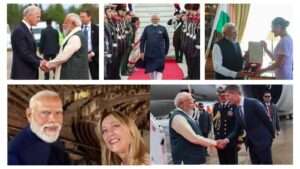
Yet sections of the Opposition appeared more interested in amplifying the theatrics of a hostile question raised by a foreign journalist than in discussing the substance of India’s expanding global influence. Such reactions expose not political maturity, but political insecurity.
The UAE leg of the visit was equally significant. India’s relationship with the United Arab Emirates has transformed into one of the most dynamic strategic partnerships in the world. From energy cooperation and fintech integration to logistics and infrastructure corridors, the India-UAE partnership is becoming central to Asia’s emerging economic architecture.
The ambitious India-Middle East-Europe Economic Corridor (IMEC), strongly backed by both India and the UAE, is now evolving into a powerful alternative trade and connectivity route linking Asia with Europe. This corridor is expected to reshape shipping, commerce, logistics and supply-chain networks in the coming decade.
That is where the final leg in Italy becomes critically important.
Modi’s engagements in Italy were not merely diplomatic symbolism. India and Italy worked towards strengthening the Joint Strategic Action Plan for 2025–2029, focusing on maritime cooperation, critical minerals, agriculture, clean energy, transport connectivity, and economic security. More importantly, Italy’s strategic location in southern Europe makes it a natural gateway for the larger India-Europe connectivity vision routed through the UAE and West Asia.
In essence, the UAE-Italy strategic axis could emerge as one of the most important trade bridges for India’s future economic expansion into Europe. This is not short-term politics; this is long-term nation-building.
Similarly, discussions in the Netherlands focused on water management, agriculture, and supply-chain resilience, while Sweden emphasized innovation partnerships, intellectual property collaboration, and green industrial transition.
The broader message from the entire tour is unmistakable: India is positioning itself as a trusted bridge between Europe, the Middle East and the Indo-Pacific. At a time when the world is fractured by wars, economic uncertainty, and shifting alliances, India is steadily emerging as a stabilising power.
Unfortunately, instead of appreciating the larger strategic vision, India’s Opposition continues to reduce everything to Modi-hatred. Democracy certainly demands criticism. But criticism divorced from national interest eventually begins to look less like accountability and more like desperation.
The real question Indians must ask is simple: if every major global power today wants deeper engagement with India under Modi’s leadership, why does India’s Opposition alone appear uncomfortable with the country’s rising stature?