The Sell-Off Was Never About AI, Taxes or the Rupee. It Was About Transparency
For nearly two years, India’s financial discourse has been dominated by one carefully manufactured narrative: Foreign Institutional Investors (FIIs) are leaving India because the country supposedly lacks cutting-edge AI companies, because taxes became unattractive, because the rupee weakened, and because global oil volatility made India vulnerable.
The television studios repeated it. Brokerage reports amplified it. Market commentators normalised it. The financial ecosystem sold the story with absolute confidence.
But there is a serious problem.
The facts do not support the narrative.
An extensive study conducted by Invectus — an independent nationalist business analysis platform committed to forensic economic scrutiny — has now systematically dismantled the mainstream explanation surrounding FII outflows from India between late 2024 and 2025.
The conclusions are explosive.
The study finds that the dominant reasons cited for FII exits are empirically weak, structurally inconsistent, and statistically unconvincing. The actual trigger behind the sustained outflow wave appears to be something far more uncomfortable for entrenched financial interests: SEBI’s post-Hindenburg beneficial ownership disclosure regime.
In simple terms, the money did not leave because India became economically weak.
The money left because India became more transparent.
And there is a massive difference between the two.
The Narrative India Was Sold
Between October 2024 and December 2025, foreign portfolio investors withdrew nearly Rs 1.6 lakh crore from Indian equities — roughly USD 18.5 billion.
The exits were sharp, sustained, and often coordinated.
Almost instantly, the financial establishment rolled out four standard explanations.
- India Has No AI Giants
This argument claimed that India lacked large-cap AI-driven companies comparable to America’s “Magnificent Seven” technology giants.
According to this thesis, global capital was naturally shifting toward the US and Chinese technology ecosystems because India supposedly missed the AI supercycle.
The argument sounds elegant.
But it collapses under scrutiny.
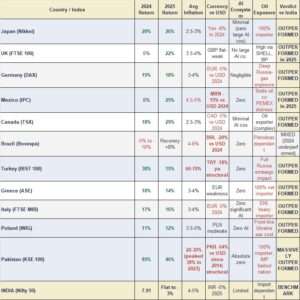
If lack of AI exposure was truly the decisive factor, then dozens of emerging markets with virtually zero AI ecosystems should have suffered similar or worse capital flight.
Instead, many outperformed India during the same period.
Over 40 global markets — several facing weaker currencies, higher inflation, political instability, or lower growth — delivered superior relative market performance.
The AI explanation, therefore, becomes selective convenience, not serious analysis.
- Capital Gains Tax Was Blamed
The July 2024 Finance Act raised Short-Term Capital Gains tax from 15% to 20% and Long-Term Capital Gains tax from 10% to 12.5%.
Brokerages immediately declared India “expensive.”
The claim was that short-duration foreign capital no longer found India attractive from an arbitrage perspective.
Again, this theory does not withstand comparison.
Several markets with significantly harsher tax regimes continued attracting foreign capital.
Moreover, institutional capital managing billions does not abruptly abandon one of the world’s fastest-growing major economies merely because of a marginal tax adjustment.
Global funds routinely absorb much larger transaction costs elsewhere when structural confidence remains intact.
Taxes may influence trading behaviour at the margins.
They do not explain a coordinated, prolonged exit cycle of this magnitude.
- The Weakening Rupee Excuse
The rupee’s depreciation toward Rs 91 per dollar during phases of 2025 became another favourite explanation.
The logic presented was straightforward: even if equities generate gains in rupee terms, dollar investors lose when the currency weakens.
Yet this argument becomes absurd when placed in a global context.
Many countries experienced far steeper currency depreciation than India during the same period.
Several emerging economies suffered double-digit currency erosion.
Still, foreign capital did not flee those markets at comparable intensity.
Why?
Because currency weakness alone does not trigger structural exits unless another deeper variable is at work.
The rupee story, therefore, explains headlines — not the real mechanics underneath them.
- Oil and Geopolitical Volatility
India’s energy dependence and exposure to global crude volatility were also repeatedly cited.
Western sanctions, supply disruptions, and current account concerns supposedly made India vulnerable.
But once again, the comparative evidence destroys the argument.
Many oil-importing economies more dependent than India continued attracting capital.
India’s macro fundamentals remained among the strongest globally: high GDP growth, resilient banking balance sheets, rising manufacturing activity, robust tax collections, and strong domestic consumption.
None of these indicators reflected a collapsing investment destination.
So what actually changed?
The answer lies not in macroeconomics.
It lies in regulation.
The Variable Nobody Wanted to Discuss
The real inflection point came after the Hindenburg-Adani episode.
On January 24, 2023, Hindenburg Research released its explosive report alleging that certain Mauritius-based FPIs were being used to route opaque capital structures into Adani Group stocks in ways that potentially circumvented minimum public shareholding norms.
The allegations triggered global attention.
More importantly, they exposed a serious structural weakness in India’s FPI regulatory architecture.
SEBI reportedly discovered that many offshore investment structures used a loophole allowing the Senior Management Officer (SMO) of a fund to be declared as the “beneficial owner” instead of identifying the actual natural persons controlling the capital.
This effectively created an anonymity shield.
It enabled the possibility of:
- round-tripping of domestic capital,
- promoter-linked offshore holdings,
- regulatory arbitrage,
- layered ownership concealment,
- and opaque concentration of market control.
In essence, the system permitted capital without accountability.
That changed after August 2023.
SEBI’s August 2023 Bombshell
On August 24, 2023, SEBI issued what may eventually be viewed as one of the most consequential transparency reforms in Indian capital market history.
The regulator mandated full “look-through” beneficial ownership disclosures for select FPIs.
The rule applied particularly to:
- FPIs with over 50% of Indian equity assets concentrated in a single corporate group, or
- FPIs managing over Rs 25,000 crore in Indian equities.
This was no cosmetic compliance tweak.
It fundamentally altered the offshore anonymity architecture.
Under the earlier framework:
- materiality thresholds protected smaller concealed interests,
- Fragmented FPI structures avoided aggregate scrutiny,
- And SMOs could mask actual controllers.
The new framework changed everything.
SEBI now demanded identification of all natural persons exercising ownership, economic interest, or control — with effectively no materiality threshold protection.
Even more importantly, SEBI introduced the “Investor Group” concept, aggregating related entities for disclosure purposes.
This directly targeted the possibility of multiple connected FPIs operating below individual disclosure thresholds while collectively controlling concentrated positions.
The implications were enormous.
Entities using offshore routes for opacity suddenly faced a binary choice:
Reveal the real beneficial owners.
Or exit India.
The Timing Is Too Precise to Ignore
The chronology tells its own story.
- January 2023: Hindenburg report released.
- February 2023: SEBI orders resubmission of beneficial ownership details.
- May 2023: Consultation paper targeting concentrated FPI structures emerges.
- August 2023: Landmark disclosure circular issued.
- November 2023 onward: Compliance deadlines begin.
- January 2024: Non-compliant FPIs face deregistration risks.
- September 2024: Final disclosure pressure intensifies.
- 2025: Sustained FII outflows accelerate.
This sequence is not random.
It maps almost perfectly onto the capital withdrawal cycle.
What followed was not a rejection of India’s economy.
It was a forced restructuring of opaque capital.
That distinction matters enormously.
Transparency Frightens Anonymous Capital
For years, India’s markets welcomed foreign money with relatively limited scrutiny into ultimate ownership layers.
The post-Hindenburg regulatory shift changed the equation.
The new regime threatened:
- tax haven opacity,
- concealed promoter linkages,
- undisclosed routing structures,
- and beneficial ownership anonymity.
Naturally, portions of such capital chose exit over exposure.
But rather than acknowledge this uncomfortable truth, the financial narrative machinery shifted attention toward AI, taxes, and the rupee.
Why?
Because admitting the real reason would raise deeply unsettling questions:
- How much anonymous capital operated in Indian markets?
- How much round-tripped money existed?
- How many concentrated structures depended on secrecy?
- How many market positions were sustained through opaque offshore layering?
These are questions the establishment would rather avoid.
India’s Real Story Was Never Weakness
The irony is striking.
At the very moment global commentary portrayed India as losing attractiveness, the country remained:
- the fastest-growing major economy,
- one of the world’s strongest consumption markets,
- a manufacturing expansion hub,
- and a geopolitical stabiliser amid global fragmentation.
Domestic SIP inflows remained resilient.
Retail participation deepened.
Corporate profitability stayed strong across multiple sectors.
India’s macro story did not collapse.
What changed was India’s tolerance for opacity.
And that may ultimately prove healthier for the long-term credibility of Indian markets.
The Bigger Question
The real debate is no longer whether FIIs exist.
The real debate is this:
Did India lose speculative opaque capital because it tightened transparency norms?
Or did India finally begin cleaning up a system that had operated for years through regulatory blind spots?
If the answer is the latter, then what India witnessed was not weakness.
It was an institutional correction.
The financial media may continue repeating the comfortable narrative.
But the data increasingly points elsewhere.
The inconvenient truth is that the great FII exit from India may have had far less to do with economics — and far more to do with disclosure.