In Indian politics, loyalty is often transactional, ideology routinely diluted, and promises made with little intent of fulfilment. Having witnessed firsthand how several so-called ideological parties function—and having been part of them—I say this without hesitation: India today needs the leadership of Narendra Modi not merely as a political choice, but as a national necessity.
This is not blind admiration. It is a conclusion drawn from experience, observation, and comparison.
India has had towering leaders in the past—figures like Jawaharlal Nehru, Indira Gandhi, Atal Bihari Vajpayee, and Lal Krishna Advani. Each had charisma, political acumen, and the ability to inspire millions. Yet, if there is one parameter where Modi distinctly stands apart, it is this: delivery.
Indian politics has long suffered from a credibility deficit—leaders who spoke eloquently but faltered in execution. Modi inverted that paradigm. His politics is not merely about articulation; it is about implementation. He does not just promise; he delivers. And where delivery is delayed, he is seen relentlessly pushing the system toward it. In a democracy fatigued by broken assurances, that difference is not cosmetic—it is transformational.
Even stalwarts like Vajpayee and Advani, despite their integrity and ideological commitment, were constrained by what was often termed “coalition dharma.” Their inability to fully implement core ideological promises was not due to lack of intent, but lack of political bandwidth. Modi, on the other hand, redefined that equation.
By leading the BJP to a full majority in 2014 and reinforcing it in 2019, he broke the compulsions of coalition-era paralysis. More significantly, even in a more complex political landscape after 2024, he continues to command the confidence of allies—many of whom had once distanced themselves.
Leaders like N. Chandrababu Naidu and Nitish Kumar are seasoned politicians with independent mass bases. Yet, their return to the NDA fold underscores a political reality: Modi remains the central gravitational force in Indian politics. His electoral appeal, governance narrative, and leadership credibility are unmatched.
What explains this phenomenon?
Part of the answer lies in Modi’s personal journey. Unlike many who emerged from privilege, Modi’s rise from humble beginnings is not a crafted narrative—it is a lived reality. That experience of poverty and struggle has shaped both his worldview and governance priorities. It is why his politics often resonates with those at the margins, not just the elite.
From his tenure as Gujarat Chief Minister to his current role as Prime Minister, Modi has consistently projected governance as a mission, not an entitlement. Gujarat under him became a model frequently debated, critiqued, and emulated. At the national level, India has witnessed accelerated infrastructure development, digital transformation, welfare delivery reforms, and a stronger global presence.
In less than a decade, India has repositioned itself as one of the world’s fastest-growing major economies and a decisive voice on global platforms. Whether one agrees with every policy or not, the scale and speed of change are undeniable.
Equally compelling is the narrative around Modi’s personal integrity. Stories from his early years as an RSS pracharak and later as a BJP functionary continue to circulate—not as political propaganda, but as testimonials of a lifestyle rooted in simplicity. One such widely discussed account by industrialist Lakshmi Mittal highlights Modi’s refusal to abandon a modest way of living despite holding high office within the party.
According to the anecdote, when offered better accommodation, Modi reportedly declined, saying he did not wish to forget his roots. Whether one treats this as symbolism or substance, it reinforces a larger perception: here is a leader whose personal life does not contradict his public messaging.
Even critics of Modi acknowledge aspects of his political method. Scholars like Christophe Jaffrelot have analyzed his governance model in detail—pointing to elements such as strong leadership, ideological clarity, and mass mobilization. While interpretations differ, the acknowledgment of his impact is universal.
Another defining trait of Modi is his ability to constantly reinvent himself. This is not political opportunism; it is strategic evolution. Interestingly, this was candidly acknowledged by Chandrababu Naidu in a recent reflection on a post-election NDA meeting. Expecting a conventional review of governance priorities, Naidu instead heard a succinct directive from Modi: prepare for 2029.
That single line reveals a great deal. Modi’s politics is not anchored in short-term survival; it is driven by long-term vision. He is always thinking ahead—about the next electoral challenge, the next developmental milestone, the next strategic shift. That mindset instills both confidence and discipline within the alliance.
As India moves toward the ambitious goal of becoming a Viksit Bharat (developed nation), leadership becomes the defining variable. Economic growth, infrastructure expansion, and industrial progress are not accidental outcomes; they require sustained direction, policy continuity, and political will.
Today, India stands at a critical juncture. The foundations for long-term growth are being laid, but the journey is far from complete. For states like West Bengal and Tamil Nadu, integration into this growth story could be transformative. Political stability aligned with national development priorities can unlock immense potential.
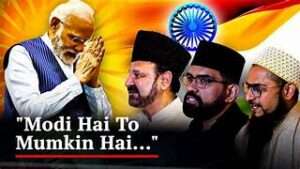
The slogan “Modi hai toh mumkin hai” is often dismissed by critics as rhetorical excess. But for millions, it represents something more tangible—a belief that governance can be decisive, leadership can be accountable, and ambition can be matched with execution.
In the final analysis, the question is not whether India has had great leaders before. It certainly has. The question is whether, at this specific moment in history, there exists a leader capable of combining vision, delivery, political strength, and mass connection.
For many, including this humble kartyakarta of the BJP, the answer is clear.
For the BJP, and arguably for India’s developmental trajectory, Modi is not just an asset—he is the axis around which the idea of Viksit Bharat currently revolves.