Upadhyayula Lakshman Rao
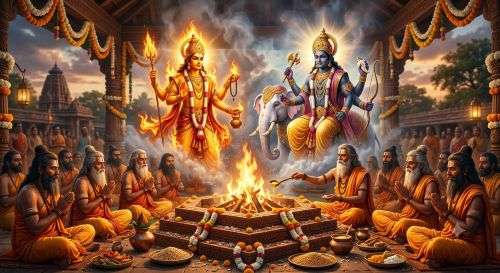
The sage Gouthama, son of Rahugana, in the elevated cadence of Jagathi, Virat, and Trishtup metres of the Rigvedic hymns, unfolds a prayer that is at once delicate, analytical, and profoundly transformative. His invocation to the Visvedevas is not merely an act of devotion but an intellectual and spiritual exercise, where prayer subtly assumes the form of guidance and instruction. In a serene atmosphere charged with introspection, the seer balances devotion with discernment, allowing the spirit of inquiry to coexist with reverence. His hymns reveal that true prayer is neither passive nor ornamental; it is purposeful, refined, and deeply aligned with cosmic principles.
Within this sacred articulation, intention is expressed with subtle precision. The sage does not merely ask; he defines, qualifies, and aligns his aspirations with the order of the universe. He prays that the rituals performed be free from harm, unrestrained in their benevolence, and capable of dispelling adversities. These sacred acts, he desires, should never abandon those who seek refuge in them but should stand as eternal protectors, guiding and safeguarding human progress. The faith embedded in such disciplined practice reflects an unwavering confidence that divine realms respond to sincerity and order, manifesting tangible results in human life.
The invocation extends to the noble patrons of righteousness, who, having taken refuge in the divine, become channels of abundance and generosity. Through them, prosperity flows, and through divine friendship, humanity attains both material well-being and spiritual companionship. The sage seeks longevity, not merely as the extension of years, but as a complete and uninterrupted experience of life, free from affliction at any stage. This aspiration reflects a profound understanding of life as a continuum sustained by harmony between body, mind, and cosmic forces.
Following the ancient Vedic path in both spirit and word, the sage invokes a vast assembly of deities—Bhaga, Mithra, Aditi, the Maruts, Aryama, Varuna, Soma, the Aswins, and others—through the sanctity of Vedic chants. Each invocation is not isolated but interconnected, reflecting the intricate web of cosmic functions. Saraswati, rich in auspicious abundance, is invoked as the source of nourishment and wisdom, while medicinal herbs, the wind, the earth, and the vast expanse of space are all recognized as carriers of healing forces. Even the stones used to press the Soma are acknowledged as contributors to well-being, revealing a worldview in which every element of existence participates in sustaining life.
This vision subtly anticipates a scientific temperament, where the interdependence of natural elements is keenly observed and honored. Earth, water, air, vegetation, and even inert matter are understood to possess inherent properties beneficial to life. The sage perceives no division between the sacred and the material; instead, he recognizes a unified field of existence where every component contributes to health, balance, and continuity.
The invocation of Indra, the lord of strength and action, signifies the importance of dynamic energy in sustaining order. Alongside him, Pushan is invoked as the protector who transcends past limitations, guiding beings toward prosperity and safety. The Maruts, radiant and omniscient, are called upon to arrive at the sacred space, embodying vitality and collective strength. Brihaspati, the lord of wisdom, is sought for auspicious fortune, reinforcing the idea that intellect and insight are as vital as physical resources.
The sage’s prayer extends to the faculties of perception, seeking that the ears hear only what is noble and the eyes behold only what is uplifting. With strong bodies and disciplined minds, humans are to engage in divine worship, thereby earning the blessing of a full lifespan. Yet, the mystery of aging remains acknowledged—its progression neither fully understood nor predictable—highlighting an early awareness of life’s uncertainties. In this humility, the sage prays for uninterrupted longevity, sustained by divine grace from beginning to end.
A profound philosophical vision emerges as the sage contemplates the Earth. It is declared to be heaven, space, mother, father, and offspring. It is all gods and the embodiment of the five elements. It is both the source and the sustainer of life. This holistic perception dissolves distinctions and establishes Earth as the ultimate ground of existence, worthy of reverence and care. The subtle intelligence of the sage recognizes that no action is accomplished in isolation; every endeavor requires the support of multiple forces. Hence, prayers are offered to all—celestial beings, natural forces, and human agents—acknowledging the necessity of cooperation and harmony.
The cyclical rhythm of time is also honored, with Mithra presiding over the day and Varuna over the night, both guiding humanity along the righteous path. Aryama and Surya illuminate the journey with clarity and purpose, ensuring prosperity and just governance. The immortal deities are invoked to grant comfort to mortals, while adversities are restrained and subdued. The collective invocation of Indra, the Maruts, Pushan, and Bhaga reflects a unified appeal for guidance, protection, and rightful direction.
The prayer further extends into the realm of sustenance and ecological balance. The wind is envisioned as the bearer of life-giving rains, rivers as carriers of nourishing waters, and plants as repositories of vital essence. Nights and dawns are wished to be gentle and comforting, the earth stable and nurturing, and space protective like a father. Trees are invoked to yield abundant fruits, the sun to ripen them appropriately, and cows to provide nourishing milk. Each aspect of nature is integrated into a comprehensive vision of well-being.
In this grand symphony of invocation, Vishnu, with his expansive stride, embodies protection and continuity, while Indra, Mithra, and Aryama stand as bestowers of comfort and order. The Visvedevas, as a collective manifestation of divine forces, represent the totality of cosmic governance. They are the custodians of order, the upholders of moral law, and the harmonizers of existence.
Thus, the hymn of the sage Gouthama is not merely a prayer but a profound synthesis of spirituality and rational observation. It encapsulates the ideals of cooperation, ecological awareness, moral discipline, and cosmic unity. Through rhythmic expression and refined thought, the sage presents a timeless vision where devotion aligns with knowledge, and where the universe itself becomes a living, interconnected system sustaining all forms of life.