



India-South Korea relations are gaining new importance in today’s global era. Both countries are champions of democratic values, economic development, technological progress, and regional peace. The shifting balance of power in Asia, China’s growing assertiveness, supply chain crises, the Ukraine war, Middle East tensions, and growing competition in the Indo-Pacific region have provided opportunities for India and South Korea to draw closer. The two countries have enjoyed friendly relations for years, but the time now demands that these relations be further enhanced with new energy, new direction, and practical cooperation.
India-South Korea relations are not limited to modern diplomacy, but also have strong cultural and historical roots. Civilizational links between the two countries date back to ancient times. The mention of Princess Suriratna of Ayodhya, known in Korea as Queen Hyo Hwang-ok, connects the two countries culturally. This relationship continues to be the basis of emotional ties between the peoples of today. Consequently, the potential for cultural exchange, tourism, and public relations between the two countries is immense.
India and South Korea established formal diplomatic relations in 1973. Since then, relations between the two countries have steadily progressed. In 2010, the relationship was elevated to a Strategic Partnership and later upgraded to a Special Strategic Partnership. This demonstrates that both countries view each other as long-term partners. High-level visits, foreign ministerial meetings, business dialogues, and defense talks continue to strengthen these ties.
South Korea is an important economic partner for India. South Korea is technologically advanced, industrially strong, and has an export-oriented economy, while India, with its large market, young population, and rapidly growing economy, is attracting global attention. This presents immense potential for trade and investment between the two countries. Bilateral trade has grown in recent years and has reached approximately $27 billion. However, this remains low compared to its potential. India’s trade deficit with South Korea also remains a concern.
Major South Korean companies have long been investing in India. Korean companies have a strong presence in sectors such as electronics, automobiles, mobile phone manufacturing, steel, shipbuilding, and infrastructure. South Korean investments could be extremely useful in boosting India’s manufacturing sector. Korean technology and capital can play a significant role in initiatives such as “Make in India,” “Digital India,” “Startup India,” and “Green Energy.”
Nevertheless, there are some challenges. The Comprehensive Economic Partnership Agreement (CEPA) was implemented in 2010, with the aim of boosting trade. However, the expected results have not been fully realized. Non-tariff barriers, quality standards regulations, complex regulatory processes, logistical problems, and market access difficulties continue to hinder trade growth. India will need to diversify its exports, while South Korea will need to provide more opportunities for Indian products and services.
Today, major changes are taking place in the global supply chain. Companies are seeking to reduce their dependence on China and are seeking new production centers. This situation presents opportunities for both India and South Korea. If South Korean companies establish large-scale production centers in India, they will benefit from a large market, affordable labor, and a strategic location. India will benefit from increased technology, employment, and export potential. Electronics, semiconductors, battery manufacturing, automobiles, defense production, and shipbuilding are areas where cooperation could grow rapidly.
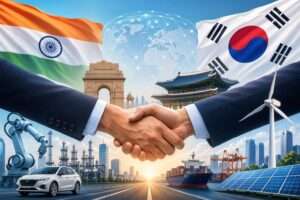
Cooperation between the two countries is also crucial from a strategic perspective. India supports a free, open, and inclusive order in the Indo-Pacific region. South Korea also supports regional stability and maritime security. China’s aggressive policies, pressure on sea lanes, and regional tensions have forced many countries to seek new partners. India and South Korea could be natural allies in this regard.
However, South Korea’s security priorities differ somewhat. Its primary focus remains the North Korean nuclear threat and its military alliance with the United States. India’s concerns, on the other hand, relate to China, the Indian Ocean, border security, and regional balance. Nevertheless, the two countries share common interests in several areas. Joint work could be undertaken in defense industry cooperation, cybersecurity, maritime surveillance, counterterrorism efforts, and new military technologies.
South Korea has established a strong global presence in the defense sector. It possesses modern defense production capabilities. If India emphasizes joint production, technology transfer, and research collaboration, both countries could benefit. India’s self-reliant defense policy and South Korea’s technological capabilities can create new possibilities.
Technology has become a crucial pillar of international relations today. Artificial intelligence, 5G, 6G, semiconductors, robotics, green energy, electric vehicles, and digital innovation will shape the economy of the future. South Korea is among the leading countries in these areas, while India is rapidly advancing thanks to its digital talent, software capabilities, and startup ecosystem. If the two countries work together to build a “digital bridge,” a new model of technological leadership could emerge in Asia.
Education and human resources cooperation can also strengthen ties. Indian students can access higher education, research, and technical training opportunities in South Korea. Korean students can benefit from India’s culture, history, yoga, Ayurveda, information technology, and management education. University partnerships, scholarships, and joint research programs could provide a strong foundation for future collaboration.
Cultural ties between the two countries are growing rapidly. Korean music, films, and television programs have grown in popularity in India. South Korea is seeing a growing interest in Indian yoga, food, dance, and spiritual traditions. This cultural connection is not just a means of entertainment, but also a means of fostering trust and understanding between peoples. Tourism, cultural festivals, language education, and media collaboration can further deepen this relationship.
Looking ahead, India and South Korea should not limit themselves to formal meetings. Trade goals should be clear, investment procedures simplified, joint missions on new technologies established, defense industry cooperation enhanced, and direct youth contact strengthened. The goal of exceeding $50 billion in trade by 2030 is practically achievable if political will and policy clarity are demonstrated.
For India, South Korea is not just a trading partner, but also a technological and strategic ally. For South Korea, India is a vast market, a trusted democratic friend, and a future economic power. The importance of such partners is further enhanced in a changing global order.
In conclusion, India-South Korea relations stand at a juncture of new possibilities today. If both countries move forward with practical cooperation, mutual trust, and a long-term vision, this partnership will not remain limited to bilateral relations but can become a new example of stability, prosperity, and balance in Asia and the world.

